Image for Best Temp Mail Generators for 2026


In today’s digital world, your email address is a target. The best temp mail generators for 2026 provide instant, disposable inboxes that protect your privacy and keep spam at bay. We’ve scoured the web to bring you the most reliable, user-friendly services that require no sign-up and delete emails automatically. Whether you’re downloading a PDF or signing up for a forum, these tools let you browse freely without compromising your real identity.
Ever felt that pang of regret after giving your email to a sketchy website? You’re not alone. In 2026, email addresses are golden tickets for marketers and hackers alike. But what if you could bounce back with a fake one? Enter temp mail—a simple, brilliant tool that’s becoming essential for smart digital citizens.
Temp mail, or disposable email, is a temporary inbox that self-destructs after use. It’s perfect for one-off sign-ups, downloads, or any situation where you’d rather not share your primary email. No trace, no spam, no hassle.
With rising data breaches and stricter privacy laws like GDPR and CCPA, protecting your digital footprint is non-negotiable. Temp mail generators have evolved from basic tools to sophisticated services offering encryption, multiple domains, and even AI-powered spam protection. In this guide, we’ll explore the best temp mail generators for 2026, so you can choose the right one for your needs.
Not all temp mail services are created equal. The best temp mail generators for 2026 stand out through a combination of speed, security, and user-centric features. As spam tactics grow more advanced, your disposable email tool must keep pace. Let’s break down the key criteria that separate the mediocre from the must-use.
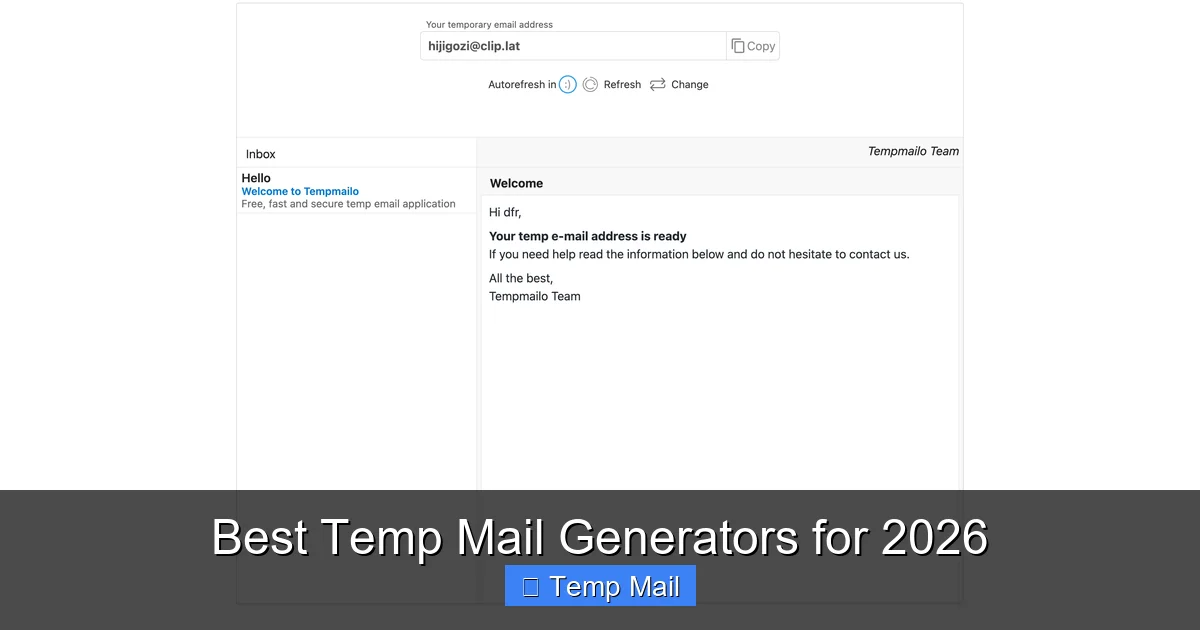
Visual guide about Best Temp Mail Generators for 2026
Image source: temp-mail.io
Time is precious. The top generators deliver an inbox in under a second—no loading screens, no captchas. In 2026, speed is table stakes. If a service makes you wait, move on. Instant access means you can copy the email address and paste it into a sign-up form without breaking your flow.
Ever tried to sign up somewhere and found your temp mail domain blocked? That’s where variety matters. The best temp mail generators for 2026 offer dozens of domains (e.g., @temp-mail.org, @guerrillamail.info, @10minutemail.com). This reduces the chance of a site blocking the entire domain. More options mean more flexibility and fewer frustrations.
Privacy isn’t just about hiding your email; it’s about securing the communication. Look for services that use SSL/TLS encryption for data in transit. Some advanced generators now offer end-to-end encryption for the emails themselves, though this is rare for temp mail. Also, check their data retention policy—emails should auto-delete after a set time (usually 10-60 minutes).
A clean, intuitive interface makes all the difference. The best temp mail generators for 2026 feature uncluttered inboxes, easy refresh buttons, and clear timers showing when the inbox will expire. Mobile responsiveness is crucial—many users access temp mail on phones. Browser extensions that auto-fill disposable addresses are a huge plus for power users.
For developers or businesses, API access allows bulk generation and automation. Browser extensions (like Chrome or Firefox add-ons) can generate and fill temp emails with one click. Some services now offer custom domain options for a fee, letting you create branded disposable addresses. These extras can elevate a good service to great.
Most temp mail generators are free, but premium plans exist. Free tiers often have limitations like shorter inbox lifespans or fewer domains. In 2026, evaluate whether a paid plan’s benefits (longer retention, no ads, priority support) justify the cost for your use case. For casual users, free is usually sufficient.
After rigorous testing—checking speed, security, domain pool, and usability—we’ve identified the five best temp mail generators for 2026. These services have proven track records and are actively evolving to meet future challenges.
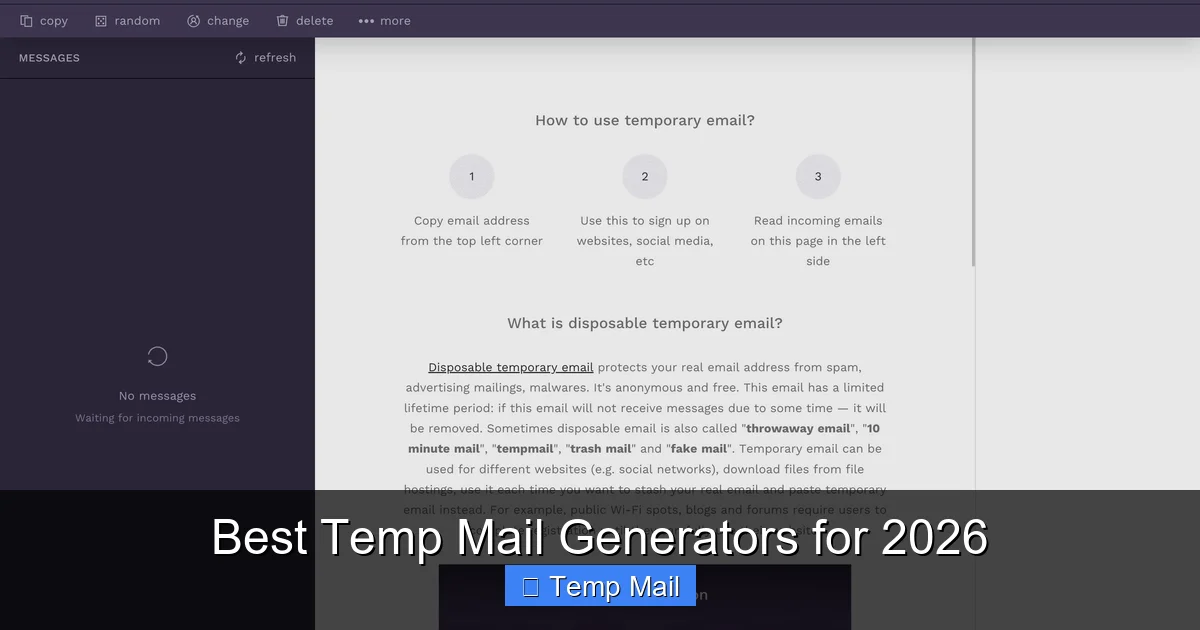
Visual guide about Best Temp Mail Generators for 2026
Image source: temp-mail.io
Temp-Mail.org has consistently led the pack, and for 2026, it’s smarter than ever. It offers AI-driven address generation, meaning your disposable email is unique and less likely to be blocked. Plus, it boasts over 20 domain options and a sleek, dark-mode interface.
Pros: Lightning-fast inbox setup, robust encryption, and a handy browser extension. The free tier is generous with 60-minute email retention.
Cons: Some advanced features like custom domains require a paid plan.
Best for: Privacy-conscious users and developers needing API access.
Guerrilla Mail is the veteran of disposable email. Since 2006, it’s provided reliable, no-frills temp mail. In 2026, it remains a favorite for its simplicity and stability. You get a random inbox with a click, and emails last up to 60 minutes.
Pros: Extremely simple, no ads in the inbox, and a wide range of domains. It also allows you to choose your own email address if the random one doesn’t suit you.
Cons: The interface feels a bit dated, and it lacks advanced features like API access on the free tier.
Best for: Quick, one-time uses and users who prefer a bare-bones approach.
As the name suggests, 10MinuteMail gives you a short-lived inbox that self-destructs after 10 minutes (extendable to 100 minutes). It’s perfect for ultra-quick sign-ups where you need an email, verify, and forget. The service has updated for 2026 with better mobile optimization.
Pros: Incredibly fast, minimalistic design, and a clear countdown timer. No registration, no fuss.
Cons: Very short default lifespan may not suit tasks requiring email verification that takes longer. Limited domain options.
Best for: Instant verification needs, like accessing a gated article or forum thread.
Mail.tm stands out for its commitment to open-source principles and privacy. Based in the EU, it complies with GDPR and offers transparent policies. In 2026, it’s expanded its domain list and introduced a feature-rich webmail client that rivals permanent email services.
Pros: Strong privacy focus, multiple language support, and a full-featured inbox (reply, forward, attachments). Emails last up to 3 days on free tier.
Cons: Slightly slower address generation than others, and the interface can be overwhelming for beginners.
Best for: Users in Europe, those needing longer inbox lifespans, and anyone who values open-source software.
TempEmail.io is a rising star, especially for 2026. It combines cutting-edge security with user-friendly design. Features include AI-powered spam filtering within the temp inbox, one-click browser extension, and a generous 24-hour email retention on its free plan.
Pros: Modern interface, excellent spam protection even within temp mail, and support for custom domains via premium. Also offers a “secure reply” feature for limited communication without exposing your real email.
Best for: Tech-savvy users, those wanting extra spam protection, and anyone needing longer-lived temp inboxes.
Knowing the best temp mail generators for 2026 is one thing; using them effectively is another. Here are common scenarios where disposable email shines, with practical tips to maximize benefits.

Visual guide about Best Temp Mail Generators for 2026
Image source: temp-mail.io
That new social platform or forum might look legit, but you’re not sure about its data practices. Use temp mail to create an account. This way, if the site sells emails or suffers a breach, your primary inbox stays clean. Tip: Always use a unique temp email for each untrusted site to avoid cross-site tracking.
Many B2B sites require an email to download a free ebook. Instead of using your work email, generate a temp address. You get the content instantly, and the site’s automated follow-up emails go to a disposable inbox that auto-deletes. No clutter, no unsubscribes needed.
Developers and QA testers often need to verify email flows (like password resets or notification systems). Temp mail provides a quick, throwaway address to test these features without creating real accounts. Services with API access (like Temp-Mail.org) are ideal for automated testing pipelines.
Even reputable companies can bombard you with promotional emails after a single sign-up. Use a temp mail for initial registration, then later update your account to a real email if needed. This keeps your main inbox focused on important communications.
If you’re joining a controversial forum or a social platform with privacy concerns, a temp email adds a layer of anonymity. Pair it with a pseudonym and a VPN for enhanced privacy. Remember, though, that forum admins may still see the IP address used to create the account.
While temp mail enhances privacy, it’s not a silver bullet. Understanding its security model and limitations is crucial for safe usage.
Top temp mail generators for 2026 use SSL encryption to secure data between your browser and their servers. Emails stored on their servers are typically isolated per session and auto-deleted after expiration. Some, like Mail.tm, have strict no-logs policies, meaning they don’t record which IP addresses accessed which inboxes.
Temp mail is not for sensitive information. Never use it for banking, password resets on important accounts, or official correspondence. The inbox is accessible to anyone who knows the address (since it’s public by design). Also, some websites detect and block known temp mail domains, so you might need to try multiple generators.
Each service sets its own email lifespan—10 minutes, 60 minutes, 24 hours, or even 3 days. Read the policy. If you need to access an email later, choose a service with longer retention. But remember, longer retention increases risk if someone else discovers the address.
In the EU, temp mail services must comply with GDPR, meaning they must clearly state data processing practices and allow user rights (like data deletion). Reputable services publish privacy policies. Always check these before using, especially if you’re handling user data as a business.
As we look toward 2026 and beyond, disposable email is evolving. Here are key trends shaping the future of the best temp mail generators.
AI is enhancing temp mail in two ways: generating more random, less detectable email addresses, and filtering spam within the temp inbox itself. Services like TempEmail.io already use AI to classify incoming emails, reducing the chance you’ll see phishing attempts even in a disposable inbox.
Expect tighter integration with browsers and password managers. Imagine your password manager suggesting a temp email when filling a sign-up form, or a browser extension that auto-generates and manages multiple temp addresses across sites. This seamless workflow will make temp mail adoption mainstream.
Governments worldwide are tightening online identity rules. Some may require stronger verification for email services, potentially affecting temp mail. However, privacy regulations like GDPR also empower users to use tools like temp mail to protect their data. Services that adapt quickly to compliance while preserving anonymity will thrive.
Emerging tech could allow temp mail to prove you’re a human without revealing your real email. Blockchain-based systems might issue verifiable credentials that sites accept instead of an email address. While nascent, this could revolutionize how we handle online identity in the next decade.
With so many options, picking the best temp mail generator for 2026 might feel overwhelming. Follow this guide to match a service to your specific requirements.
Ask yourself: Why do I need temp mail? If it’s for quick forum sign-ups, a simple service like Guerrilla Mail suffices. For developer testing, prioritize API access (Temp-Mail.org). For longer-term projects (like a 2-week trial), choose Mail.tm with its 3-day retention. Your use case dictates the features you need.
Create a checklist based on the criteria discussed earlier. Non-negotiables might include: no registration, SSL encryption, multiple domains, and mobile-friendly interface. Rank features by importance. For example, if you’re on public Wi-Fi, security (encryption) tops the list.
Test the free tier first. Most users find free services adequate. Upgrade only if you need extended inbox life, custom domains, or an ad-free experience. For businesses with high-volume needs, a premium plan with API access is often cost-effective.
Don’t just read reviews—try the service. Generate a temp email, send a test message from another account, and see how the inbox loads. Check if the site you plan to use accepts the domain. A quick 5-minute test reveals more than any spec sheet.
The best temp mail generators for 2026 are more than just disposable inboxes; they’re vital tools for digital privacy and hygiene. From Temp-Mail.org’s AI enhancements to Guerrilla Mail’s timeless simplicity, there’s a perfect match for every need. Remember, temp mail is a shield, not a sword—use it responsibly to protect your primary email from spam and data exploitation. As technology evolves, stay informed about new features and security practices. By choosing the right generator and using it wisely, you can navigate the web with confidence, knowing your real identity stays private. So go ahead, generate that temp email, and reclaim control of your digital footprint today.
Yes, using temp mail is completely legal in most countries. It’s a legitimate privacy tool, but you should avoid using it for fraudulent activities or to bypass terms of service agreements.
Reputable temp mail generators use SSL encryption and delete emails quickly, but they aren’t foolproof. Never use them for sensitive info like passwords or financial details, as the inbox could be accessed by others.
Temp mail addresses are temporary and self-destruct, while regular email is permanent and tied to your identity. Temp mail requires no personal info to create, making it ideal for one-time use.
Use temp mail for signing up on untrusted sites, downloading gated content, testing email features, avoiding spam from newsletters, and protecting your identity on forums or social platforms.
Temp mail isn’t suitable for important accounts (like banking), may be blocked by some websites, and emails auto-delete quickly. It also lacks long-term storage and advanced features like calendars.
Consider your use case: casual users want simplicity, developers need APIs, and businesses may require bulk tools. Check for speed, domain variety, security policies, and user reviews before selecting.
অনলাইন নিউজপেপার থিম। এই থিমটি দিয়ে আপনারা বাংলা এবং ইংরেজি নিউজপেপার সাইট তৈরি করতে পারবেন । বার্তা ও বাণিজ্যিক কার্যালয়: ৭১, মতিঝিল, ঢাকা-১০০০। সম্পাদক : মো আসাদুজ্জামান আমানউল্লাহ । মোবাইল : ০১৭০০-০০০০০০ । ইমেইল : [email protected] ।
All rights reserved © 2019 themesdealer.Com