Image for How Temporary Email Protects Your Privacy Online



Temporary email addresses act as a disposable shield for your personal inbox. They prevent your real email from being collected by marketers, hackers, and data brokers during everyday online activities like signing up for websites or downloading files. By using a throwaway address, you drastically reduce spam, minimize your digital footprint, and protect your identity from being sold or exploited. It’s a simple, free tool for anyone looking to take control of their online privacy.
Let’s be honest: your email inbox is a digital attic. Over the years, you’ve signed up for countless newsletters, forums, free trials, and online accounts. Each one is a potential crack in your privacy wall, a little piece of your digital identity that’s out there, being tracked, sold, and potentially exposed in a data breach. What if you could hand out a fake, disposable address instead? That’s the powerful, simple promise of temporary email. It’s not a magic cloak of invisibility, but it’s one of the most effective, low-effort tools for reclaiming your online privacy. This guide will walk you through exactly how temporary email protects you, when and how to use it, and what its limits are.
Think of a temporary email service as a public phone booth for the internet. You walk in, you get a random phone number (the email address), you make your call (use it for a sign-up), and then you walk away, leaving that number behind forever. The core mechanics are beautifully simple.
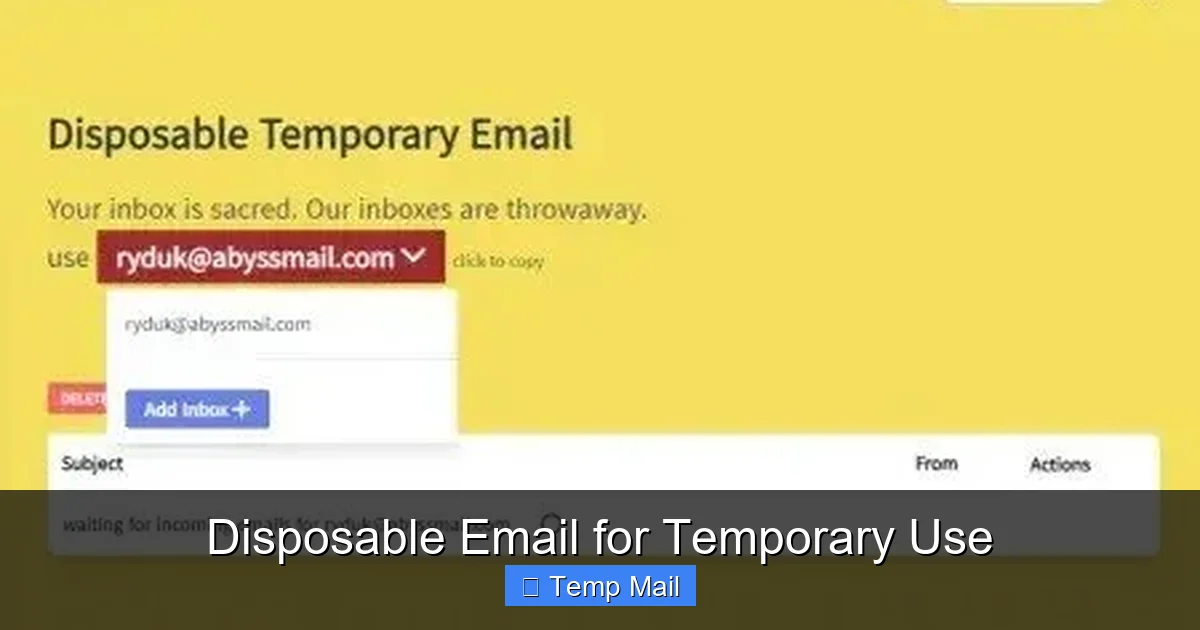
When you visit a site like Temp-Mail.org, 10MinuteMail.com, or Guerrilla Mail, the service instantly generates a unique email address for you. This address is usually a random string of characters at a domain they control (e.g., [email protected]). Crucially, you don’t need to register, provide a password, or link it to any personal information. The address and its associated inbox are created on the fly.
All emails sent to that temporary address appear in a web-based inbox that is accessible directly from the provider’s site. This inbox is typically tied to the browser session or a simple, unique URL. There’s no persistent login. The inbox exists only as long as the address is active—often for 10 minutes, 1 hour, or 1 day, depending on the service. Once the timer expires, the address and all its emails are permanently deleted from the server.
Most temporary email services are receive-only. You can get emails sent to the address, but you cannot send emails *from* it. This is a deliberate security and anti-spam design choice. The purpose is to receive verification links or access codes, not to engage in correspondence. Some advanced services may offer limited sending, but the standard model is purely for reception.
Now, let’s connect the dots between this simple mechanism and robust privacy protection. The defense happens at the very first point of data collection: the sign-up form.

Visual guide about How Temporary Email Protects Your Privacy Online
Image source: anonymmail.net
When you use your real, permanent email (like Gmail or Outlook) to sign up for a free e-book, a discount code, or a forum, that company now has a direct, authenticated channel to you. Your address becomes a valuable asset. It’s often added to marketing lists that are sold or shared with “partner” companies. This is the primary pipeline for spam. By using a temporary address, you give them a dead-end address. Any marketing emails they send bounce immediately after the temp address expires, never reaching you. You’ve just cut off a major revenue stream for data brokers and reduced your spam load significantly.
Your email address is a powerful tracking identifier. Websites can use it to link your activity across different sessions and even across different sites if they share analytics. If you use the same email everywhere, a single data breach can allow a hacker or tracker to correlate your activity on Site A with your activity on Site B. A unique, disposable address for each site (or at least for low-trust sites) severs this chain. There is no single identifier that ties all your random sign-ups back to your core identity.
Data breaches are a matter of “when,” not “if.” When a company you signed up with suffers a breach, the stolen database often contains usernames, passwords, and email addresses. If that email address is your primary one, hackers now have a key to try and access your other accounts (through password resets) or launch highly targeted phishing attacks against you. If the breached email is a temporary one that expired weeks ago, the stolen data is useless. The attacker has a key to a door that no longer exists. You are insulated from the direct consequences of that specific breach.
Phishing emails are designed to look legitimate and trick you into clicking malicious links or giving up credentials. Spear-phishing is even more targeted, using personal details to seem authentic. A flood of phishing emails to your primary inbox increases the odds you’ll click one by mistake. By using a temporary address for non-essential sites, your primary inbox stays clean. You only receive emails from contacts and services you truly trust and expect, making any suspicious email there stand out like a sore thumb.
Knowing the theory is one thing; knowing when to use it is everything. Here are the prime scenarios where a temporary email is your best friend.

Visual guide about How Temporary Email Protects Your Privacy Online
Image source: gadgetsin.com
This is the #1 use case. A blog post, research paper, or software download asks for your email in exchange. Ask yourself: “Will I want updates from this company in 6 months?” If the answer is no, use a temp address. You get the content immediately, and the company gets an address that will vanish before their first newsletter can even be drafted.
You want to try a new project management tool, a photo editor, or a streaming service for 7 days. Use the temp email. The trial verification email goes to the disposable inbox. When the trial ends, you simply walk away. No risk of being auto-converted to a paid plan without reminder emails landing in your primary inbox, and no need to hunt for the “cancel subscription” link later.
Do you really need to create an account on that obscure tech forum to ask one question? Use a temp email. This protects you from the forum’s own newsletters, potential data leaks from that specific community, and any spammy members who might scrape user emails.
If you’re a developer testing a sign-up flow, or a privacy-conscious user wanting to see what data a new app requests before committing, a temporary email is perfect. You can complete the registration process, see the welcome email, and inspect the permissions, all without leaving a trace on your real identity.
Sites offering pirated software, cracked games, or other gray-market content are notorious for email harvesting and subsequent spam. Using your primary address here is practically begging for your inbox to be flooded with malware offers and scam emails. A temporary email is a mandatory shield in these high-risk zones.
Temporary email is a powerful tool, but it’s not a silver bullet. Using it blindly without understanding its limits can backfire.

Visual guide about How Temporary Email Protects Your Privacy Online
Image source: gadgetsin.com
This is the most critical rule. Once the temporary address expires or you close the browser tab, that inbox is gone forever. Any account recovery emails, password resets, or important notifications sent to that address are lost. This is why you must never use a temporary email for:
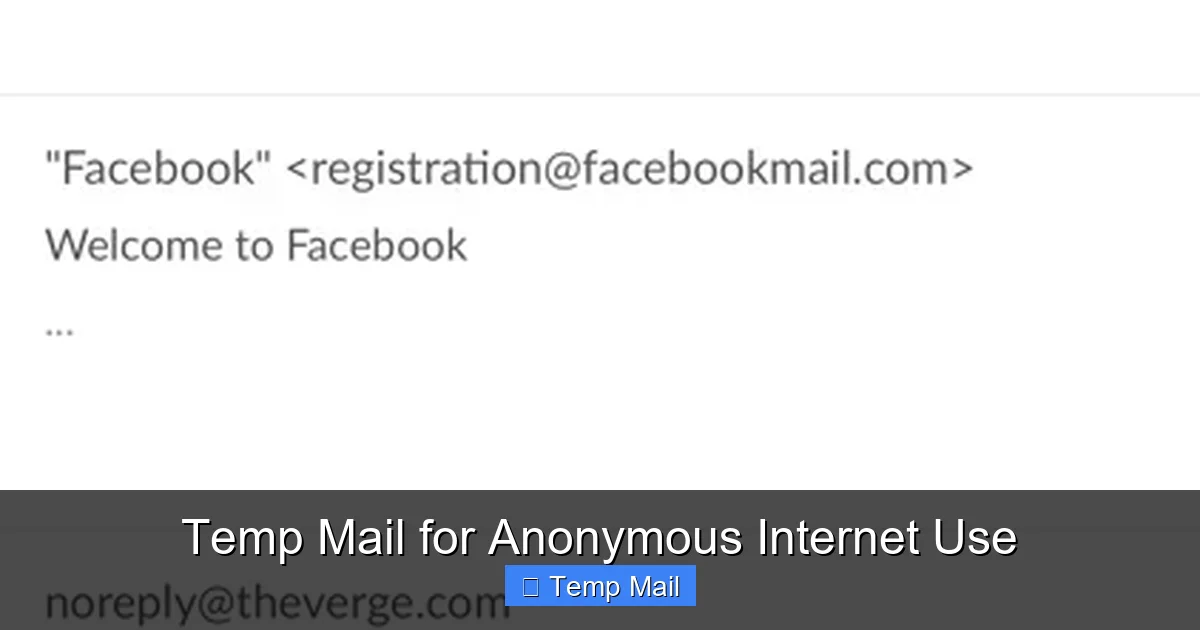
Because of abuse by spammers and fraudsters, many popular websites maintain lists of known temporary email domains and block sign-ups from them. If you try to use @tmpmail.org on a major platform like Facebook, Amazon, or Netflix, it will be rejected. You’ll get a message like “Please use a valid email address.” This is a deliberate filter. You may need to try a few different temp mail providers to find one whose domain isn’t blocked for a specific site.
You are trusting a third-party service with the emails you receive. A shady provider could:
Therefore, you must choose reputable providers that use HTTPS (look for the padlock), have a clear privacy policy stating they do not log or sell data, and are well-established. A quick search for “temp mail reviews” can help identify trustworthy options.
As mentioned, you typically cannot send emails from a temporary address. This is by design. If you need to send an email anonymously, you need a different tool, like a secure, privacy-focused email provider (e.g., ProtonMail) used with a pseudonym.
Not all temp mail services are created equal. When selecting one, prioritize these features:
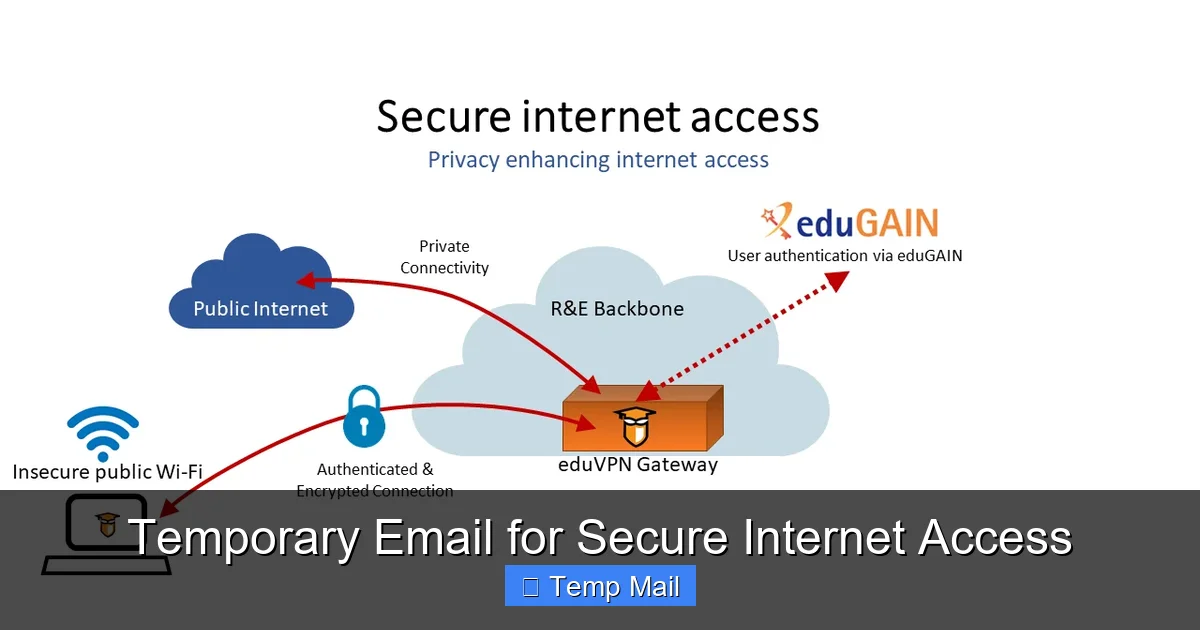
This is non-negotiable. The connection between your browser and the temp mail site must be encrypted (HTTPS). This prevents your network operator or a hacker on the same Wi-Fi from seeing which emails you are receiving. Never use a provider that only offers HTTP.
The whole point is anonymity. If a service asks you to create an account, solve a CAPTCHA with personal clues, or link a phone number, it is defeating the purpose and collecting your data. The best services generate an inbox for you instantly with zero required information.
A good provider offers multiple domain names (e.g., @tempmail.com, @tmpmail.org, @dispostable.com). This is useful if one domain gets blocked by a website you’re trying to sign up for. Also, check the default inbox lifespan. 10 minutes is great for a quick verification code, but if you need to receive an email that might arrive in 30 minutes, look for a service offering 1-hour or 1-day expiration options.
Many free temp mail services are supported by ads. A few text ads are tolerable, but avoid sites bombarded with pop-ups, misleading download buttons, and adult ads. These are often the same sites that are less scrupulous about your data security and more likely to infect your device with malware.
Take 60 seconds to find and skim their privacy policy. Look for explicit statements that they do not log IP addresses, do not store messages after deletion, and do not sell user data. If the policy is vague or non-existent, move on.
Reputable examples to start with: Temp-Mail.org, 10MinuteMail.com, Guerrilla Mail, Maildrop.cc. Always do your own recent research as service quality can change.
To integrate temporary email seamlessly and safely into your digital life, follow these habits.
If you use a temp mail for a service you might need to access again (like a free tool trial you want to extend), you must remember which provider and which random address you used. The inbox is gone after the timer. There is no password recovery. Keep a simple notepad file or a secure password manager note with entries like: “Canva Trial – [email protected] – expires 2023-10-27.”
Don’t just use the same temp address for everything. Have a mental rotation: one for “online shopping/newsletters,” one for “forums and gaming,” one for “software trials.” This adds an extra layer of segmentation. If one category’s address gets spam (while it’s active), it doesn’t “contaminate” your other categories.
For maximum effect, use your temporary email while browsing in a privacy-focused browser like Brave or Firefox with strict tracking protection enabled, or even in a private/incognito window. This prevents the site you’re visiting from setting long-term tracking cookies that could still link your activity to your real IP address, even if you used a temp email.
This cannot be stressed enough. The “Forgot Password?” function on any important account must point to an email you control permanently. Setting a temporary email as your recovery option is like mailing the spare key to your house to a random street corner and then forgetting where you left it.
If you find yourself relying on temporary email for dozens of sign-ups, it might be a sign your primary email is already too compromised. Consider creating a new, dedicated primary email address (using a secure provider like ProtonMail or Tutanota) that is used *only* for important accounts. Use your old, spam-filled primary address for low-stakes sign-ups, or vice-versa. This is the “alternate email” strategy, which is a step up from full temporariness but still offers great segmentation.
Online privacy often feels like a complex, technical battle fought with encryption keys and VPN configurations. But sometimes, the most powerful strategies are brilliantly simple. Temporary email is exactly that. It operates on the fundamental principle of data minimization: give away as little of your personal information as possible, as infrequently as possible. By handing out a digital “burner” address to the countless websites that ask for it, you build a moat around your true identity. You stop the spam at the source, you insulate yourself from data breaches, and you make it exponentially harder for marketers and trackers to build a complete profile of you. It’s not for everything—your bank and your family will always get your real address. But for the vast, noisy, and often predatory world of online sign-ups and downloads, a temporary email is your first and best line of defense. Start using one today for your next free trial or gated download. You’ll wonder how you ever browsed without it.
Yes, using temporary email services is completely legal in virtually all jurisdictions. They are legitimate tools for privacy protection. However, using them to commit fraud, bypass bans, or send illegal content is, of course, illegal regardless of the email type used.
Security varies by provider. Reputable services use HTTPS encryption to protect emails in transit. However, many providers can technically read the emails stored in their servers since they are not typically end-to-end encrypted (like ProtonMail). Therefore, you should never receive sensitive personal data (like password reset links for important accounts, financial statements, or private documents) via a temporary email. Use it only for non-sensitive verifications and content access.
It depends entirely on the service. Common timeframes are 10 minutes, 1 hour, 1 day, or until you close your browser tab. Some services allow you to extend the lifespan manually. Always check the specific timer for the inbox you are using.
No. In most cases, the address and its inbox are tied to your browser session or a unique, unbookmarked URL. Once you close the tab or browser, that specific inbox is typically lost forever. This is why you must copy any needed verification codes or information immediately.
Websites block domains associated with temporary email services to prevent spam, fraud, and abuse. Spammers and bots often use temp mail to create thousands of fake accounts quickly. By blocking these domains, a site reduces fake registrations and protects its community. It’s a defensive measure, but it can be frustrating for legitimate privacy-conscious users.
For ongoing communication with trusted entities, a dedicated, secure, and permanent email address from a privacy-focused provider (like ProtonMail, Tutanota, or Mailfence) is superior. These offer strong encryption, no data mining, and Swiss or German privacy laws. The strategy is to use your secure permanent email for important, long-term accounts and your temporary email for everything else—a layered approach to inbox hygiene.
অনলাইন নিউজপেপার থিম। এই থিমটি দিয়ে আপনারা বাংলা এবং ইংরেজি নিউজপেপার সাইট তৈরি করতে পারবেন । বার্তা ও বাণিজ্যিক কার্যালয়: ৭১, মতিঝিল, ঢাকা-১০০০। সম্পাদক : মো আসাদুজ্জামান আমানউল্লাহ । মোবাইল : ০১৭০০-০০০০০০ । ইমেইল : [email protected] ।
All rights reserved © 2019 themesdealer.Com