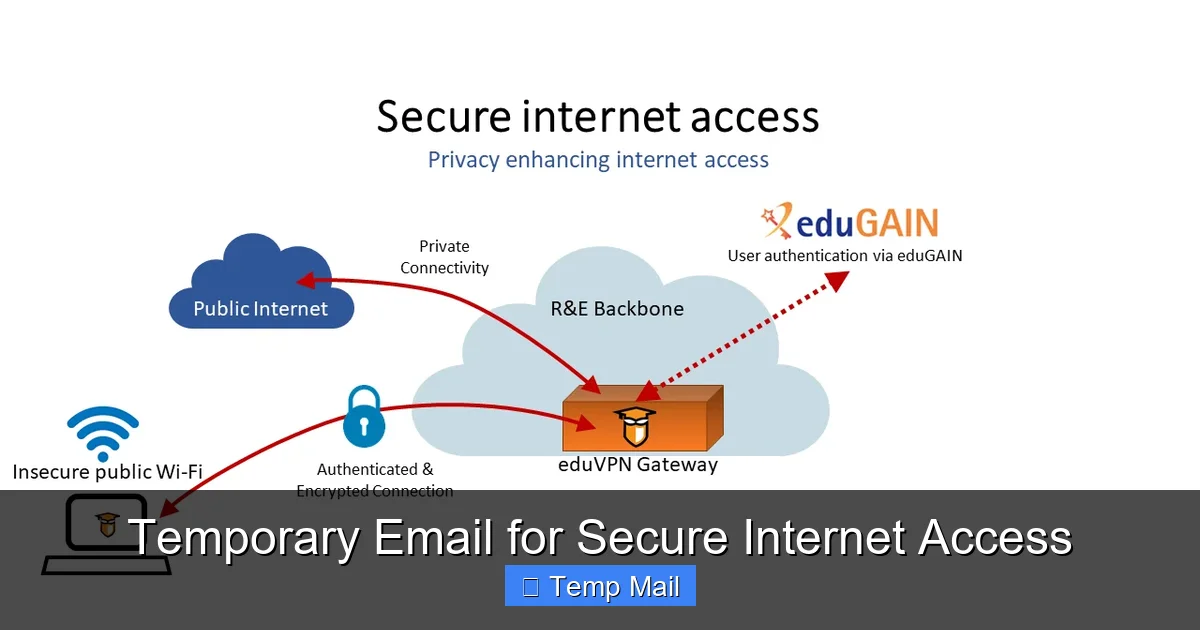
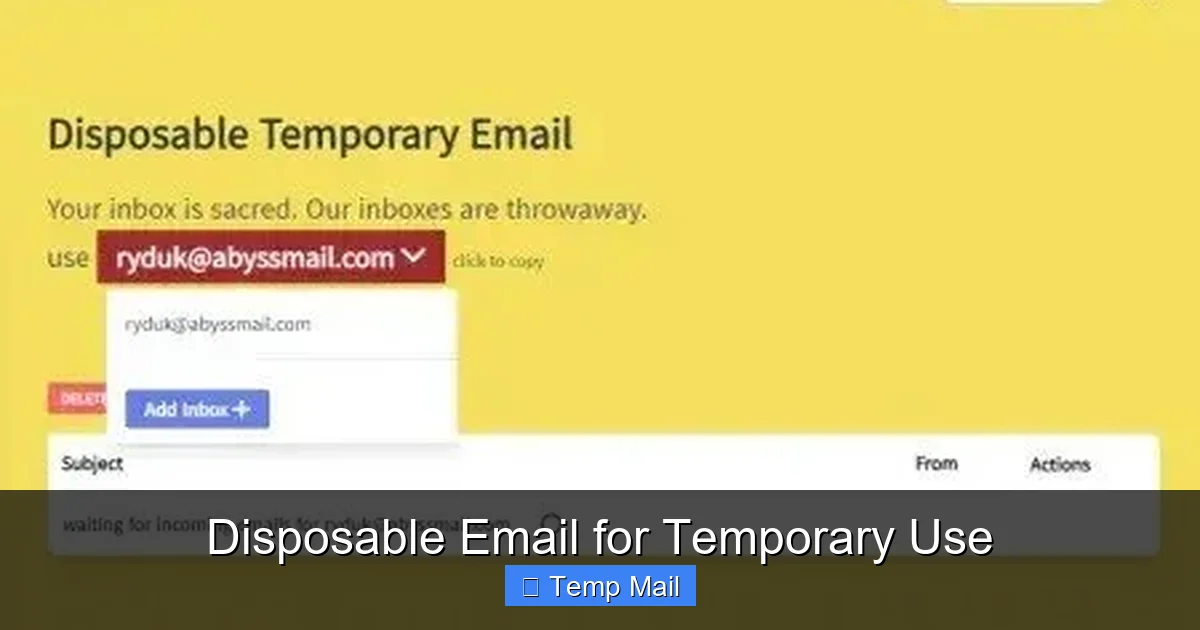
Image for Temporary Email for Secure Registrations



Temporary email services provide a powerful, simple tool for protecting your digital identity. By using a disposable address for one-time sign-ups, you create a vital barrier between your permanent email and unwanted spam, data harvesting, and potential security breaches. This practice is essential for safely navigating today’s web, from downloading files to accessing gated content, without compromising your main communication channel.
Think about the last time you signed up for something online. A new streaming service trial, a downloadable ebook, a forum to ask a single question, or a discount code from a retail site. What’s the first thing they ask for? Almost always, an email address. You type in your primary, personal, or work email without a second thought. That simple action is like handing out a key to your digital front door. Every new website, app, or blog you register with now has a direct line to your inbox. The consequences? A relentless cascade of promotional newsletters, the constant risk of your email being sold or leaked in a data breach, and the chilling possibility of your identity being stitched together from dozens of digital breadcrumbs.
But what if there was a simple, effective, and free way to say “no” to that permanent connection? Enter the world of temporary email for secure registrations. This isn’t some shady hack; it’s a mainstream privacy and security practice adopted by savvy internet users worldwide. A temporary email, also called disposable or throwaway email, is a service that provides you with a random, functional email address for a short period—usually 10 minutes to a few hours. You use it to receive that crucial verification link or download file, and then you simply close the tab. The address, and all the spam it might have attracted, vanishes into the digital ether. In this comprehensive guide, we’ll explore why using a temporary email for registrations is one of the easiest yet most impactful habits you can build for a safer, cleaner, and more private online experience.
At its core, a temporary email service is a web-based platform that generates a random email address on demand, without requiring you to create an account, provide a password, or share any personal information. These services maintain their own pool of email domains and inboxes. When you visit a site like Temp-Mail.org, Guerrilla Mail, or 10MinuteMail, the system instantly assigns you an address like [email protected] and opens an inbox for it right in your browser.
Your Gmail, Outlook, or Yahoo account is a permanent, secure, and feature-rich identity tied to your name, phone number, and recovery contacts. It’s designed for long-term communication, storage, and integration with countless other services. A temporary email is the polar opposite: it’s a bare-bones, anonymous, and ephemeral tool. There is no login, no password recovery, and no expectation of longevity. Its sole purpose is to receive a single email (or a few) and then be forgotten. This fundamental difference in design philosophy is what makes it so effective for specific tasks like registrations.
When you use a temporary email service, you’re interacting with a sophisticated backend system. Here’s a simplified breakdown:
Using your primary email for every website registration is a fundamental privacy mistake with real-world consequences. Let’s break down the compelling reasons to make temporary email for secure registrations your default habit.

Visual guide about Temporary Email for Secure Registrations
Image source: anonymmail.net
That “free newsletter” you signed up for? It rarely stays free or optional. Companies sell email lists. Your address gets added to “partner” networks. The result is an inbox flooded with deals, updates, and “you might also like” emails you never wanted. Even with aggressive filters, some always get through. By using a disposable address for these low-stakes sign-ups, you ensure your primary inbox is reserved for people you know and communications you actually care about—like bills, work messages, and family updates. The temporary inbox becomes the spam catcher, and you simply don’t look at it after the verification is done.
Hacker news is constant. From major social platforms to niche hobby forums, databases are compromised daily. When a breach occurs, the most common data stolen is usernames and email addresses. Why? Because that email is the key to further attacks. With your email in hand, a hacker can try that same email/password combination on your bank, social media, or email account (a tactic called “credential stuffing”). If you used a temporary email for the breached site, that hacker has nothing of value to link back to your real identity or your primary accounts. The breach is contained to a disposable address that no longer exists. This is a massive, proactive security win.
Every online account you create with your real email is a data point. Ad networks and data brokers are experts at stitching these points together to build a shockingly accurate profile of your interests, location, income bracket, and life stage. This profile is used to target you with ads, influence prices you see (dynamic pricing), and even be sold to third parties. Using a different temporary email for different types of sites (one for gaming forums, one for coupon sites, one for news blogs) breaks this linkage. It prevents the creation of a single, monolithic digital dossier tied to your real identity, preserving your anonymity in the vast data economy.
Some websites, especially those with questionable ethics, will not let you proceed without confirming your email. They make it difficult to unsubscribe later. Sometimes, they send a “confirmation” email that, when clicked, actually subscribes you to more spam or signs you up for a paid trial. Using a temporary email neutralizes this tactic. You get the one link you need, click it, and then abandon the address. They have no way to continue marketing to you because the communication channel ceases to exist.
Using this tool is intentionally simple, but a clear process ensures you don’t get locked out of a service you actually want to keep. Here is your foolproof guide.

Visual guide about Temporary Email for Secure Registrations
Image source: anonymmail.net
Not all temporary email providers are created equal. While most perform the basic function, some offer features that make the experience smoother and more secure. Here’s what to consider when selecting your tool.

Visual guide about Temporary Email for Secure Registrations
Image source: anonymmail.net
Some providers go the extra mile with features that enhance utility:
Temporary email is a tool, not a magic shield. Understanding its limits is crucial for using it safely and effectively.
To make the most of this tool, incorporate it into a broader personal security and privacy strategy. Think of it as your first line of defense.
Adopt a clear mental rule: “If I don’t want this website to have my real email and potentially communicate with me forever, I use a temporary email.” This applies to:
Your primary email becomes a “whitelist” for essential services: family, friends, work, banking, critical cloud services, and subscriptions you actively manage and value.
This is the perfect companion habit. When you register on a site with a temporary email, your password manager (like Bitwarden, 1Password, or Dashlane) can generate and store a strong, unique password for that site. Now, even if that site gets breached (and you used a temp email), the stolen password is useless anywhere else because it’s unique. The attacker has a disposable email and a unique, strong password that doesn’t work on your other accounts. You’ve effectively compartmentalized the breach.
Once a quarter, take 30 minutes to review accounts associated with your primary email. Use a service like Have I Been Pwned to check if your email appears in known breaches. For any old, unused accounts you find (especially those you signed up for with your real email before you knew about temp mail), delete them. This reduces your attack surface. For accounts you created with a temporary email? They are already functionally deleted from your life because you lost access to the email. That’s the point.
As data privacy regulations like GDPR and CCPA have given users more rights, the underlying business model of much of the internet—data-driven advertising—has not changed. Companies are more incentivized than ever to collect accurate, persistent user data. Your email address is the golden key that links your anonymous web browsing to your real-world identity. Every new registration with your primary email strengthens that link.
Using a temporary email for secure registrations is a small, daily act of digital self-defense. It’s a practical application of the “data minimization” principle: only give out the personal information absolutely necessary. It reclaims your attention from spam, insulates your critical accounts from the ripple effects of data breaches, and makes you a less profitable target for invasive profiling. It costs nothing, takes seconds, and builds a cleaner, safer, and more private digital life. In an age of constant data harvesting, this simple tool is not just helpful—it’s essential.
The internet doesn’t have to be a place where your primary email address is a public commodity, traded and targeted until it’s useless. By consciously choosing to use a temporary email for the vast majority of website registrations, you draw a clear, bright line between your essential digital identity and the noisy, risky, and often disposable world of one-off web interactions. You stop the spam at the gate, you break the chains of data profiling, and you contain security breaches to a harmless, forgotten corner of the internet. It’s a shift from passive acceptance to active control. Start today. Bookmark a reputable temporary email service. Make it your default browser tab when you see that “sign up” form. Take back your inbox and, more importantly, take back your privacy. Your future self—the one with the clean inbox and the unbreached accounts—will thank you.
Yes, using a temporary email is completely legal and a recognized privacy tool. It is safe for its intended purpose: receiving verification emails for non-critical registrations. The safety risk only arises if you misuse it for important accounts where you need reliable, long-term access to the email address.
No, and that is by design. Since you do not own or control the temporary address, you cannot receive password reset links sent to it. This is why you must never use a temporary email for any account where you need to log in regularly or recover access, such as social media, banking, or primary email accounts.
Often, yes. Many websites check the domain of the email address against known lists of disposable email providers and may block registration attempts. They do this to prevent spam and fraud. If a site blocks your temporary email, you will need to use a permanent address for that specific service.
The emails are stored in the temporary inbox on the service provider’s server for a predetermined time (usually 10-60 minutes). After that time, the inbox and all its contents are automatically and permanently deleted from their servers. The email address itself is then retired and recycled for a future user.
The main downside is the lack of persistence. You cannot use them for any service requiring long-term communication, account recovery, or two-factor authentication. Additionally, some sites block them, and you must be disciplined about not using them for important accounts. They also typically offer no sending capability or file storage.
This is an excellent question. Services like Gmail’s “plus addressing” ([email protected]+alias) or Apple’s “Hide My Email” create forwards to your primary inbox. You still own and control the address, and emails are stored in your main account. A true temporary email is a completely separate, anonymous inbox that you do not own and that self-destructs. It provides stronger anonymity and compartmentalization but no long-term access. Aliases are great for filtering and organizing; temporary emails are for complete, anonymous isolation.
অনলাইন নিউজপেপার থিম। এই থিমটি দিয়ে আপনারা বাংলা এবং ইংরেজি নিউজপেপার সাইট তৈরি করতে পারবেন । বার্তা ও বাণিজ্যিক কার্যালয়: ৭১, মতিঝিল, ঢাকা-১০০০। সম্পাদক : মো আসাদুজ্জামান আমানউল্লাহ । মোবাইল : ০১৭০০-০০০০০০ । ইমেইল : [email protected] ।
All rights reserved © 2019 themesdealer.Com