Image for Temporary Email for Online Subscriptions



Tired of your primary inbox getting flooded with promotional spam after every online sign-up? A temporary email address is your secret weapon. These disposable inboxes let you subscribe to websites, download resources, or access gated content without risking your real email. They effectively shield you from unwanted marketing, potential data breaches, and phishing attempts linked to your main identity. However, they’re not a one-size-fits-all solution and come with important limitations for critical accounts. Use them strategically for low-stakes interactions to maintain digital hygiene and control over your online footprint.
[FEATURED_IMAGE_PLACEHOLDER]
Let’s start with the basics. A temporary email address, often called a disposable email, throwaway email, or temp mail, is a service that provides you with a random, working email inbox for a very short period. Think of it like renting a public mailbox for an hour. You get an address like [email protected], you can send and receive emails to it, but after a predetermined time—usually anywhere from 10 minutes to 24 hours—the entire inbox and its contents vanish into the digital ether. The address itself is then recycled and given to someone else.
The technology behind it is surprisingly straightforward. These services generate a vast pool of random email addresses connected to their own mail servers. When you visit their website, they assign you one of these available addresses. Any email sent to that address is routed to their server and displayed in a web-based inbox interface accessible only to you via a unique session or a temporary password. There’s no need to create a username or password in most cases; the browser session or a simple code is your key. Once the timer expires, the server deletes the inbox data, making recovery impossible.
What makes this possible is the decoupling of the email address from any persistent user account. Traditional email providers like Gmail or Outlook tie your address to a long-term account with storage, settings, and a recovery process. Temp mail services intentionally avoid this. They operate on a principle of maximum anonymity and minimal data retention. Their infrastructure is designed for high turnover, serving thousands of users cycling through addresses daily. This model is financially sustainable through ads on their own sites or premium plans offering longer inbox lifespans or custom domain names.
Using a temporary email service is famously simple—often just one click. But understanding the process helps clarify its strengths and weaknesses. Here’s a typical user journey:

Visual guide about Temporary Email for Online Subscriptions
Image source: techseen.com
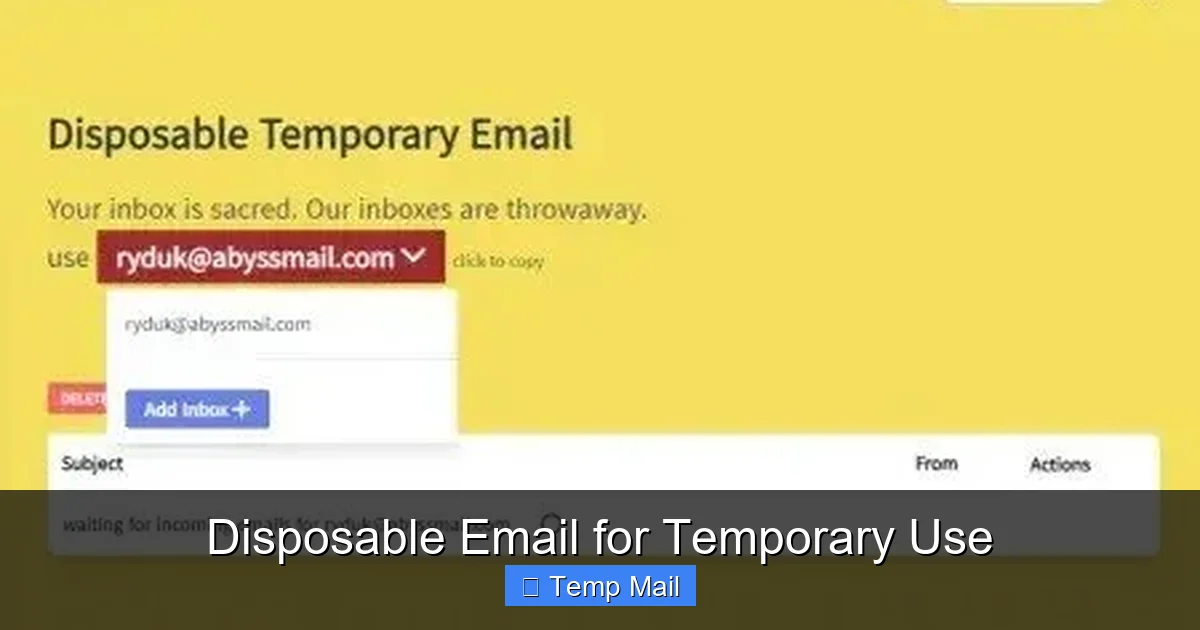
Step 1: Visit the Service Website. You navigate to a site like Temp-Mail.org, 10MinuteMail.com, or Guerrilla Mail. The homepage immediately generates a random email address for you, often within a prominent box. No registration forms, no “I agree to the terms” checkboxes (though terms are usually linked in the footer).
Step 2: Copy the Address & Use It. You copy that randomly generated address (e.g., [email protected]) and paste it into the email field of the website you’re signing up for—perhaps to download a free PDF or get a discount code.
Step 3: Receive the Verification. The website sends a confirmation link or code to that temporary address. You switch back to the temp mail tab in your browser. The inbox, which was empty moments ago, now shows a new email. You open it and click the link or copy the code to complete the sign-up on the original site.
Step 4: Inactivity & Deletion. Once you’ve retrieved the necessary email, you can simply close the browser tab. A countdown timer on the temp mail site is ticking down (e.g., 9:58 remaining). If you don’t receive an email before time runs out, the inbox is wiped. Even if you did receive an email, after the timer expires, that entire inbox—including the verification email—is permanently deleted from the server. The email address is now free to be assigned to a new, random user somewhere in the world.
The seamless experience relies on sophisticated server-side automation. The mail server is configured to accept mail for any address at its domain (e.g., @tempmail.top) without requiring pre-created user accounts in a traditional database. Instead, it creates a virtual mailbox on-the-fly when the first email arrives for a specific, never-before-seen address. It then associates that mailbox with the browser session or the unique identifier that initially generated the address. This on-demand creation is what allows for millions of unique addresses to be managed without a 1:1 user account ratio.
So, why go through this extra step? The benefits are compelling, especially in an era of relentless data collection and omnipresent spam.

Visual guide about Temporary Email for Online Subscriptions
Image source: clean.email
1. Your Primary Inbox Remains Pristine. This is the biggest win. That free e-book you wanted? The webinar you registered for? The 10% off coupon from an online store? The confirmation email for that one-time service? All of these typically trigger a cascade of follow-up marketing emails. With a temp mail address, that entire cascade gets delivered to a disposable inbox that self-destructs. Your main Gmail, Outlook, or iCloud inbox stays a clean, organized space for emails from real people—your family, boss, and actual friends—and critical services.
2. A Powerful Shield Against Data Breaches and Spam Networks. When you use your real email everywhere, you create a vast “reputation graph” tied to your identity. If any one of those dozens of websites suffers a data breach (and many do), hackers now have your email address. They can sell it on spam markets, use it for phishing campaigns targeting “known” accounts, or cross-reference it with other breaches to build a more complete profile of you. A temporary email breaks this chain. The breached database contains a disposable address that leads to a dead end. It cannot be used to target your primary accounts or identity.
3. Enhanced Privacy and Anonymity. For users concerned about privacy, a temp mail provides a layer of anonymity. The website you’re signing up for only sees the disposable address. It has no direct, persistent link to your name, your primary email, or your other online activity (unless you use the same temp address repeatedly, which defeats the purpose). This is particularly useful for whistleblowers, activists in restrictive regions, or anyone researching sensitive topics online without leaving a clear trail back to their primary identity.
4. No Long-Term Commitment or Unsubscribing Hassles. We’ve all been there: you sign up for something, get bombarded with emails, and then have to hunt for the tiny “unsubscribe” link at the bottom, often only to be taken to a preference center that still sends you emails. With temp mail, there is no “unsubscribe” because there is no persistent subscription. The entire channel vanishes. The marketing emails have nowhere to go. You simply stop checking that inbox. It’s the ultimate “unsubscribe.”
5. Bypassing Basic Gating Mechanisms. Many blogs and news sites use “content gates”—they ask for your email to read the full article or download a resource. While some argue this is a fair exchange, many users just want the content without entering their real email into yet another marketing funnel. A temp mail lets you bypass this friction instantly, accessing the content while protecting your privacy.
Despite the advantages, temporary email is not a magic bullet. Using it in the wrong context can lead to serious problems. Understanding these limitations is crucial for safe usage.

Visual guide about Temporary Email for Online Subscriptions
Image source: clean.email
1. You Will Lose Access Permanently. This is the cardinal rule. The temporary inbox is ephemeral. If you use a temp mail to sign up for a service you later need to log into—like a cloud storage account, a paid software subscription, or a social media profile—you will be locked out forever once the inbox expires. Password reset links will go to an address that no longer exists. Account recovery will be impossible. You will have effectively thrown away the key to that account.
2. Two-Factor Authentication (2FA) is a Non-Starter. Most secure services that offer 2FA require you to add a recovery email or receive codes via email. A temporary address cannot fulfill this role. If your account is compromised or you lose your phone, you need a stable, accessible email to recover it. A temp mail address provides zero recovery path.
3. Potential for Service Blocking. Many popular websites and platforms actively maintain lists of known disposable email domains. They block sign-ups from these domains at the registration form itself. You might see an error message like, “Please use a valid email address.” This is because businesses want to reduce fraud, fake accounts, and ensure they can communicate with users. If your temp mail domain is blocked, you’ll need to try a different provider or use your real email.
4. Trust and Security of the Provider. You are placing trust in the temporary email service itself. While reputable ones don’t log your activity, a malicious or compromised provider could theoretically log all emails passing through and link them to your session IP address. You are also trusting that they truly delete the data as claimed. For highly sensitive communications, this risk is unacceptable. Never use temp mail for confidential business contracts, legal documents, or private health information.
5. Lack of Features and Reliability. Don’t expect attachments to work perfectly, advanced filtering, or reliable delivery. Some services may have downtime. Large attachments might be rejected. The focus is on bare-bones text delivery for verification codes and simple links.
To maximize the benefits and minimize the risks, follow these practical guidelines:
Treat It Like a Public Payphone. Use a temporary email for exactly what it’s designed for: transient, low-value interactions. The rule of thumb: if you wouldn’t use a public payphone to discuss the matter, don’t use a temp email. This means downloads, forum sign-ups, trial access, and one-time forms are perfect.
Never Use It for Financial or Primary Identity Services. This cannot be stressed enough. Banking, PayPal, cryptocurrency exchanges, your main Amazon account, your primary Apple ID or Google Account—these must always be tied to a secure, permanent, and recoverable email address that you control indefinitely.
Check the Site’s Terms of Service (ToS). While often ignored, the ToS sometimes explicitly prohibit the use of disposable email addresses. Violating ToS can get your account suspended without warning, even if you used a temp mail just for the initial sign-up and later added a real email. It’s a gray area, but it’s a risk.
Use Different Temp Mail Services for Different Needs. Don’t put all your eggs in one basket. If a site you frequently use blocks Domain X, try Domain Y. Have 2-3 trusted temp mail sites bookmarked. Some services offer browser extensions that make generating and accessing temp mail even smoother.
Don’t Expect It to Last for “Important” Follow-Up. If you sign up for a webinar that happens in two weeks, do not use a 10-minute email. The reminder emails will be lost. Use a temp mail service that offers a longer lifespan (e.g., 24 hours or a few days) for such cases, or better yet, use your real email if you genuinely want the follow-up information.
Clear Your Browser History/Cookies After Sensitive Use. If you’re particularly privacy-conscious, close the temp mail browser tab and clear your session cookies after retrieving your verification email. This prevents any potential session linking on the temp mail provider’s side, though reputable ones don’t track anyway.
Let’s make this concrete. Here are common, everyday scenarios where a temporary email is the smart choice:
While simple temp mail services are great for quick tasks, other strategies exist for managing email overload:
Dedicated “Junk” or Newsletter Email: Create a separate, permanent email address (e.g., a free Gmail account) used solely for newsletters, promotions, and online sign-ups. This keeps your primary inbox clean but is still a persistent address you can log into if you *do* want to check a newsletter or recover a password for a service you signed up with it. This is a more organized, long-term solution than pure temp mail but requires managing another account.
Email Aliasing Services (The Premium Solution): Services like SimpleLogin, AnonAddy, or Firefox Relay (free tier) offer a powerful middle ground. They create unique, forwardable email aliases (e.g., [email protected]) that forward to your real inbox. You can disable the alias with one click if it starts spamming you, and you maintain full control and permanence. This is often considered the best practice for serious privacy enthusiasts.
Built-in Browser Features: Some browsers, like Firefox with its “Firefox Relay” integration, or Apple’s “Hide My Email” feature in iCloud+, allow you to generate unique, random email addresses that forward to your real one directly from your browser or device settings. This is incredibly convenient and secure.
The landscape is evolving. As privacy awareness grows, we’re seeing a shift from purely *temporary* solutions to *controllable* ones. The ideal future likely involves widespread adoption of email aliasing, giving users the power to create and revoke email addresses at will without losing access to necessary communications.
Temporary email addresses are a simple yet profoundly effective tool in the modern digital toolkit. They serve as a first line of defense against the relentless tide of promotional spam and a shield for your primary online identity. By using them strategically for low-stakes, one-time online interactions—downloads, trials, forum sign-ups—you reclaim control over your inbox and dramatically reduce your digital footprint’s attack surface.
However, their power comes with a stark warning: they are utterly unsuitable for anything you need to access again. No banking, no primary social media, no critical cloud services. Understanding this dichotomy is key. Used wisely, a temp mail is like a digital condom—it protects you during a risky encounter with an unknown website, and then it’s gone. Combine this practice with a dedicated “junk” email or, better yet, an email aliasing service for a comprehensive strategy. In the battle for your privacy and attention, the disposable inbox is a cheap, easy, and surprisingly potent weapon. Wield it with knowledge, and keep your real email for the people and services that truly matter.
Yes, using reputable temporary email services is both safe and legal. It’s a legitimate privacy tool. The “safety” depends on the provider’s practices; choose well-known services that don’t log your activity. The legality is unquestioned, as you’re not forging emails, just using a provided forwarding service. However, using it to commit fraud or evade bans is illegal and violates most services’ terms.
Yes, many can and do. Websites maintain lists of domains from known temporary email providers. When you attempt to sign up, their system checks the domain part of your email (the part after @) against these blocklists. If it matches, you’ll be prevented from registering with a message like “Invalid email address.” This is why using multiple, lesser-known temp mail services can sometimes work.
You will be permanently locked out of that account. Password reset links are sent to the registered email address. Since the temporary inbox has expired and been deleted, you will never receive that link. There is typically no alternative recovery method if the account is solely tied to that disposable address. This is why it’s critical to never use temp mail for any account you intend to keep long-term.
No, by definition, a temporary email service is not permanent. Some services offer longer timeframes (24 hours, 48 hours, or even a week), but they still have an expiration. For a permanent but private solution, you need an email aliasing service like SimpleLogin or AnonAddy, which creates a forwardable alias that lasts until you delete it, giving you control without exposing your main address.
There is no single “best” service, as reliability and domain blocklists change. Popular and generally reliable options include Temp-Mail.org, 10MinuteMail.com, and Guerrilla Mail. For slightly longer needs, services like Mohmal or DropMail offer configurable lifespans. The best practice is to have 2-3 bookmarked and try an alternative if one is blocked on a specific website.
It is deliberately not difficult. Simply visit a temp mail website. An email address is generated for you automatically. Copy that address, paste it into the sign-up form on the other website, and complete the process. Then, switch back to the temp mail tab to view the incoming verification email. No registration, no password, no setup required. It takes about 15 seconds.
অনলাইন নিউজপেপার থিম। এই থিমটি দিয়ে আপনারা বাংলা এবং ইংরেজি নিউজপেপার সাইট তৈরি করতে পারবেন । বার্তা ও বাণিজ্যিক কার্যালয়: ৭১, মতিঝিল, ঢাকা-১০০০। সম্পাদক : মো আসাদুজ্জামান আমানউল্লাহ । মোবাইল : ০১৭০০-০০০০০০ । ইমেইল : [email protected] ।
All rights reserved © 2019 themesdealer.Com