Image for Temp Mail Vs Disposable Email: What’s the Difference?



Temp mail and disposable email are often used interchangeably, but they have distinct characteristics. Temp mail is typically an automatically generated, ultra-short-lived address for instant, anonymous sign-ups. Disposable email is a manually created, slightly longer-lasting address you control for specific, short-term tasks. Choosing between them depends on your need for control, longevity, and security.
Ever stared at an email sign-up form, sighed, and wondered, “Do I really have to give them my real email for this?” You’re not alone. In our digital lives, we’re constantly trading our email address for access—to a whitepaper, a discount, a forum account. That’s where the world of temporary email solutions comes in. But here’s where it gets confusing: you’ve probably heard terms like “temp mail” and “disposable email” thrown around. Are they the same thing? Can you use them interchangeably? The short answer is: not exactly. While the lines blur in casual conversation, understanding the Temp Mail vs Disposable Email debate can save you from frustration, security risks, and missed emails.
Think of it this way: both are tools in your privacy toolbox, but one is a single-use paper plate and the other is a cheap, temporary plastic cup. You wouldn’t use a paper plate to drink a hot beverage for a week, right? Similarly, using the wrong tool for your online task can lead to a mess. This article will be your definitive guide. We’ll slice through the jargon, compare them side-by-side, and give you clear, practical rules on when to reach for which tool. By the end, you’ll never be confused about temp mail versus disposable email again.
Let’s start with the absolute basics. To understand the difference, we need clear definitions.
Temp mail, short for temporary mail, is the most ephemeral form of email you can get. It’s typically generated automatically by a service the moment you visit their website. You don’t sign up, create a password, or choose a username. A random, jumbled email address (like [email protected]) is created for you, and an inbox tied to that exact address is opened simultaneously. The lifespan is brutally short—often just 10 minutes to a few hours. The entire purpose is to receive one single email, usually a verification link or code, and then cease to exist forever. The inbox is usually public; anyone who knows that exact random address can view the emails. There is zero ownership, zero persistence, and zero expectation of return.
Disposable email (also called throwaway email) gives you a bit more agency. You typically visit a service like Guerilla Mail, 10 Minute Mail (in its original form), or Mailinator and choose a username for your temporary address (e.g., [email protected]). You often have to click a button to “create” or “refresh” the inbox. The lifespan is longer—usually anywhere from a few hours to several days (some services offer up to a week). You can often log out and log back in to that same inbox during its lifetime, as long as you remember the address (and sometimes a simple captcha). It’s designed for slightly more complex tasks where you might need to receive a couple of emails over a short period, like confirming an account and then getting a welcome email.
So right away, the key differentiator emerges: temp mail is automatic and instantaneous; disposable email is manual and offers slight persistence.
Now let’s get into the nitty-gritty. We’ll compare them across the most critical factors that affect your user experience.

Visual guide about Temp Mail Vs Disposable Email: What’s the Difference?
Image source: temp-mail.eu.com
This is the biggest, most practical difference. Temp mail addresses are designed to die. The countdown timer is often displayed prominently on the page. Once the timer hits zero, the address and all its emails are purged from the server, never to be seen again. It’s a digital fire-and-forget missile. Disposable email addresses have a defined, but flexible, window. You might get 24 hours, 48 hours, or 7 days. During that window, the inbox persists on the server. You can close your browser, come back later (if you saved the address), and check for new messages. This makes disposable email suitable for multi-step processes that span a day or two.
With temp mail, you are a passive recipient. You load the page, and *poof*, an address is born. You have no say in what it is. You cannot change it. You simply copy the random string and use it. With disposable email, you are an active participant. You get to pick a username (within the service’s domain). This gives you a memorable address for the duration of its life. Some services even let you “refresh” to a new address if you think the old one is compromised, extending your control slightly.
This is a crucial security and privacy consideration. Temp mail inboxes are, by design, completely public. The service’s entire model is based on anonymity for the sender and the receiver. If someone else stumbles upon that same random temp mail address (which is easy to do, as they are often sequential or guessable), they can see every email sent to it. There is no password, no login. It’s an open mailbox on a street corner. Disposable email inboxes are semi-private. While they don’t require a strong password, they often use a simple captcha or a unique URL to access a specific inbox. Knowing the exact address isn’t enough; you usually need the specific session link or to solve a challenge to view the emails. It’s a locked mailbox, but the lock is very simple.
Here’s a common point of confusion. Almost all temp mail services are receive-only. You cannot send emails from a temp mail address. Their infrastructure is built solely for the one-way task of receiving a verification code. Most disposable email services also block outbound sending to prevent spam abuse. However, a few (like certain tiers of Mailinator or formerly 10 Minute Mail) have historically offered limited sending, but this is rare and often heavily restricted. Neither should be considered a tool for sending personal or professional correspondence.
theory is fine, but when do you actually pull out each tool? Let’s match the tool to the task.

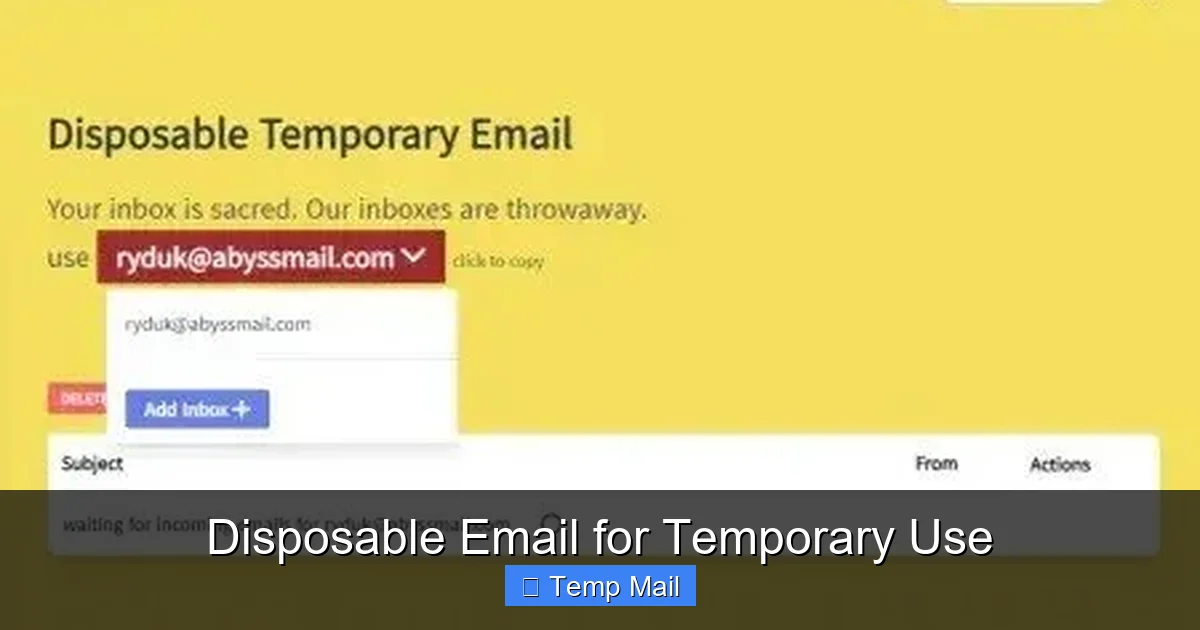
Visual guide about Temp Mail Vs Disposable Email: What’s the Difference?
Image source: atempmail.com
This is where the rubber meets the road. Using the wrong tool can expose you.

Visual guide about Temp Mail Vs Disposable Email: What’s the Difference?
Image source: store-images.s-microsoft.com
Both services offer a layer of separation from your primary email, but it’s a thin one. With temp mail, the anonymity is high for you because the address is random and forgotten. But the anonymity for the inbox is zero—it’s public. Anyone monitoring the service’s network or who guesses the address can read your “private” verification code. With disposable email, the inbox is more private from random outsiders, but the service provider itself is the weak link. They can log everything: your IP address when you created/accessed the inbox, the emails you received, and your activity. Reputable disposable services have privacy policies stating they delete data quickly, but you are trusting a company whose business model is often based on anonymity, not long-term security.
You must assume all data is logged until the inbox is purged. For temp mail, the purge is automatic and fast. For disposable, the purge happens at the end of the timer. During that window, the provider has your data. Some disposable services have been known to sell aggregated data from inboxes or use it for targeted advertising within their own network. Temp mail services, due to their ultra-short lifespan, have less data to sell, but their public nature is a bigger flaw. Never use either for sensitive personal data (password resets for important accounts, medical info, financial documents). The moment you click a link from a temp/disposable inbox, you are on a device that may be monitored.
Let’s lay it all out on the table.
Stop wondering. Ask yourself these three questions in order:
Just one (a code/link right now)? → Use Temp Mail. You need that instant, fire-and-forget inbox.
Two or more over a day or two? → Use Disposable Email. You need a persistent inbox for the duration of the task.
No, it’s just for me on this device right now. → Temp Mail. The random string is fine.
Yes, I might need to tell someone “check that inbox” or come back to it later. → Disposable Email. Choose a username you can recall.
Yes (banking, primary cloud storage, main social media, official government). → NEITHER. Use your primary, secure email. These tools are for low-value, non-critical interactions.
No (free trial, ebook download, forum sign-up). → Proceed with the appropriate tool from steps 1 & 2.
Remember, when in doubt, lean towards disposable email for its slightly longer leash and user control. But if you’re in a hurry and it’s clearly a one-off, temp mail is your fastest friend.
The landscape is evolving. Some modern “disposable” services are blurring lines by offering browser extensions that auto-generate and manage temp-like addresses within your primary email client (like SimpleLogin or AnonAddy), which adds a layer of control and forwarding. Meanwhile, major platforms like Gmail now offer “hide my email” features that create unique, forwardable aliases—a form of managed disposable email tied to your real account.
So, what’s the final word on Temp Mail vs Disposable Email? They are siblings, not twins. Temp mail is a spark: brilliant, immediate, and gone in a flash. Disposable email is a short candle: you light it, it burns for a set time, and you can shield it from the wind until it’s done. Your job is to know whether your task needs a spark or a candle. Use the wrong one, and you’ll either get burned (by a dead inbox) or left in the dark (by an address that expired too soon). Master this distinction, and you’ll navigate the web’s endless email gates with privacy, efficiency, and confidence.
Yes, using these services is perfectly legal in most jurisdictions. They are legitimate privacy tools. However, using them to commit fraud, evade legal obligations, or send spam is illegal. The legality depends on your intent, not the tool itself.
It’s a trade-off. Temp mail is safer from the recipient website linking the address to you (it’s random), but unsafe from anyone else viewing the public inbox. Disposable email is safer from random public viewing but requires you to trust the provider not to log your IP and activity during its lifespan. For maximum privacy against the website, temp mail wins. For privacy against other humans, disposable email wins.
Almost universally, no. These services are designed for receiving only, primarily to prevent abuse for sending spam. You should never rely on them for outbound communication. If you need to send an email anonymously, look into secure, encrypted email providers like ProtonMail, not temp/disposable services.
It varies by provider. Common lifespans are 10 minutes (some “10 minute mail” services), 1 hour, 24 hours, 48 hours, or 7 days. Always check the specific service’s policy before using it. Never assume it lasts longer than what is clearly stated on the page.
Yes, many websites, especially popular ones (Google, Facebook, Twitter) and financial services, maintain lists of known disposable email domains and will block sign-ups from them. Smaller blogs or forums may not. Disposable email domains are often less commonly blocked than the most popular temp mail domains, but this is a constant cat-and-mouse game.
First, never use them for important accounts (banking, primary email, main cloud storage). Second, use a password manager to store the disposable address and any credentials you create with it, if you need to log in multiple times. Third, assume everything you do with that address is visible to the provider during its lifetime. Finally, close the browser tab after you’re done to reduce session exposure.
অনলাইন নিউজপেপার থিম। এই থিমটি দিয়ে আপনারা বাংলা এবং ইংরেজি নিউজপেপার সাইট তৈরি করতে পারবেন । বার্তা ও বাণিজ্যিক কার্যালয়: ৭১, মতিঝিল, ঢাকা-১০০০। সম্পাদক : মো আসাদুজ্জামান আমানউল্লাহ । মোবাইল : ০১৭০০-০০০০০০ । ইমেইল : [email protected] ।
All rights reserved © 2019 themesdealer.Com