Image for Temp Mail for Testing Signup Forms



Temp mail services are a game-changer for testing signup forms. They provide disposable, anonymous email addresses that let you automate and streamline the entire verification process without polluting your personal or work inbox. This cost-effective, secure method is essential for developers, QA engineers, and marketers to ensure forms work flawlessly before launch.
Imagine this: you’ve just spent two weeks building a beautiful, complex signup form for your new web application. It has password strength meters, real-time validation, social login buttons, and a multi-step onboarding flow. The code is clean, the design is pixel-perfect, and you’re ready to test it. You fill out the form with your personal email, hit submit, and… nothing. Or worse, you get an error. You try again. And again. Soon, your inbox is flooded with “Welcome!” emails, password reset links, and promotional newsletters from your own test runs. You’ve successfully broken your own system and created a digital mess to clean up. Sound familiar? This is the exact problem that temporary email for testing signup forms solves.
For developers, quality assurance (QA) engineers, and product testers, the signup form is one of the most critical and delicate parts of any application. It’s the first handshake with your user, the gateway to your service. A broken form means lost users, lost revenue, and a tarnished reputation. Yet, testing it thoroughly—especially the email verification step—has always been a pain. You either use your own email, creating spam, or you set up complex test email server infrastructure, which is overkill for most projects. Enter the world of temporary, disposable email addresses, or “temp mail.” This simple, elegant tool has quietly revolutionized how we test user-facing forms, making the process faster, cleaner, and infinitely more reliable.
This article isn’t just a list of temp mail websites. It’s a deep dive into why temp mail is indispensable for signup form testing, how to use it effectively in both manual and automated workflows, the best practices to follow, and the potential pitfalls to avoid. Whether you’re a solo developer launching your first SaaS or part of a large enterprise QA team, by the end of this guide, you’ll understand exactly how to integrate temp mail into your development lifecycle to ship flawless forms, every time.
At its core, a temp mail service provides a temporary email address that exists for a short period—usually 10 minutes to a few hours—before being automatically deleted. You don’t need to register, provide a password, or link it to any personal information. You simply visit a website like tempmail.net or 10minutemail.com, and a random inbox is generated for you instantly. The inbox is publicly accessible via a unique URL, and any email sent to that address appears in that web interface in real-time.
These services operate their own mail servers. When you generate an address (e.g., [email protected]), the service configures its mail server to accept all incoming mail for that domain and route it to a temporary storage database linked to your session ID. When you close the browser or the timer expires, that database entry is purged. The key technical advantage for testers is that these are real, functional SMTP/IMAP servers. They aren’t mocks or simulators. They genuinely receive emails from any server on the internet, just like a Gmail or Outlook address would. This is crucial because it tests the entire delivery chain: your application’s email server, DNS records (SPF, DKIM, DMARC), and the final rendering in a mail client.
To appreciate its value, let’s contrast temp mail with other common methods:
Temp mail fills the critical gap between local development mocks and using a real, permanent inbox. It gives you real-world delivery validation without the long-term baggage.
Now that we understand what it is, let’s explore the compelling reasons why every serious tester should have temp mail in their toolkit. The benefits extend far beyond just “not getting spam.”

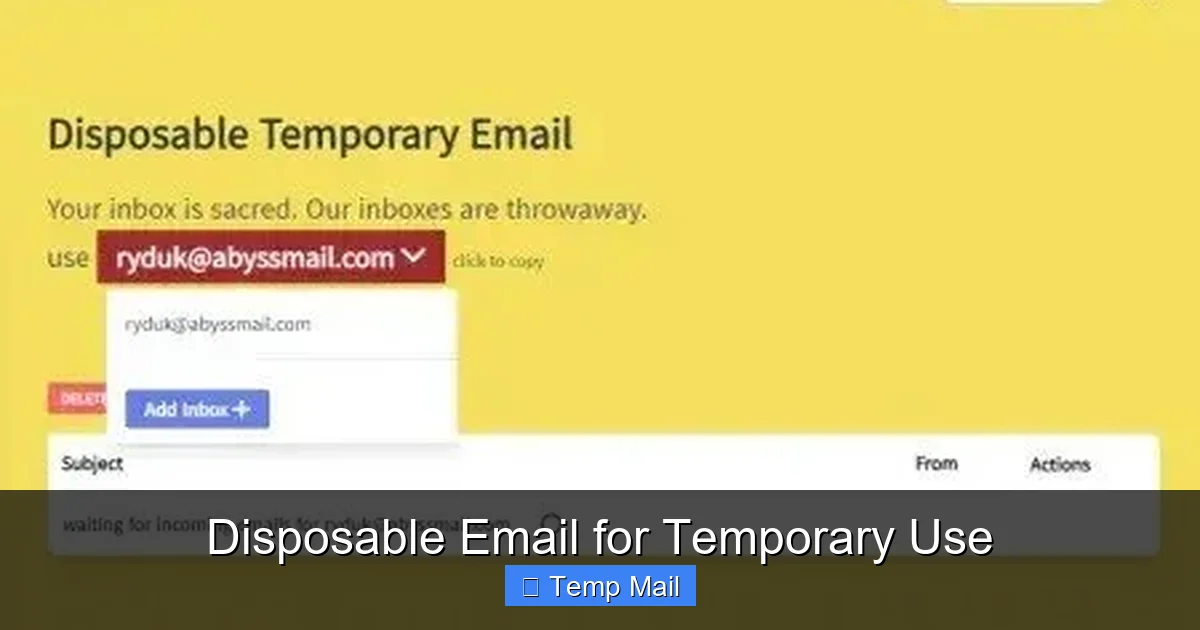
Visual guide about Temp Mail for Testing Signup Forms
Image source: mailerlite.com
Each test run gets a brand-new, unique email address. There is zero overlap between test User A and test User B. This means:
This is the killer feature. E2E tests aim to simulate a real user’s journey. A real user provides their real email, receives a real email, clicks a real link, or enters a real code. Temp mail allows your automated test scripts (using Selenium, Cypress, Playwright) to do exactly that.
Practical Example: Your Cypress test script can:
This tests your entire stack: frontend form validation, backend user creation, your email service provider’s (ESP) API, email deliverability, and your app’s code verification logic—all in one go. You cannot achieve this level of confidence with local mail catchers or mocks.
Need to run 50 signup tests in parallel to stress-test your system? With temp mail, it’s trivial. Your test framework can generate 50 unique addresses in seconds. Each test thread has its own isolated inbox. This is impossible with a single shared test inbox. This scalability is vital for load testing the signup flow and checking for race conditions (e.g., “email already in use” errors when two tests try to sign up with the same address simultaneously).
Signup forms often have email validation regex that can be buggy. Does your form accept emails with Unicode characters (e.g., 用户@例子.中国)? Does it handle very long local parts or unusual domain names? Temp mail services often provide a variety of domains (e.g., @mailinator.com, @guerrillamail.com, @tempmail.net). You can test your form’s validation logic against these different formats. Furthermore, you can test how your verification emails render in different clients by accessing the temp inbox from various devices or email clients that support IMAP/POP3 (some advanced services do).
As a tester, you are often accessing pre-production environments with dummy data. Using a temp mail ensures that if that test environment is compromised, the attacker only gains access to a disposable, meaningless email address, not your personal or corporate credentials. It also prevents your real email from being associated with test user accounts in your production database (even if it’s a “test” database, it’s best practice to avoid any real PII).
Knowing the theory is one thing; implementing it is another. Let’s walk through practical workflows for both manual testers and automation engineers.

Visual guide about Temp Mail for Testing Signup Forms
Image source: email.uplers.com
This is the simplest, no-code-required approach.
Pro Tip: Bookmark your favorite temp mail site as a toolbar button. It becomes a one-click tool in your manual testing arsenal.
This is where temp mail truly shines for continuous integration. Many services offer a simple REST API. Let’s use the Temp-Mail API (from temp-mail.io) as an example, but the principles apply to others like MailSlurp or TempMailAPI.
Step 1: Get an API Key. Sign up for a free or paid plan on the provider’s site. You’ll get an API key (a long string).
Step 2: Write the Test Script Logic (Pseudo-code).
// 1. Generate a new disposable email address
response = POST https://api.temp-mail.io/v2/email/create
headers = { "Authorization": "Bearer YOUR_API_KEY" }
emailData = response.json()
disposableEmail = emailData["email"] // e.g., "[email protected]"
inboxId = emailData["inbox_id"] // Needed to poll later// 2. Use this email in your application's signup request
signupResponse = POST https://your-app.com/api/signup
body = { "email": disposableEmail, "password": "Test123!", "name": "Test User" }
assert signupResponse.statusFrequently Asked Questions
Is using temp mail for testing legal and ethical?
Yes, absolutely. Temp mail services are designed for this exact purpose. Using them to test your own applications or with explicit permission from the application owner is standard practice. It is unethical and potentially illegal to use them to create fraudulent accounts, bypass bans, or spam others.
How long do emails last in a temp mail inbox?
It varies by provider, but typically emails are stored for 1 to 24 hours after they arrive, and the entire inbox/address is deleted after 1 to 7 days from creation. Always check the specific service’s policy. For testing, you usually only need the inbox alive for a few minutes to an hour.
Can I use temp mail with automated testing frameworks like Selenium?
Yes, and it’s highly recommended. You can either automate the web interface of the temp mail site (by opening a second browser tab) or, more robustly, use a provider that offers an API. The API approach is cleaner, faster, and more reliable for CI/CD integration.
Are temp mail services secure? Could my test data be intercepted?
Reputable services do not log or misuse your test data, but by definition, the inboxes are not private. Anyone with the unique URL could access the inbox. Therefore, never use temp mail for sensitive information like real passwords, credit card numbers, or personal identifiable information (PII). Only use it for the disposable email address and non-sensitive test data.
Do I need to pay for a temp mail service?
You can accomplish a great deal with free web-based services for manual testing. However, for reliable, scalable automation, a low-cost paid API plan is worth the investment. Free API tiers are often too limited for daily CI use. Paid plans offer higher rate limits, dedicated domains, and better uptime.
Will using temp mail affect my application’s email sender reputation?
No. Your application’s sender reputation is built on how real email providers (Gmail, Yahoo, etc.) treat your emails. Sending to temp mail addresses does not harm this reputation because temp mail services accept all mail. However, if your emails are consistently rejected or spam-filtered by real providers, that will hurt your reputation. Temp mail tests only confirm delivery to their servers, not deliverability to real users—hence the need to also test with a real Gmail address.
অনলাইন নিউজপেপার থিম। এই থিমটি দিয়ে আপনারা বাংলা এবং ইংরেজি নিউজপেপার সাইট তৈরি করতে পারবেন । বার্তা ও বাণিজ্যিক কার্যালয়: ৭১, মতিঝিল, ঢাকা-১০০০। সম্পাদক : মো আসাদুজ্জামান আমানউল্লাহ । মোবাইল : ০১৭০০-০০০০০০ । ইমেইল : [email protected] ।
All rights reserved © 2019 themesdealer.Com