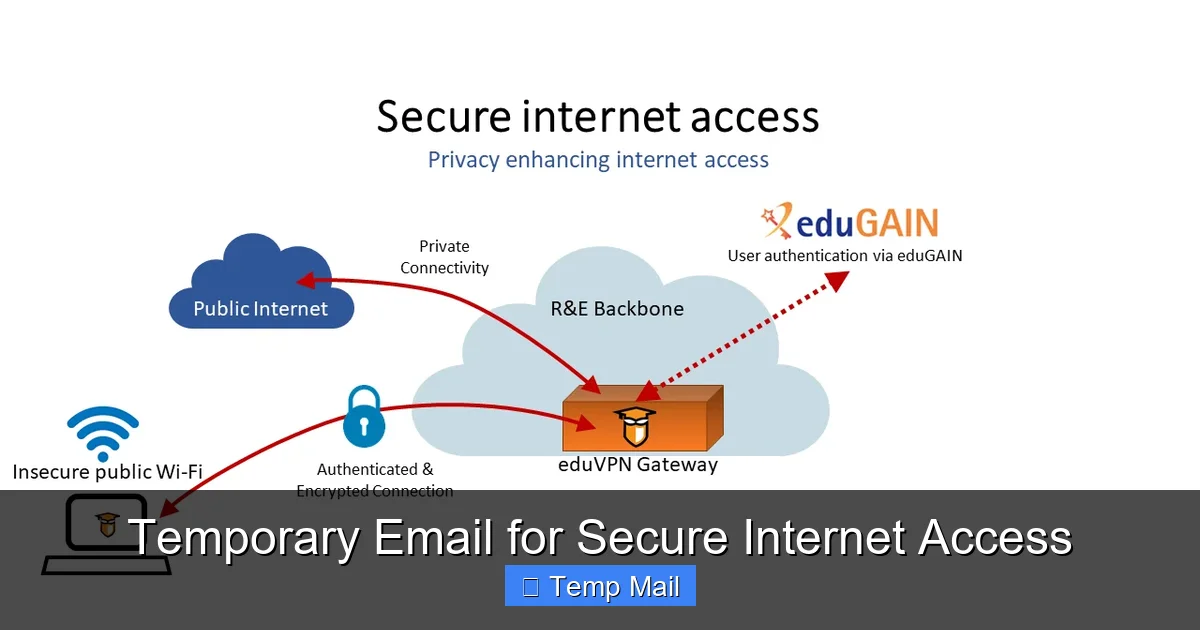
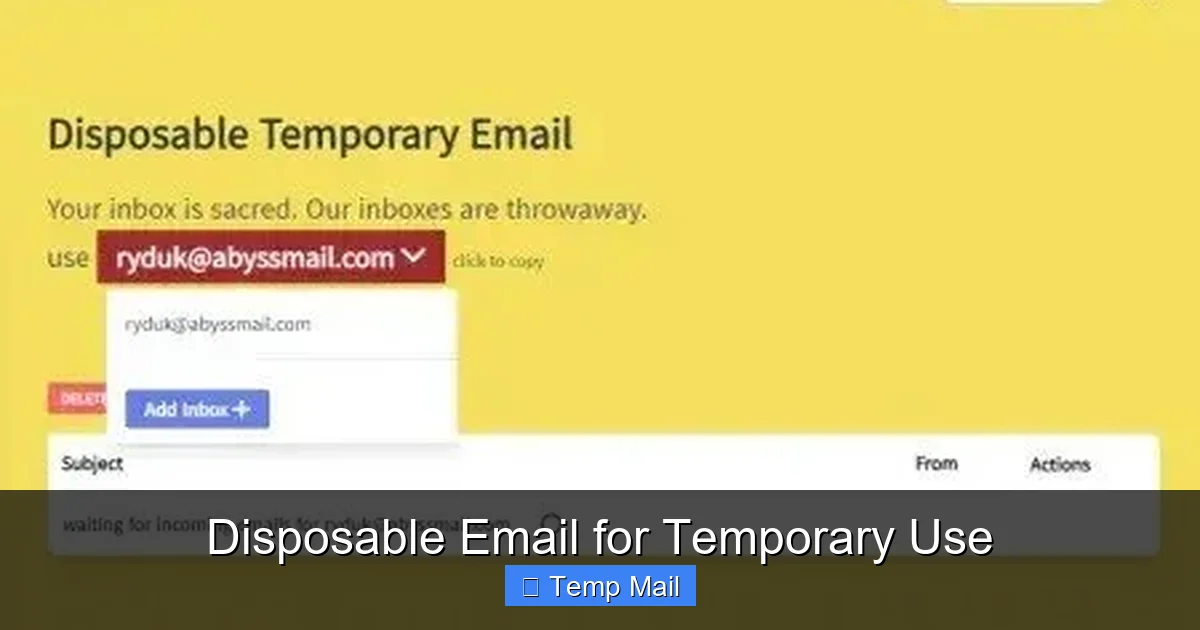
Image for Temporary Email for Spam Prevention



Tired of your inbox flooding with spam after every online sign-up? A temporary email is your first line of defense. These disposable addresses let you register for websites, download files, or access content without ever revealing your real email. By using a throwaway address that self-destructs, you effectively isolate spam to a dead-end inbox, keeping your primary account clean and private.
You know the drill. You want to read a juicy article behind a paywall, download a free ebook, or sign up for a forum discussion. You enter your email address, hit submit, and boom—within hours, your inbox is under siege. Promotional offers, “news”letters you never asked for, and suspicious links flood your screen. That one casual sign-up has triggered a spam avalanche that will linger for months, maybe years. What if there was a simple, clever way to say “yes” to the content you want while whispering “no” to the spam you don’t? Enter the world of temporary email—your secret weapon for spam prevention and digital privacy.
Think of a temporary email address as a digital burner phone. It’s a fully functional, receiving inbox that exists for a short, predetermined period—sometimes just 10 minutes, sometimes a few hours or days. It has its own random address, you can receive emails in it, and then, poof, it vanishes without a trace. The magic lies in using this ephemeral address for any online interaction where you suspect the email might be used for marketing, sold to third parties, or simply not worth the long-term commitment. By doing so, you create a perfect buffer zone. Any spam generated from that interaction gets delivered to an inbox that will auto-delete itself, leaving your precious, permanent email address pristine and spam-free.
This isn’t about being paranoid; it’s about being practical. In an age where your email address is a valuable commodity for data brokers and marketers, taking control of where it lands is a fundamental step in managing your digital footprint. This guide will walk you through exactly how temporary email services work for spam prevention, when to use them (and when not to), how to choose a reliable service, and best practices to make your online life cleaner and more private. Let’s reclaim your inbox.
At first glance, a temporary email service seems almost too simple to be effective. You visit a website, it generates a random email address for you (like [email protected]), and you use that somewhere else. But there’s a clever backend process that makes it all function seamlessly without you needing to set up an account or password.
Unlike your Gmail or Outlook, which require a username and password to access, a temporary inbox is publicly accessible via its unique address. When the service generates [email protected], it simultaneously creates a database entry linking that address to a temporary inbox folder on their server. The moment you (or a bot) send an email to that address, the service’s server receives it, stores it in that folder, and displays it on a web page. You return to the original temp mail site, often the same page, and your emails are waiting. No login, no password, no recovery questions. It’s open access tied solely to the randomness of the address string.
Every temporary email service operates on a timer. This is the “temporary” part. The countdown might start when the inbox is generated (e.g., “Your inbox expires in 60 minutes”) or when the first email arrives. Once the timer hits zero, the server automatically purges the inbox and the email address becomes invalid. Any future emails sent to it bounce back to the sender. This automated deletion is what makes it a powerful spam tool—it guarantees that any future marketing emails have nowhere to land. Some services offer a “extend” button if you’re waiting for a crucial verification email, but the default is always ephemeral.
You might wonder: if anyone can access the inbox via the URL, can’t spammers just harvest these public inboxes? Reputable services have safeguards. They often use complex, non-sequential address generation (like cryptographic hashes), making it impossible to guess another user’s inbox. Furthermore, they may limit the number of emails per address or per IP address to prevent abuse. The business model isn’t in storing your data; it’s in providing a quick, anonymous service, sometimes supported by non-intrusive ads on their site. Their incentive is to keep the system clean and functional for legitimate users like you.
Now, let’s connect the mechanics to the core benefit: stopping spam. The prevention happens at the very source of the problem—the initial email collection.

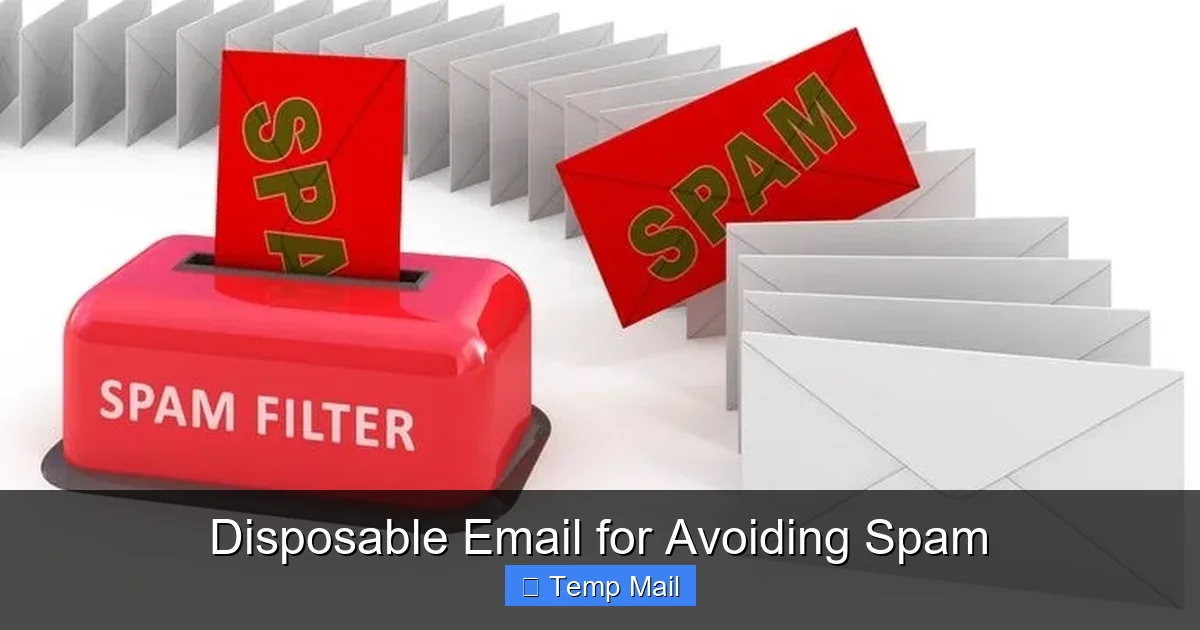
Visual guide about Temporary Email for Spam Prevention
Image source: unspam.email
When you use your primary email to sign up for a questionable website, you are giving that entity a permanent key to your digital doorstep. They can email you forever (or until you unsubscribe, which is often a tricky process). A temporary email changes this dynamic entirely. You give them a key to a hotel room that checks out in two hours. They can send all the “offers” they want to that address, but after the checkout time, the room is stripped bare and the key is void. The spam never enters your personal space because your personal space was never connected in the first place. It’s a brilliant form of digital quarantine.
Many websites don’t just use your email for their own newsletters; they package it and sell it to third-party data brokers as part of “user lists.” These brokers then sell that list to other marketers, leading to a cascade of spam from companies you’ve never heard of. When you use a temporary email for that initial sign-up, you are giving them a dead-end address. Even if they sell it, the buyer will eventually find the address bounces or is inactive. You’ve effectively poisoned the well of your own data, making your email worthless to the data economy. This breaks the chain of proliferation at its weakest link: the initial, often careless, submission.
Not all spam is malicious. Sometimes, you just check a box without reading the fine print during a rushed sign-up. “Yes, I’d like to receive promotional offers from partners.” Oops. With your main email, that’s a commitment. With a temporary email, it’s a non-event. The promotional email goes to the disposable inbox, which self-destructs before you even see it. There’s no “unsubscribe” link to hunt down, no confirmation that your request was processed. The spam simply ceases to exist for you. It’s the ultimate “ignore” button for unwanted commercial email.
Knowing *how* it works is one thing; knowing *when* to use it is the key to effectiveness. Here are the prime scenarios where a temporary email is not just helpful, but essential.

Visual guide about Temporary Email for Spam Prevention
Image source: unspam.email
This is the classic use case. A company offers a valuable PDF in exchange for your email. Often, the sole purpose of this “lead magnet” is to build an email list for marketing. Using your primary email here is a high-spam-risk move. Instead, use a temporary address. Download the file, and if the company sends a follow-up “thank you” email or a related offer, it lands in the temp inbox. You get the resource, they get a fake lead, and your main inbox stays serene. Pro tip: If the resource is time-sensitive (e.g., a webinar replay with a 24-hour link), make sure your temp mail service’s lifespan exceeds that window.
News websites, industry blogs, and software companies frequently gate premium content behind an email form. “Read the rest of this article by entering your email.” Again, this is a list-building tactic. A temporary email lets you bypass the gate cleanly. You get the content, and the publisher gets an address that will vanish. This is perfect for researching a one-time purchase or reading an article you stumbled upon. No long-term obligation, no future newsletter spam.
Many forums require registration to post or view certain threads. These communities can be valuable, but they also generate high email volume (reply notifications, digest emails, promotional cross-mails). Using a temporary email for forum sign-up contains all that notification clutter. If the forum becomes toxic or spammy, you simply walk away. Your primary email, tied to your identity, remains untouched. This is also useful for anonymous or pseudonymous posting where you don’t want your real email linked to your forum persona.
Want to try a new SaaS tool or app that requires email verification? Use a temporary address. This is especially smart for tools you’re just exploring. You avoid the relentless “Your trial is ending!” and “Upgrade now!” email sequences that often follow a trial sign-up. If you love the tool and decide to pay, you can always switch to your real email later. But for the 90% of trials you’ll abandon, the temp email ensures a clean exit with no lingering marketing emails.
This is your gut-instinct scenario. A website looks a little sketchy, has too many pop-ups, or you simply don’t recognize the brand. For any sign-up on a site you don’t fully trust to handle your data responsibly, a temporary email is a must. It protects you from potential data breaches (your real email won’t be in their compromised database) and from the certainty of spam if they are a shady operator. If the site later asks for your real email for a legitimate reason (e.g., a purchased product shipment), you can decide then and there.
Not all temporary email services are created equal. Some are ad-supported freebies, others offer premium features. Choosing the right one impacts your experience and security.

Visual guide about Temporary Email for Spam Prevention
Image source: unspam.email
First, check the inbox lifespan. Is it 10 minutes, 1 hour, or 1 day? For most uses, 1 hour is sufficient. For longer trials or content access, look for services offering 24-48 hours. Second, examine the user interface. Is it clean? Does it auto-refresh to show new emails, or do you have to manually reload? A good service will have a simple, no-fuss inbox view. Third, consider multiple domain options. Some services let you choose from several domains (e.g., @tempmail.com, @dispostable.com). This is useful if a particular domain gets blocked by a website you’re trying to sign up for. Finally, look for a “reply” function. While most temp mail is for receiving only, some services allow you to reply from the disposable address, which can be handy for a quick confirmation.
Avoid any service that requires registration to get a temporary email. The whole point is anonymity and no commitment. If they ask for a phone number or a CAPTCHA that’s overly difficult, it might be a data collection trap in disguise. Be wary of services cluttered with misleading download buttons and aggressive pop-up ads; these can be malware vectors. Also, understand that no service is 100% private. The provider technically has access to any email that passes through their servers. While reputable ones don’t log or sell content, you should never use temp mail for passwords, financial info, or private documents. Finally, know that some websites actively block known disposable email domains. If you encounter this, try a different service or domain from your chosen provider’s list.
For a balance of reliability and simplicity, look for services that have been around for years (like Guerrilla Mail or 10MinuteMail). They tend to have stable systems and are less likely to disappear overnight. Services that offer a browser extension can be convenient, generating an address with one click from your browser. The ideal service is fast, has a clear countdown timer, allows you to copy the address easily, and refreshes the inbox automatically. Remember, you’re using this tool for convenience and spam prevention, not for high-stakes communication.
Temporary email is a powerful tool, but it’s not a magic bullet. Understanding its limitations is crucial to using it safely and effectively.
This is the most obvious and important limitation. When the timer expires, the inbox and all its emails are gone forever. There is no recovery, no password reset, no customer support to call. If you used a temporary email to sign up for a service and later need to reset your password, you are locked out. You will have to create a new account with a real email. This is why the cardinal rule is: Never use temporary email for any account you need to access long-term or that contains valuable data. Social media, online banking, cloud storage, primary email accounts—these are all off-limits for disposable addresses.
Many websites, especially financial institutions, social platforms, and reputable SaaS companies, maintain lists of disposable email domains and block them during registration. They do this to reduce fraud, spam accounts, and abuse. If you try to sign up with a blocked domain, you’ll get an error message like “Please enter a valid email address.” This is a feature, not a bug, from their perspective. It means you’ll need to use your real email for those services, which is appropriate. For the sites that don’t block them, it’s a green light to use your temp address.
While a temp mail service protects your address from being harvested, it does not guarantee the content of your emails is secure. The service provider could technically read any email sent to the address. Reputable services don’t log or scan content, but you are placing trust in that provider. Therefore, never use a temporary email to send or receive:
Think of the temporary inbox as a public mailbox on a street corner. Anyone with the key (the URL) can open it. Use it only for non-sensitive, low-value communication.
Because disposable domains are frequently used for spam and abuse, emails sent from them (if the service allows replies) often have poor sender reputation. This means if you try to use a temp email to send an important email to someone, it might land in their spam folder. Furthermore, you cannot build a “sender reputation” with a temp address—it’s gone tomorrow. This is another reason they are strictly for receiving verification links and one-time content, not for ongoing correspondence.
To integrate temporary email seamlessly and safely into your digital life, follow these practical guidelines.
Don’t use the same temporary email address for multiple unrelated sites. If you use [email protected] for a crypto forum, a freebie ebook, and a sketchy game site, you’ve just linked those three activities to one disposable identity. While it’s still better than using your main email, using a new temp address for each unrelated service or category provides better compartmentalization. If one list gets sold or spammed heavily, it’s isolated to that single, soon-to-expire address. Many services generate a new address with each visit, making this easy.
For activities that require a more persistent but still non-primary email (e.g., a newsletter you genuinely want to read, a hobby forum you visit daily), consider creating a dedicated secondary email address with a free provider like Gmail or ProtonMail. Use this only for low-to-medium risk sign-ups. This keeps your primary inbox for family, close friends, and critical services. Think of it as a middle layer: Primary (critical) -> Secondary (regular subscriptions) -> Temporary (high-risk/one-time). This tiered approach is the gold standard for inbox management.
Manually visiting a temp mail site, copying the address, and switching tabs is a friction point that might tempt you to just use your real email. Solve this with a reputable browser extension (like those offered by some of the established services). With one click, the extension generates a new temporary address and copies it to your clipboard. You can then paste it directly into the sign-up form. Some even detect email fields on pages and offer to fill them automatically. This removes the barrier and makes using a disposable address the path of least resistance.
Since your temporary inbox is accessed via a unique URL, closing that tab doesn’t necessarily log you out. If you share a computer or are concerned about someone seeing your browsing history, make it a habit to close the temp mail tab and clear your browser’s recent history/cookies for that site. Better yet, use your browser’s “private” or “incognito” mode for all temporary email activities. This ensures no session data persists, and the inbox URL is not saved in your history. When you close the incognito window, the session is completely gone.
The relentless march of data collection and email marketing isn’t slowing down. Every new account you create, every free resource you download, is a potential gateway for spam. But you don’t have to be a passive victim. Temporary email services offer a simple, elegant, and powerful tool to take back control. They are the digital equivalent of a “No Soliciting” sign for your inbox, but one that works perfectly because you’re handing out a fake address instead of arguing with a real salesman.
Incorporate disposable emails into your standard online behavior. Make it a habit: before you type your primary email into any form, ask yourself, “Is this a relationship I want to maintain, or is this a one-night stand with a website?” If it’s the latter, reach for the temp mail. Combine this habit with a secondary email for lower-stakes commitments and robust spam filters on your primary account. This layered defense strategy will slash the amount of unwanted email you receive, reduce phishing risks (since your main email is less exposed), and significantly decrease your digital clutter.
Ultimately, using a temporary email is a small action that speaks to a larger philosophy: being intentional about your digital footprint. You are not just preventing spam; you are making a conscious choice about who gets to contact you and for how long. In a world where your attention is a currency, protecting your inbox is one of the smartest investments you can make. So go ahead, generate that disposable address, download that ebook, and rest easy knowing your real inbox is safe and sound.
Yes, using temporary email services is completely legal and safe for the user. These services operate within data protection laws. The safety caveat is that you should never use them for sensitive transactions or to send private information, as the inbox is not secure and the provider could potentially view contents.
Lifespans vary by service. Common options range from 10 minutes (for a quick verification code) to 1 hour, 24 hours, or even up to 7 days. Always check the countdown timer on the service you use. Most are designed for short-term tasks, so assume any given address will be gone within a day.
Some services allow you to reply to emails received in your temporary inbox, but most do not support sending new emails from the disposable address. The primary function is receiving. Even when reply is possible, it’s from the same disposable address, which may have poor deliverability and should not be used for important communication.
Yes, the email address itself (e.g., @tempmail.demo) clearly indicates it’s from a disposable service. The sender will see this when you sign up. Some may block such domains during registration. If they send an email to it, they are sending it to an address they can likely identify as temporary, but they cannot trace it back to your real identity.
This is the major limitation. If you use a temporary email to sign up for an account and later need a password reset or account recovery, you will not receive the email. You will be permanently locked out. This is why temporary emails must only be used for accounts you do not intend to keep or that have no long-term value.
No, businesses should never encourage or accept temporary emails for customer accounts. It leads to unreachable customers, failed communications, and a poor user experience. Businesses use email verification and domain blocking to prevent this. Temporary email is strictly a tool for end-users to protect their primary contact information from businesses they do not fully trust or wish to have a long-term relationship with.
অনলাইন নিউজপেপার থিম। এই থিমটি দিয়ে আপনারা বাংলা এবং ইংরেজি নিউজপেপার সাইট তৈরি করতে পারবেন । বার্তা ও বাণিজ্যিক কার্যালয়: ৭১, মতিঝিল, ঢাকা-১০০০। সম্পাদক : মো আসাদুজ্জামান আমানউল্লাহ । মোবাইল : ০১৭০০-০০০০০০ । ইমেইল : [email protected] ।
All rights reserved © 2019 themesdealer.Com