Image for Best Temp Mail Options for 2026


In 2026, temporary email services are more critical than ever for protecting your primary inbox from spam, fraud, and data breaches. This guide cuts through the noise to review the most reliable, secure, and feature-rich disposable email providers. We evaluate them on speed, privacy policies, domain variety, and ease of use, giving you a clear winner for every need, from quick sign-ups to sensitive account verification.
Remember that feeling? You just want to download a free ebook, peek at a gated article, or sign up for a one-time discount. You hesitantly type your real email into a web form, hit submit, and… the floodgates open. Suddenly, your primary inbox is a warzone of promotional blasts, “urgent” newsletters you never asked for, and the lingering fear your data was sold to the highest bidder. This isn’t just annoying; it’s a genuine threat to your digital peace and security. In 2026, with data breaches making headlines and AI-powered marketing hyper-targeting, the humble temporary email has evolved from a clever trick into an essential tool for every savvy internet user. But with dozens of services promising anonymity and ease, which ones actually deliver? We’ve rigorously tested the landscape to bring you the definitive guide to the best temp mail options for 2026.
This isn’t just a list. We’ll dive deep into what makes a temp mail service trustworthy in an era of sophisticated cyber threats. We’ll explore the critical features that separate a useful utility from a potential privacy trap. Whether you’re a casual browser tired of spam, a developer testing workflows, or a journalist communicating securely, our analysis will match you with the perfect disposable inbox solution. Forget sifting through endless, outdated reviews. This is your 2026 playbook for email anonymity.
At its core, a temporary email service provides you with a random, disposable email address and a corresponding inbox that exists for a short, predetermined period—often 10 minutes to 48 hours. Think of it as a burner phone for your digital correspondence. You use it once, for a specific purpose, and then it self-destructs, leaving no trace linked back to your real identity.
When you visit a service like Temp-Mail.org, the platform instantly generates a unique email address (e.g., [email protected]) and a corresponding inbox URL. Any emails sent to that address are routed to the service’s servers and displayed in your browser-based inbox. The magic lies in the ephemeral nature: the address and its contents are automatically purged after the timer expires or you manually delete them. No password is typically required to access the inbox initially, as the URL itself is the key. This simplicity is its greatest strength for instant access.
The fundamental principle is separation. Your permanent email is your identity—linked to your bank, your work, your family. It should be reserved for critical, trusted communications. A temporary email is for everything else: the unknown website, the forum you’ll visit once, the software trial. This compartmentalization drastically reduces your “attack surface.” If a temp mail service is compromised or the site you used it on suffers a breach, hackers only get access to a defunct, anonymous inbox, not your primary digital life.
While avoiding spam is the most common reason, the utility of disposable email has expanded dramatically. In 2026, with pervasive online tracking and sophisticated social engineering, the benefits are more profound.
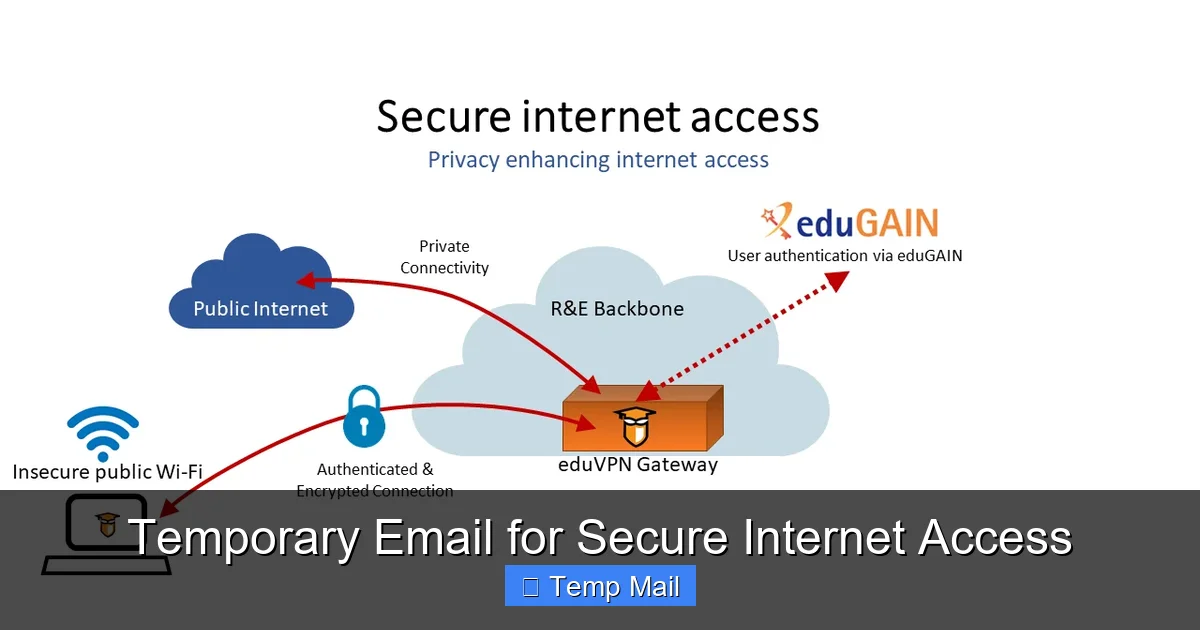
Visual guide about Best Temp Mail Options for 2026
Image source: temp-mail.io
Every time you use your real email, you create a data point. Companies build detailed profiles by linking your email to your browsing history, purchases, and location. A temp email breaks this chain. It allows you to interact with a service anonymously, preventing that interaction from being added to your permanent digital dossier. For activists, researchers, or anyone concerned about surveillance, this is non-negotiable.
Phishing attacks are getting smarter, using personal details to craft believable lures. If your real email is exposed in a breach, you’re a target. Using a temp mail for low-trust sites means any “security alert” or “account issue” email sent to that address is automatically suspect because you know you never used that address for anything important. It creates a natural filter. Furthermore, many top 2026 services now integrate with virus scanners to flag malicious attachments before you even click.
Many websites, especially news outlets or streaming services with free tiers, limit content based on your IP or block certain countries. They often require an email for a “free trial” or to read an article. A temp mail service with servers in multiple global regions can help you access that content by providing an email address that doesn’t immediately flag you as being from a restricted location.
For developers, QA testers, or even power users trying out dozens of new apps, creating a new permanent email for each test is a management nightmare. Temp mail allows for rapid, isolated testing environments. You can sign up, test the core functionality, and abandon the account without leaving a trail of unused, password-forgotten accounts in your wake.
Not all disposable email services are created equal. We evaluated dozens based on speed, privacy policy transparency, domain options, inbox longevity, mobile experience, and unique features. Here are the standouts for 2026.
Visual guide about Best Temp Mail Options for 2026
Image source: temp-mail.io
Temp-Mail.org consistently tops our list for its perfect balance of simplicity and power. It remains the go-to for most users in 2026.
As its name implies, this service is built for pure, unadulterated speed. The inbox is ready the moment you land on the page.
One of the oldest names in the game, Guerrilla Mail has evolved while keeping its quirky, anti-establishment charm. It offers more control than most.
MailDrop strips away every conceivable feature to provide nothing but a clean, public inbox for a given username. No frills, no fuss.
Mohmal stands out for its unwavering commitment to privacy and its Middle Eastern domain, which can be useful for bypassing certain geo-blocks.
Using a temp mail service that itself is a data-hungry platform defeats the purpose. Here are the non-negotiable security pillars for 2026.
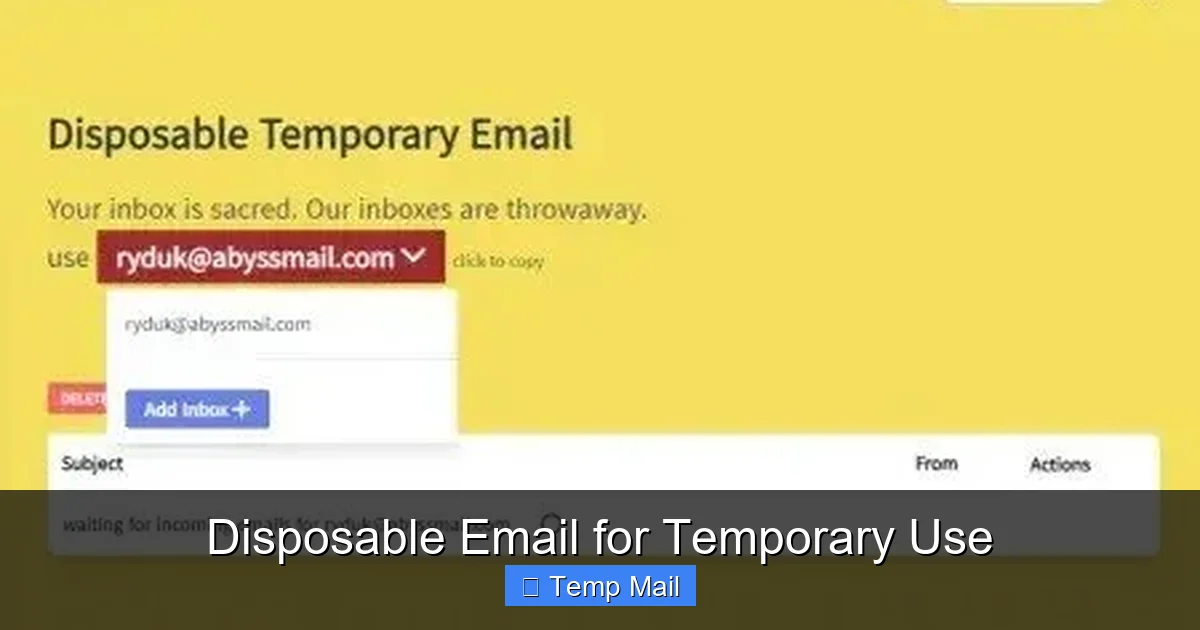
Visual guide about Best Temp Mail Options for 2026
Image source: temp-mail.io
This should be table stakes. Any service not using HTTPS (the padlock in your browser) is actively dangerous. Your connection to the temp mail site must be encrypted from start to finish to prevent eavesdropping on your inbox contents or the address generation process.
Read it. The policy must explicitly state that emails are deleted from servers after the inbox expires. It should state they do not log, sell, or analyze your email content or access patterns. Look for phrases like “we do not store emails after deletion” and “no personal data is required.” Vague policies are red flags.
The entire point is anonymity. If a service asks for your phone number, a password, or any personal detail to “create an account” for a temp inbox, walk away. The inbox URL or a randomly generated password shown once is the only credential you should ever need.
It’s not enough to just hide the inbox. The service must overwrite the storage space where your emails resided to prevent forensic recovery. While you must trust their implementation, reputable services will mention secure deletion practices in their technical documentation or privacy FAQs.
Many free services bombard you with aggressive, misleading ads that can themselves be malware vectors. The best 2026 services either have a clean, minimal ad experience (contextual, non-tracking) or offer a low-cost premium tier to remove ads entirely. Your privacy shouldn’t be the price you pay for a free temp mail.
Knowing which service to use is only half the battle. Using it correctly is key.
1. Choose Your Service: Refer to our list above based on your need (speed, control, privacy).
2. Generate an Address: Click the button. Copy the provided email address.
3. Use It: Paste it into the website or app you’re signing up for.
4. Access Inbox: Keep the inbox tab open or bookmark the inbox URL. Refresh periodically to check for the verification email.
5. Complete Your Task: Click the link or copy the code from the temp email.
6. Leave & Forget: Close the tab. Let the timer expire. Do not use this address for anything important.
Using a temp mail is perfectly legal for protecting your privacy. However, it is almost always a violation of a website’s Terms of Service. Platforms like Facebook, Google, or LinkedIn require a “real, verifiable” email address to maintain account integrity and combat fraud. Using a temp mail to create an account on these sites will likely result in immediate suspension. The ethical use case is for sites that offer a content gate or trial with no expectation of a long-term relationship. When in doubt, read the ToS. Use your judgment.
The temp mail landscape is not static. Here’s what we expect to see solidify in 2026 and the coming years.
Leading services are integrating lightweight AI models directly into their mail parsing systems. Before you even see the email, the system scans for known phishing URLs, suspicious attachment types (.exe, .js), and scam language patterns. It can then flag, quarantine, or even delete such emails automatically, adding a crucial layer of protection beyond just anonymity.
A few avant-garde services are experimenting with private blockchain networks to create a verifiable, immutable log of an inbox’s creation and deletion time. This allows a user to cryptographically prove that an email address was indeed temporary and that its contents were purged at a specific time, which could be useful for legal or compliance scenarios where you need to prove you didn’t retain data.
We anticipate native browser extensions (for Chrome, Firefox, Safari) that allow you to generate a temp email address with one click from any web form. Even more integrated will be OS-level features, perhaps in future versions of Android or iOS, that offer a “Generate Disposable Email” option directly within the share sheet or contact field, managed by a trusted system provider or a partnership with a top-tier temp mail service.
The trend is moving away from ad-supported free tiers towards subscription-based “Privacy Suites.” For a small monthly fee ($2-$5), you get an ad-free experience, access to a larger pool of premium domains (like @yourname.privy.com), extended inbox lifetimes (up to 1 week), and priority support. This model aligns incentives: the service makes money from you, not from your data or attention.
The internet of 2026 is a double-edged sword: unparalleled access to information and services, coupled with unprecedented surveillance and data harvesting. Reclaiming control starts with the smallest steps, and managing your email footprint is one of the most impactful. A reliable temporary email service is not a tool for deception; it’s a tool for deliberate privacy. It’s the digital equivalent of wearing a hat and sunglasses in a crowd—you’re not hiding, you’re simply choosing when and where to be recognized.
Based on our extensive testing, Temp-Mail.org stands as the best overall temp mail option for 2026 for its unbeatable combination of speed, domain variety, and user-friendly design. For pure speed on a single task, 10MinuteMail is unbeatable. If you demand the highest privacy guarantees, Mohmal is your fortress. Integrate one of these tools into your daily digital routine. Use it for the newsletter you’re curious about, the free toolkit you want to try, and the forum you’ll visit once. Let your permanent email be reserved for what truly matters: your family, your work, and your critical accounts. Protect it fiercely. In the battle for your digital identity, the disposable inbox is your first and most effective line of defense.
Best Temp Mail Options for 2026 is an important topic with many practical applications.
অনলাইন নিউজপেপার থিম। এই থিমটি দিয়ে আপনারা বাংলা এবং ইংরেজি নিউজপেপার সাইট তৈরি করতে পারবেন । বার্তা ও বাণিজ্যিক কার্যালয়: ৭১, মতিঝিল, ঢাকা-১০০০। সম্পাদক : মো আসাদুজ্জামান আমানউল্লাহ । মোবাইল : ০১৭০০-০০০০০০ । ইমেইল : [email protected] ।
All rights reserved © 2019 themesdealer.Com