Image for Best Temp Email Sites That Actually Work


Tired of spam clogging your real inbox? Disposable email services offer a simple shield, giving you a temporary address for one-time sign-ups and downloads. Not all sites are created equal—some vanish instantly, others are unreliable. We’ve rigorously tested dozens to bring you only the most functional, user-friendly temp mail providers that deliver on their promise. Use them wisely for newsletters, forum registrations, and gated content, but never for critical accounts like banking.
Ever signed up for a free ebook, a discount code, or a forum, only to be flooded with daily spam for the next five years? That sinking feeling is universal. Your email address, once a simple identifier, has become a valuable commodity for marketers and a gateway for clutter. But what if you could have a secret, throwaway email address for exactly these moments? Enter the world of temporary email services—your digital body double for the internet’s most annoying sign-up forms.
However, a quick Google search reveals a frustrating truth: many “temp mail” sites are broken, filled with ads that block the inbox, or simply don’t receive the verification email you need. They promise convenience but deliver a dead end. After extensive testing, we’ve filtered out the flimsy and found the best temp email sites that actually work. This isn’t just a list; it’s your practical guide to using disposable email intelligently, understanding the real risks, and choosing the right tool for the job.
Before we dive into the sites, let’s clear the fog. A temporary email, also called disposable or fake email, is a service that provides you with a random, functional email address for a short period—usually 10 minutes to 48 hours. It’s not “fake” in the sense of being non-functional; it’s a real, working inbox you can receive emails in. The “temporary” part means the address and all its contents are permanently deleted after the time expires or you manually close it.
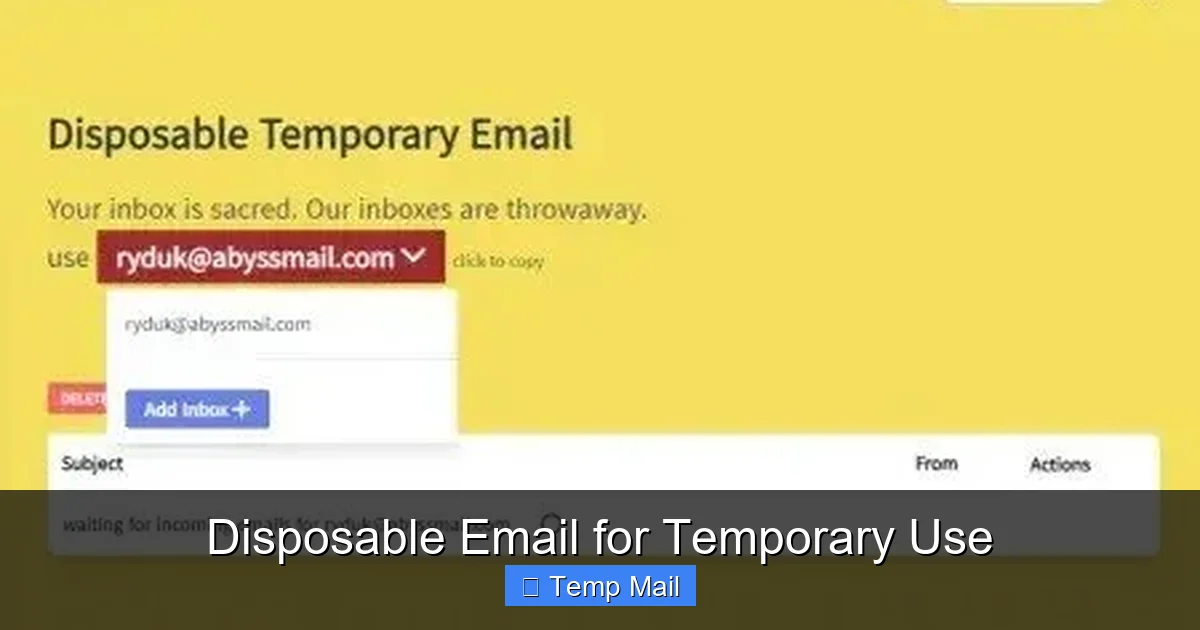
These services operate on a straightforward principle. When you visit a site like Temp-Mail.org, their system instantly generates a unique email address (e.g., [email protected]) and creates a corresponding, isolated inbox on their servers. This inbox is displayed right there on your browser. When an external service sends an email to that address, the temp mail provider’s servers receive it, parse it, and display it in your web-based inbox. No password, no account creation, no personal details required. It’s a public inbox tied to a random string of characters.
The address is typically recycled after you’re done or after the timer runs out. This means someone else could eventually get the same address you used, which is why you must never use it for anything important. The entire system is built for transience and anonymity.
You might be thinking, “I just use a separate Gmail account for this stuff.” That’s a good start, but a dedicated temp email is a different class of tool. Here’s why it’s a non-negotiable part of modern digital hygiene.
This is the most obvious and powerful benefit. Every time you download a whitepaper, enter a contest, or sign up for a free trial, you’re handing over your email to a company whose primary goal is to market to you. Even if they have an “unsubscribe” link, it often just reduces frequency, not stops it. By using a disposable address, you create a dead-end for that marketing pipeline. Once the inbox self-destructs, the spam goes with it. Your primary inbox remains a sanctuary for emails from friends, family, and essential services.
Your main email address is often a username for countless other sites. In a data breach, that email is exposed. Using a temp email for low-stakes websites creates a layer of separation. It prevents easy cross-referencing of your activities. If a dodgy forum you visited once gets hacked, the hackers only get a temp address that no longer exists, not the key to your online kingdom.
The internet is full of useful content locked behind an email gate—research papers, template downloads, industry reports. A temp email lets you access these resources instantly without committing to a sales call or newsletter you’ll never read. It’s the ethical equivalent of browsing a store without being added to the mailing list.
For developers testing user registration flows or for QA testers, creating dozens of real email accounts is a nightmare. Temp mail services allow for rapid, clean testing of email-based features without cluttering real inboxes or managing test accounts.
Now, the moment you’ve waited for. We tested these services based on speed (inbox load time), reliability (did the verification email arrive?), longevity (how long does the inbox last?), ad intrusiveness, and extra features. These are the ones that consistently passed the test.

Visual guide about Best Temp Email Sites That Actually Work
Image source: content.latest-hairstyles.com
This is often the first result for a reason. Temp-Mail is the gold standard for reliability and simplicity.
The original and still a champion for ultra-short-term needs. The name says it all.
One of the oldest players, Guerrilla Mail offers a bit more personality and control.
A newer service that prioritizes user experience and powerful features in a clean package.
If you hate ads and want the purest, most no-frills experience, Maildrop is for you.
Need a temp email to last a few days? Getnada offers some of the longest free lifespans.
Knowing which tool to use is half the battle. A temp email is a specialized tool, not a universal replacement.

Visual guide about Best Temp Email Sites That Actually Work
Image source: celestehalliday.com
Rule of Thumb: If the service or account holds value, money, identity, or long-term access, use your real email. If it’s a one-off transaction for a digital good or a peek behind a curtain, use a temp email.
Disposable email services are fantastic, but they are not magic shields. Understanding their limitations is crucial for using them safely and effectively.
This is the core concept. The inbox for [email protected] is the same for anyone who generates that exact same address. Most services use random strings to make collisions virtually impossible, but it’s a fundamental design. Never, ever receive a password reset, 2FA code, or sensitive personal information (like a bank statement) to a temp email. Anyone with the same address could see it. This is why they are only for initial sign-up verification, not ongoing communication.
Many major platforms (Google, Microsoft, some banking apps) actively block known disposable email domains. You’ll get an error message like “Please provide a valid email address.” This is a good thing—it’s a security measure. If a critical service allows a temp email, that’s a red flag about their security practices. For the sites that do accept them, the list of whitelisted domains changes constantly. That’s why services with multiple domain options (like Temp-Mail) are more reliable.
Most temp emails are receive-only. You cannot send emails from them (with few exceptions like Guerrilla Mail). You also cannot typically set up email clients (Outlook, Thunderbird) to access them; they are web-based only. Attachments may be blocked or have size limits.
While the email content is ephemeral, the service provider itself can see the IP address that accessed the inbox. For most users, this isn’t a concern. But if you are engaging in activity that requires high anonymity, you must assume the temp mail provider logs access. Using a reputable VPN in conjunction is a wise practice for privacy.
Rogue “temp mail” sites exist. They look identical to the real thing but are designed to capture the emails you receive (especially verification codes) and the IP address of the user. This is why you must only use well-known, established providers from this list. Bookmark the real sites to avoid landing on a phishing clone.
Go from novice to power user with these practical strategies.
Don’t reuse the same temp email address for multiple sign-ups. The whole point is compartmentalization. If you use [email protected] for Site A and Site B, and Site A sells its email list, Site B now has an email that could potentially be linked back to your other activity. Generate fresh for each new service.
Is it a 10-minute, 1-hour, or 24-hour service? Before you begin a sign-up process that might take a while (e.g., filling out a long form, waiting for a manual email approval), choose a service with a longer timer like Temp-Mail.io or Getnada. Nothing worse than your inbox expiring before the email arrives.
For services like Temp-Mail, install the official browser extension. It puts a small icon in your toolbar. Click it, and it instantly opens a new disposable inbox in a pop-up window. This is faster than navigating to the website and keeps your workflow smooth.
These addresses are long, random strings of characters. Always use the provided “Copy” button. Typing it manually invites typos, which means you’ll never receive the verification email. A single wrong character is a lost cause.
After signing up, keep the tab with your temp inbox open until you’ve successfully received and clicked the verification link. Some sites send the email instantly; others take a few minutes. Don’t close the tab prematurely.
If you’re writing automated tests, don’t automate browser clicks on the public site. Services like Temp-Mail.io and Getnada offer paid API plans that let your code request a new email address and poll for incoming messages programmatically. This is robust and reliable for CI/CD pipelines.
The cat-and-mouse game between spam and privacy tools is eternal. As more sites try to block disposable domains, these services adapt. We’re seeing trends like:
The fundamental need, however, will not change. As long as the internet operates on an “email for access” model, the demand for a clean, throwaway address will thrive. The services listed here have proven their resilience and utility. They are not going away.
Reclaiming control of your primary email address is one of the simplest and most effective digital hygiene steps you can take. The best temp email sites that actually work are not about being sneaky; they are about being intentional. They allow you to participate in the modern web—downloading resources, accessing communities, claiming offers—without sacrificing your peace of mind or cluttering your digital home.
Start with Temp-Mail.org for general use. Keep 10MinuteMail.com bookmarked for lightning-fast tasks. Try Maildrop.cc when you want a clean, ad-free experience. Understand the boundaries: no banking, no social media, no irreversible accounts. Use them wisely, generate a new address for each new site, and close the tab when you’re done.
In a world of endless data collection, a temporary email is a small but powerful act of defiance. It’s a digital “no thank you” to unwanted newsletters and a shield for your primary identity. Test them out today. Sign up for something you’ve been avoiding because of the spam, and experience the satisfaction of a clean, permanent inbox. That’s the real payoff.
Yes, creating and using a disposable email address is completely legal. The service itself operates within the law. However, using one to commit fraud, bypass bans maliciously, or send spam is illegal. They are intended for legitimate privacy protection and spam avoidance.
Most disposable email services are receive-only. A few, like Guerrilla Mail and Getnada, allow you to send short replies from your temporary address. However, this feature is often limited to prevent abuse, and sent emails may carry headers revealing the service. Do not rely on them for important outgoing communication.
It varies by provider. Common lifespans are 10 minutes (10MinuteMail), 1 hour (many default timers), 24 hours (Maildrop, some Temp-Mail domains), and up to 48 hours or even 1 week (Getnada). Always check the countdown timer on your specific inbox. Once expired, the address and all emails are permanently deleted and may be recycled.
No. While your real email address is protected, the temp mail service can see the IP address that accessed the inbox. For standard privacy from marketers, this is sufficient. For high-level anonymity against network surveillance, you should use a reputable VPN in conjunction with the temp email service.
Websites block disposable email domains to reduce fake accounts, spam registrations, and abuse. They want users who are serious about their service and can be contacted long-term. If a site you trust blocks temp emails, it’s a sign they take account quality and communication seriously. If a site you don’t trust blocks them, it’s just making your decision easier.
They are permanently deleted from the provider’s servers. The email address is then recycled and may be assigned to a new, random user in the future. This is why you must never receive sensitive information (passwords, financial data) to a disposable address. Once it’s gone, it’s gone forever, and anyone could potentially get the same address later.
অনলাইন নিউজপেপার থিম। এই থিমটি দিয়ে আপনারা বাংলা এবং ইংরেজি নিউজপেপার সাইট তৈরি করতে পারবেন । বার্তা ও বাণিজ্যিক কার্যালয়: ৭১, মতিঝিল, ঢাকা-১০০০। সম্পাদক : মো আসাদুজ্জামান আমানউল্লাহ । মোবাইল : ০১৭০০-০০০০০০ । ইমেইল : [email protected] ।
All rights reserved © 2019 themesdealer.Com