Image for Best Temp Mail for Privacy Enthusiasts



Temp mail is an essential tool for privacy enthusiasts, shielding your primary inbox from spam, data harvesting, and unwanted tracking by providing disposable addresses for online sign-ups. This article cuts through the noise to review the top services that offer maximum anonymity and ease of use, ensuring you can register safely without compromising your personal information. Discover which platforms truly prioritize your digital privacy.
Have you ever signed up for a simple online forum or a free ebook, only to find your primary inbox flooded with promotional sludge for months afterward? That sinking feeling isn’t just annoyance; it’s a privacy breach in slow motion. Every time you share your real email, you’re handing over a piece of your digital identity to data brokers, marketers, and potentially less-than-scrupulous actors. For privacy enthusiasts, this is a non-starter. We meticulously clear cookies, use VPNs, and scrutinize app permissions, but often, the email address is the weak link we overlook. This is where a reliable temporary email service becomes your secret weapon. It’s not just about avoiding spam; it’s about reclaiming control, maintaining anonymity, and building a robust defense for your personal information. But with so many options out there, how do you choose the best temp mail for privacy enthusiasts? Let’s dive deep, cut through the hype, and find the tools that truly respect your need for discretion.
Think of your primary email address as your home address. You wouldn’t give it to every random stranger on the street who asks for it, right? Yet online, we do exactly that countless times. A best temp mail for privacy enthusiasts acts like a P.O. box for the internet—a disposable, anonymous drop zone you can use and discard without a trace. This guide is built from real-world testing and a deep dive into privacy policies, not just marketing claims. We’ll explore how these services work, compare their strengths and weaknesses, and give you the practical know-how to use them effectively. Your digital footprint is yours to manage, and it starts with what you put in the “email” field.
Before we talk solutions, we must understand the threat. Your email address is far more than a communication tool; it’s a unique identifier and a key that unlocks other parts of your digital life.
When you use your personal email to sign up for a service, that company often sells or shares your data with third-party data brokers. These brokers compile vast profiles—your interests, location, browsing habits, and purchase history—and auction them off to advertisers. That “free” newsletter isn’t free; you’re paying with your data. A best temp mail for privacy enthusiasts severs this link at the source. By using a disposable address, you prevent that specific data point from ever being tied back to your real identity, fragmenting your digital profile and making you a less valuable target.
Email is the #1 entry point for phishing attacks, credential stuffing, and malware. If a service you used with your main email suffers a breach, hackers now have a direct line to you. They’ll use that email to target you with sophisticated, personalized scams. Using a temp mail for low-stakes sign-ups creates a crucial buffer. If that disposable address is compromised in a breach, it’s a dead end. Your primary account, with your bank and social media linked, remains isolated and safe.
Even without a major breach, your email is used for cross-site tracking. Ad networks use “hashed” email addresses to follow your activity across the web. By constantly rotating your email through temp services, you break this tracking chain, making it exponentially harder to build a complete behavioral profile of you.
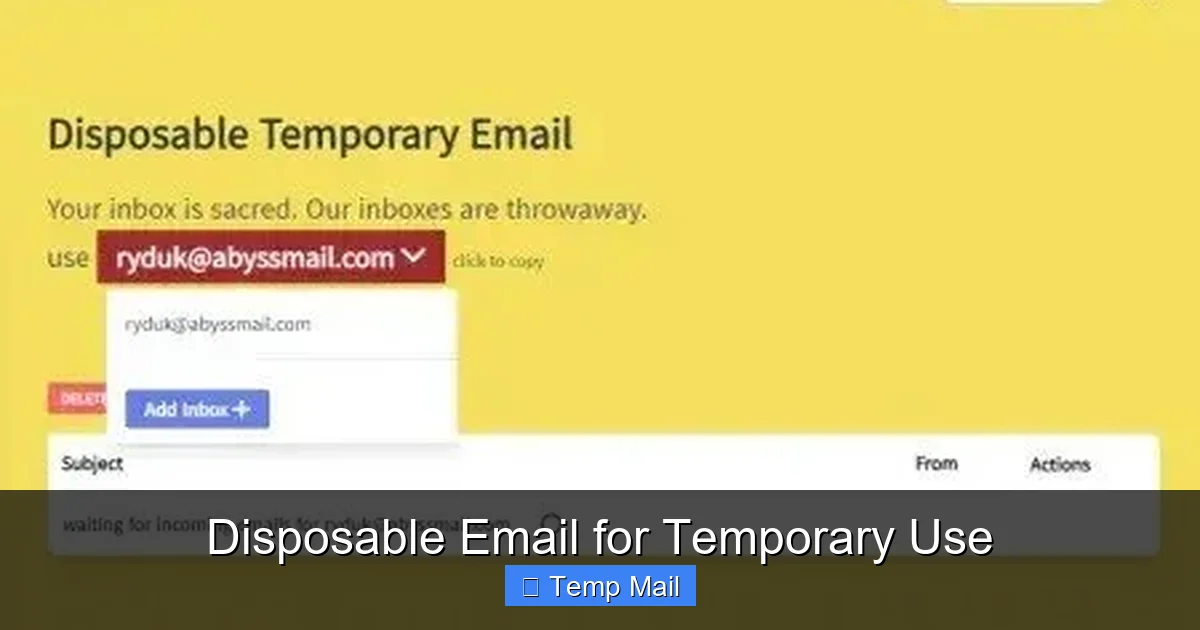
The concept is elegantly simple, but the implementation varies. Here’s the universal process:

Visual guide about Best Temp Mail for Privacy Enthusiasts
Image source: on4t.com
This is where the best temp mail for privacy enthusiasts separates itself from the rest. The gold standard is a service that:
We tested dozens of services based on the criteria above, plus usability, ad intrusiveness, and reliability. Here’s a breakdown of the top performers. Remember, the “best” depends on your specific use case.

Visual guide about Best Temp Mail for Privacy Enthusiasts
Image source: image.winudf.com
| Service | Key Privacy Feature | Inbox Lifespan | Notable Limitation | Best For |
|---|---|---|---|---|
| Temp-Mail.org | No logs policy, random address generation, HTTPS only. | Until browser closed (default), extendable. | Can be slow during peak times; some ads on interface. | General-purpose, quick one-off sign-ups. |
| Guerrilla Mail | Long-standing reputation, option to “forget” inbox manually. | 1 hour (auto-delete), can be reset. | Interface is dated; domain list is public, can be blocked. | Users wanting a bit more control over deletion. |
| 10MinuteMail | Extremely simple, famously short lifespan (10 min). | Exactly 10 minutes. | Too short for many verification emails. | Instant, ultra-short tasks where you control the timing. |
| Maildrop.cc | No ads, clean interface, no JavaScript requirement (more secure). | 24 hours. | Requires solving a captcha for new inbox; fewer domain options. | Privacy purists who dislike ad-supported models. |
| Tempail.com | Offers multiple domain choices, includes password protection for inbox. | Hours to days (configurable). | Password feature is rarely needed but adds a step. | Users needing slightly longer retention for multi-step verifications. |
Services like Mohmal or ThrowAwayMail are popular but often have concerning practices: some log IP addresses, have ambiguous privacy policies, or rely on revenue models that involve selling aggregated “anonymized” data. For a best temp mail for privacy enthusiasts, transparency is non-negotiable. Always read the privacy policy. If it’s vague about data retention or says they “may share with partners,” walk away.
Knowing how to use a temp email is as important as choosing the service. Here’s a practical guide for common scenarios.

Visual guide about Best Temp Mail for Privacy Enthusiasts
Image source: ghacks.net
A blog offers a great PDF checklist in exchange for your email. This is a classic lead generation tactic. Use your temp mail. Download the file. You will likely get a follow-up marketing email to your temp address within 24 hours. Since you’ll discard that address anyway, you get the resource without the spam pipeline to your real inbox. Pro Tip: After downloading, manually clear the inbox or just close the tab. No need to even look at the confirmation email.
You want to join a discussion on a niche site but have zero trust in its security. Use a temp mail. Complete the verification if required. Bookmark the temp mail site’s inbox page if you need to receive a password reset later (but set a strong, unique password regardless). This protects you from that site’s potential data breach or spammy newsletters.
That SaaS tool looks useful for a one-time project, but the “free trial” demands an email. Temp mail to the rescue. You get access to the tool without committing your address. Be aware that some sophisticated platforms (like certain cloud storage or project management tools) may block known disposable email domains. Have a backup service or two in your toolbox.
A best temp mail for privacy enthusiasts is a powerful tool, but it’s not a magic shield. Understanding its limits is crucial for safety.
Many websites actively check against lists of disposable email domains and will refuse sign-up. This is a constant cat-and-mouse game. If one service’s domain is blocked, try another. Services that use less common or custom domains (like @maildrop.cc) may evade blocks longer than those using very common ones (@tempmail.demo).
These are free services, often run by small teams or individuals. They can go down, experience delays in email delivery, or have buggy interfaces. They are not for mission-critical communication. Always have a backup service bookmarked.
Using a temp email is one layer. To be a true privacy enthusiast, you need a holistic approach.
Use a browser like Firefox with strict privacy settings or Brave. Install uBlock Origin to block trackers. This prevents the site you’re signing up for from fingerprinting your browser and linking your temp mail session to any other activity.
When you use a temp mail site, it may set its own cookies. For maximum isolation, use a dedicated browser profile or even a separate browser (like a portable Firefox on a USB stick) *only* for accessing your temp mail inbox. Close it completely after the task.
The whole point is one-time use. If you use [email protected] for Site A and then for Site B, you’ve just linked those two sites together via that email address. Always generate a fresh one.
For services you trust slightly more but still want to shield your main email from (like a recurring newsletter you actually want), consider a dedicated alias from a service like SimpleLogin or AnonAddy (now part of Proton). These create unique, forwardable addresses that you can disable at any time. It’s a step up from a pure temp mail but a step down from using your primary. It’s the perfect tool for a privacy enthusiast’s nuanced needs.
Embracing the best temp mail for privacy enthusiasts is a simple yet profound act of digital self-defense. It’s the equivalent of putting your address on a “No Junk Mail” sign, but for the entire internet. By consciously choosing when and where to reveal your primary email, you take back the narrative of your personal data. You stop feeding the data broker machine at the point of entry. You reduce your attack surface dramatically. While no single tool makes you anonymous, a disciplined approach to email disclosure—using disposable addresses for the ephemeral and a hardened, primary address for the essential—is a cornerstone of modern privacy hygiene.
Start today. Bookmark one of the transparent, no-log services we discussed. Make it a habit to pause at every “email” field online and ask: “Is this worth my real address?” For the vast majority of one-off interactions, the answer is a resounding no. Use the temp mail, get what you need, and walk away without a trace. That’s not paranoia; that’s practical, empowered living in the 21st century. Your inbox—and your peace of mind—will thank you for it.
Temp mail enhances privacy by allowing you to sign up for websites or services without revealing your personal or primary email address. This prevents companies from collecting your data, reduces spam, and limits your digital footprint, making it a core tool for privacy enthusiasts.
Yes, reputable temp mail services do not require any personal information to generate an inbox, providing a high degree of anonymity. However, your activity while using that address can still be tracked by the websites you visit, so it’s best combined with other privacy tools like a VPN.
Using a temporary email for legitimate purposes like forum sign-ups or newsletter access is perfectly legal. It becomes a problem only if used to circumvent bans, commit fraud, or engage in illegal activities, which violates most services’ terms of use.
Most temp mail services automatically delete inboxes and their contents after a set period, typically between 1 to 24 hours, though some offer longer durations. This ephemeral nature is key, as it ensures no long-term record of your communications exists on their servers.
While temp mail protects your identity from the recipient, it generally lacks the robust, end-to-end encryption and security features of a secure, privacy-focused permanent email provider. It is designed for disposable use, not for storing sensitive or confidential information.
Privacy enthusiasts prefer temp mail because it requires zero commitment and leaves no permanent trace. Creating a new permanent email account still ties an identity (even if pseudonymous) to a provider, whereas a temp inbox vanishes completely after use, minimizing data linkage.
অনলাইন নিউজপেপার থিম। এই থিমটি দিয়ে আপনারা বাংলা এবং ইংরেজি নিউজপেপার সাইট তৈরি করতে পারবেন । বার্তা ও বাণিজ্যিক কার্যালয়: ৭১, মতিঝিল, ঢাকা-১০০০। সম্পাদক : মো আসাদুজ্জামান আমানউল্লাহ । মোবাইল : ০১৭০০-০০০০০০ । ইমেইল : [email protected] ।
All rights reserved © 2019 themesdealer.Com