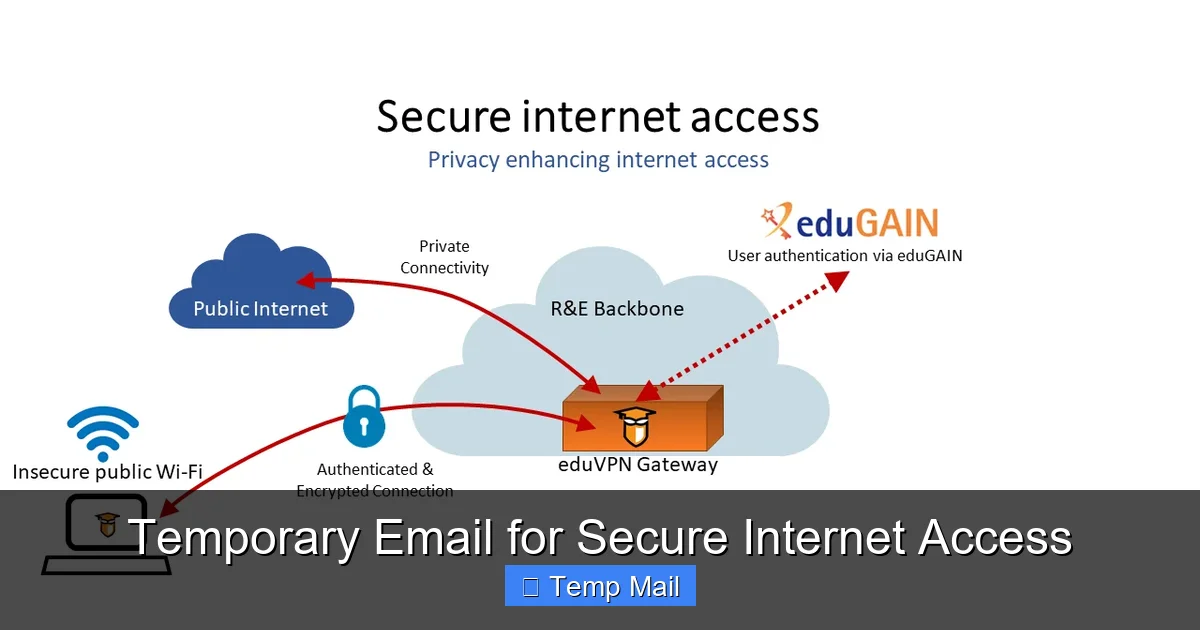
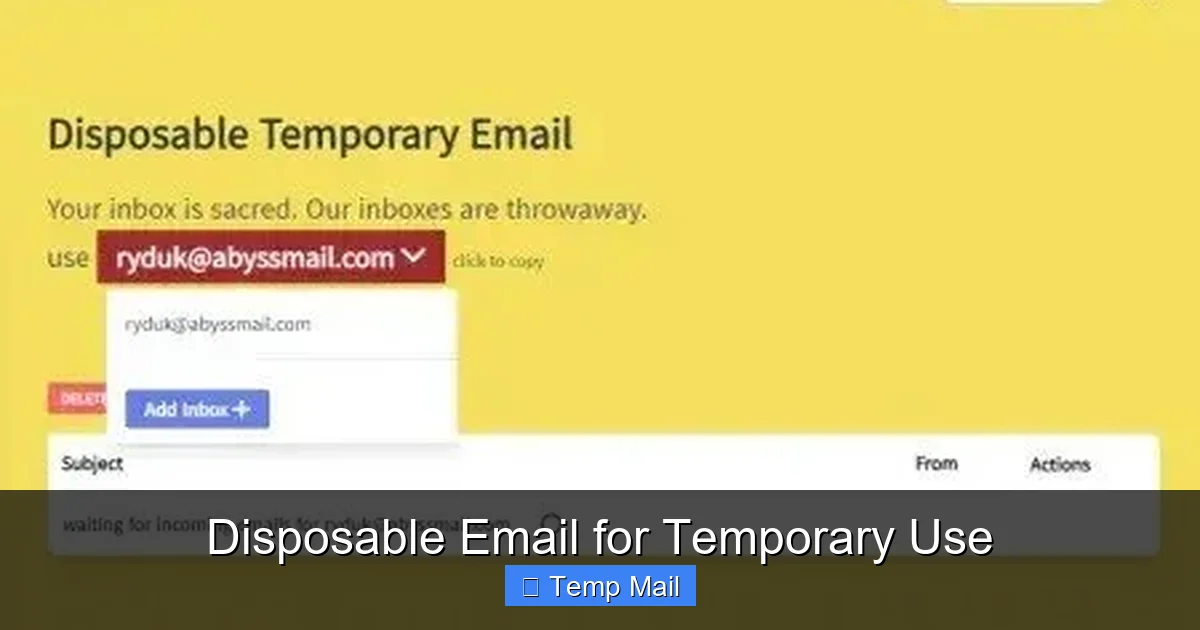
Image for Best Temp Mail Websites for Free Email



Temporary email services provide instant, disposable inboxes to protect your primary email from spam and data breaches. Our top picks like 10MinuteMail and Temp-Mail offer hassle-free setup, no registration, and automatic deletion. Always use temp mail for non-critical sign-ups and never for sensitive accounts like banking or password resets.
Ever signed up for a free webinar, downloaded a handy template, or joined an online forum, only to see your primary inbox flooded with promotional emails weeks later? That’s the digital price we often pay for convenience. But what if you could bypass that entirely? Enter the world of temporary email—a simple, powerful tool for safeguarding your online privacy. Think of it as using a burner phone for one-off digital interactions. In this guide, we’re diving deep into the best temp mail websites that offer free, disposable email addresses. We’ll break down exactly how they work, who they’re for, the hidden risks, and give you a clear, actionable list of services to use today. Whether you’re a casual browser, a developer testing an app, or just someone tired of spam, this is your definitive roadmap.
Let’s start with the basics. A temporary email service generates a random, working email address for you to use instantly. The key difference from your Gmail or Outlook account? It’s designed to be short-lived and anonymous.
You visit a temp mail website. A unique email address—something like [email protected]—is automatically created for you. You copy that address, paste it into the website or service you’re signing up for, and then switch back to the temp mail tab to check for a verification email or download link. That’s it. No creating a password, no verifying a phone number, no security questions. The inbox associated with that address is usually accessible to anyone who knows the address, and it auto-deletes after a set time (often 10 minutes to 1 hour) or when you close the browser tab. It’s email as a utility, not an identity.
Before we list the services, understand why this matters. Using a temp mail isn’t about being paranoid; it’s about being practical and proactive with your digital footprint.

Visual guide about Best Temp Mail Websites for Free Email
Image source: cdn-www.bluestacks.com
This is the biggest win. When you use your primary email for every free download or forum sign-up, you’re handing over a golden ticket to marketers. Your address gets sold on data broker lists, added to relentless newsletter chains, and becomes a target for phishing. A temp mail catches all that junk. After the one-time verification email is received, the address dies. The spam goes to a dead inbox. Your real email stays pristine.
Every time you enter your email on a website, you create a data point. That site could suffer a breach tomorrow, leaking your email, username, and possibly password if reused. With a temp mail, the breached data is useless—it’s an anonymous, disposable address with no link to your real identity or other accounts. It breaks the chain of association that data harvesters rely on.
Some websites force an email sign-up just to read an article or access a basic tool. It’s frustrating. A temp mail lets you courteously comply with their requirement without committing your information. You get the content or tool you wanted, and they get an email that vanishes. It’s a fair compromise.
Not all temp mail services are created equal. Some are faster, some offer more features, and some have better privacy policies. Here are our top tested picks, each excelling in a different area.
As the name suggests, 10MinuteMail gives you a functional inbox for 10 minutes, extendable in some cases. It’s one of the oldest and most straightforward services.
Temp-Mail (temp-mail.org) is a powerhouse. It offers a default 10-minute address but with a crucial feature: you can choose your own username and domain from several options (like @tempmail.com, @tmpmail.org).
Guerrilla Mail has been around forever and is famous for one key advantage: it can receive attachments. Many temp mail services strip attachments for security, but Guerrilla Mail handles them.
Mailinator is arguably the most famous, but also the most public. Any address you use at Mailinator (e.g., [email protected]) is publicly accessible by anyone who guesses or knows that address.
Tempail (tempail.com) is incredibly fast and offers a unique feature: your inbox can last up to 3 days if you bookmark the specific URL.
DropMail (dropmail.me) emphasizes privacy and control. It generates a random address but also gives you a unique, long URL to access your inbox. It supports forwarding to a real email if you need to preserve a message.
It’s tempting to think of temp mail as a magic privacy shield. It’s not. Understanding its limits is crucial for using it safely and effectively.
Remember: the inbox is not password-protected. Anyone who knows the exact email address can view the contents. While most services generate random, hard-to-guess addresses, the server itself is inherently open. Never, ever use a temp mail address for:
The moment you click a “reset password” link sent to a temp mail, you have permanently lost access to that account if you forget the password again.
Using a temp mail to sign up for a service that explicitly requires a “real, valid, and maintained” email address likely violates their Terms of Service. While you won’t get arrested, the service can ban your account without warning. It’s a gray area. Use it for low-stakes, one-time interactions, not for building a long-term profile on a platform.
To get the most value and avoid pitfalls, follow these simple rules.
Before you use a temp address for a sign-up, open a tab with your real email. Why? If the service you’re signing up for is critical and might send future notifications (like a paid service with a 7-day trial), you’ll want to change the email to your real one later. Do it immediately after sign-up, before the temp inbox expires.
Treat a temp mail address like a paper plate. Use it for a single meal (verification email), then toss it. Do not use the same temp address for multiple unrelated sites. If one site gets spammy or breached, you’ve only compromised that single-use address, not a pattern of your activity.
Verification emails can sometimes land in spam (even in a temp inbox) or take a minute to arrive. Keep the temp mail tab open and refresh it every 30 seconds for the first 2-3 minutes after you sign up somewhere. Don’t walk away and assume it will be there later.
For an extra layer of cleanliness, close the temp mail browser tab and clear your site data for that specific domain (in Chrome: Settings > Privacy & Security > Clear Browsing Data > “Cookies and other site data” for the specific site). This ensures no residual session data is left behind.
Temp mail is a specific tool. For other needs, consider these alternatives.
Services like SimpleLogin or AnonAddy create unique, forwardable aliases (e.g., [email protected]) that deliver to your real inbox. You can disable an alias anytime if it gets spammy. This is perfect for managing newsletters, online shopping, or professional sign-ups where you want organization and the ability to revoke access later, but still receive emails in your main inbox.
If you need to send emails privately and maintain a long-term, secure identity, use providers like ProtonMail or Tutanota. They offer end-to-end encryption, don’t scan your emails for ads, and are based in strong privacy jurisdictions. This is for activists, journalists, or anyone handling sensitive information.
Temporary email websites are an essential, free tool in the modern internet user’s privacy toolkit. They act as a first line of defense against the relentless tide of spam, data harvesting, and unwanted digital associations. The best temp mail websites—like 10MinuteMail for speed, Temp-Mail for customization, and Guerrilla Mail for attachments—make it absurdly easy to create a burner inbox in seconds. However, their power comes with a clear caveat: they are for receiving, not for securing. They are public, temporary, and unsuitable for any account where recovery or security is paramount. By understanding their strengths and, more importantly, their limitations, you can use temp mail confidently. Deploy it wisely for those one-time sign-ups, quick downloads, and anonymous form fills. Keep your primary email sacred, and let the disposable addresses take the spam bullet for you. In the battle for inbox sanity and online privacy, a temp mail is your perfect, low-effort secret weapon.
Yes, using a temporary email service is perfectly legal. However, using it to fraudulently sign up for services or to evade bans may violate a specific website’s Terms of Service, which could result in that account being suspended.
It varies by service. Most temporary inboxes last between 10 minutes and 1 hour by default. Some services, like Tempail, allow you to bookmark a URL to extend the life to 3 days. Always check the specific timer on the service you are using.
Most temp mail services are receive-only. A few, like Guerrilla Mail, allow you to send a limited number of emails from the temporary address. Do not rely on this feature for important communication, as the recipient may not be able to reply to the disposable address.
They are safe from a malware perspective, but not private. The inbox is accessible to anyone who knows the address. They are safe for avoiding spam on your main account, but unsafe for any sensitive information. Never use them for password resets, banking, or personal identification.
Common reasons include: the website you signed up for has blocked the temp mail domain (common with Mailinator), the email took longer than your inbox’s lifetime to arrive, or it was caught in the (minimal) spam filter. Try a different temp mail service like Temp-Mail or 10MinuteMail.
Yes, many websites maintain lists of known disposable email domains (like mailinator.com) and will block sign-ups from those addresses. This is why using less common services (like those listed above) or custom-domain options can sometimes bypass these blocks, though it’s not guaranteed.
অনলাইন নিউজপেপার থিম। এই থিমটি দিয়ে আপনারা বাংলা এবং ইংরেজি নিউজপেপার সাইট তৈরি করতে পারবেন । বার্তা ও বাণিজ্যিক কার্যালয়: ৭১, মতিঝিল, ঢাকা-১০০০। সম্পাদক : মো আসাদুজ্জামান আমানউল্লাহ । মোবাইল : ০১৭০০-০০০০০০ । ইমেইল : [email protected] ।
All rights reserved © 2019 themesdealer.Com