Image for Disposable Email for App Testing


Disposable email for app testing is a critical tool for modern developers and QA engineers. It provides a clean, anonymous inbox for every test run, eliminating clutter, protecting personal data, and automating verification flows. By using temporary email addresses, teams can simulate real user signups without compromising security or polluting primary inboxes. This practice is essential for efficient, scalable, and privacy-conscious application testing across email-dependent features.
Let’s talk about a quiet hero in the world of software development: the disposable email address. If you’ve ever tested an app that requires email signup, you know the pain. You use your real Gmail, then you’re bombarded with marketing newsletters for a feature you’ll never use. Or worse, your personal inbox gets cluttered with test notifications, password resets, and “Welcome!” emails from a thousand different test accounts. It’s messy, unprofessional, and a real headache to manage. This is where disposable email for app testing comes in to save the day.
Think of it like using a burner phone. For a specific, temporary purpose—like verifying a new account during a test run—you use a number you’ll discard. A disposable email is the digital equivalent. It’s a fully functional, real email address you can use to receive messages, but it’s designed to be thrown away. For developers, QA engineers, and product testers, this isn’t just a convenience; it’s a fundamental best practice for clean, secure, and scalable testing. In this guide, we’ll dive deep into exactly why and how you should be using temporary mail for your app testing workflows, covering everything from basic setup to advanced automation and risk mitigation.
Before we get into the “why,” let’s clarify the “what.” A disposable email service (also called temp mail, throwaway email, or fake email) is a platform that generates random, unique email addresses on demand. These addresses are tied to a temporary inbox you can access via a web interface or, in more advanced cases, an API.
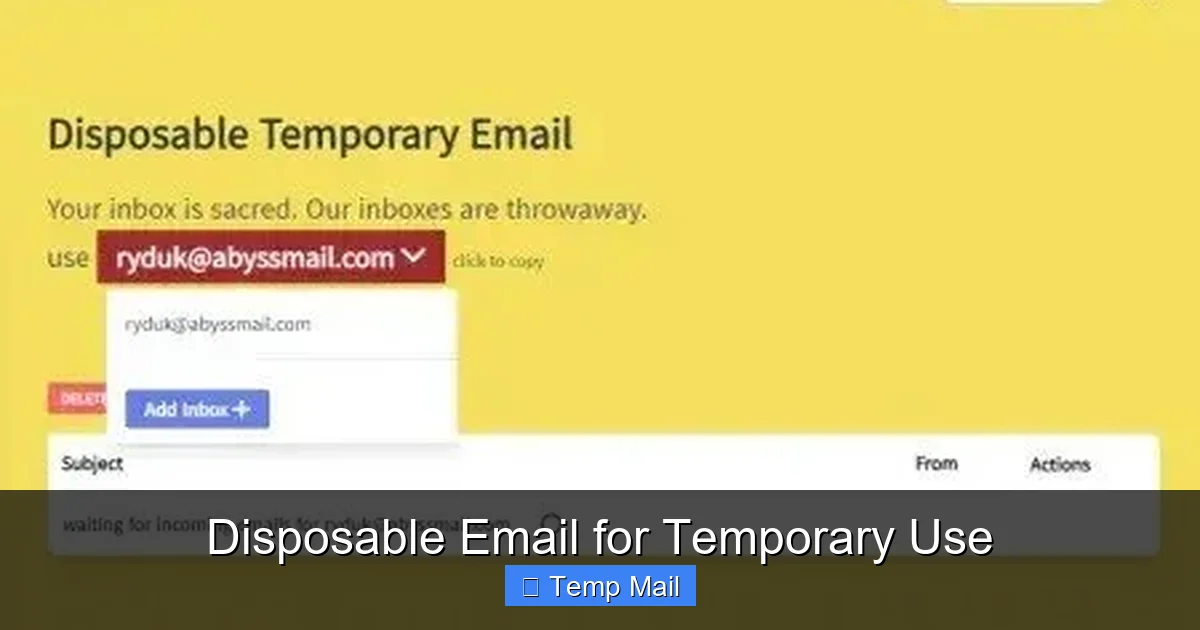
When you visit a service like Mailinator, Temp-Mail, or 10MinuteMail, the site instantly creates an inbox for you, often without requiring any registration. The email address might look something like [email protected]. You give this address to the app you’re testing. When the app sends a verification email or a notification, the disposable service receives it and displays it right in your browser window on their site. The magic is in the impermanence. These inboxes typically expire after a set period—10 minutes, 1 hour, 1 day—or when you close the browser tab. Once expired, the address and all its messages are permanently deleted from the server. There’s no password, no saved history, and no connection to your identity.
Not all disposable email services are built alike. For app testing, you need to look for specific features:
So, why go through the trouble of integrating a temp mail service? It’s not just about keeping your personal inbox clean (though that’s a huge perk). The benefits are strategic and technical.

Visual guide about Disposable Email for App Testing
Image source: ai-gen-images.compile7.com
When you use your personal email for testing, you introduce a massive variable: your real identity. The app you’re testing might link your test account to your real name, profile picture, or past activity. This corrupts the test environment. You’re no longer testing as a “new, anonymous user”; you’re testing as “John Doe, the QA guy from Accounting.” This can skew results for features like onboarding flows, recommendation engines, or permission systems. A disposable email guarantees a pristine, first-time user experience every single time.
Imagine you need to run a regression test that creates 50 new user accounts to check database performance or notification rules. Doing this manually with your own email is impossible. With a disposable email API, your test script can:
This entire cycle can run in seconds, 50 times in a row, with zero human intervention. It’s the backbone of Continuous Integration.
Using your work or personal email in a test environment—especially a staging server that might be less secure—is a security risk. If that test database is ever breached, your real email address is exposed. More insidiously, many third-party testing tools, analytics SDKs, or error logging services (like Sentry or Bugsnag) can automatically capture and log email addresses used within the app. You don’t want your personal email ending up in a third-party log file. Disposable emails create a clean, un-linkable barrier between your real identity and the test application.
Data privacy regulations like GDPR treat email addresses as Personally Identifiable Information (PII). When you use your real email in a test, you are introducing real PII into a system that may not have the same data handling policies, consent mechanisms, or right-to-deletion workflows as production. This can create a compliance gray area. Using a randomly generated, anonymous disposable address that is never linked to a real person sidesteps this issue entirely for non-production environments.
In a team setting, if everyone uses their own emails for shared testing, you get a tangled web. Who created the “[email protected]” account? Which inbox has the verification email for the latest build? With a disposable email strategy, each tester can generate their own unique address for each test session. There’s no sharing, no confusion, and no cleanup. The inboxes vanish when done.
Knowing the theory is one thing; doing it effectively is another. Here’s a practical guide to integrating temp mail into your process, from manual checks to full automation.

Visual guide about Disposable Email for App Testing
Image source: cdn.pseo.one
For a quick smoke test or exploratory session, you don’t need an API.
Pro Tip: Bookmark your favorite disposable service. Even better, use a browser extension that generates a temp address with one click. Some services offer browser plugins for this exact purpose.
For scripted tests (using Selenium, Cypress, Playwright, etc.), you need programmatic control. This is where services with a proper API come in.
Step-by-Step Automation Flow:
Sample Pseudocode (Python-like):
# 1. Get temp email
temp_email = api_client.create_inbox()  # Returns "[email protected]"

# 2. Use in app
driver.find_element(By.ID, "email").send_keys(temp_email)
driver.find_element(By.ID, "submit").click()

# 3. Wait for email
verification_code = None
for _ in range(30):  # Poll for 2.5 minutes
    messages = api_client.get_messages(temp_email)
    if messages:
        body = messages[0].body
        verification_code = extract_code(body)  # Your regex function
        break
    time.sleep(5)

# 4. Use code
driver.find_element(By.ID, "code").send_keys(verification_code)
driver.find_element(By.ID, "verify").click()
This is a critical decision. Here’s a comparison framework:
Using disposable email seems simple, but there are nuances that separate a smooth test from a flaky, time-wasting one.

Visual guide about Disposable Email for App Testing
Image source: cdn.pseo.one
Never use a disposable email to sign up for a production app with real users. That’s not just against Terms of Service; it pollutes the real user database. Use them strictly on staging, QA, UAT, or development environments. Configure your app’s email routing so that in non-prod environments, all outgoing emails are routed to your disposable service domain, not to real users. This is often done via environment variables or config files (e.g., setting `ACTION_MAILER_DEFAULT_URL` to a temp domain in Rails).
Even with random addresses, there’s a minuscule chance of collision on a public service. Your test should be resilient. If the signup fails with “email already registered,” your script should automatically generate a *new* disposable email and retry the flow once or twice. This prevents false negatives.
Email subjects can be changed by spam filters or email clients. Always parse the email body for the verification code or link. Look for patterns like 6-digit numbers, or phrases like “Verify your email,” “Confirm,” or “Activate.” Use robust regex.
App emails aren’t instant. There can be a 5-30 second delay. Your polling script must have a reasonable timeout (e.g., 2-3 minutes) and a sensible retry interval (e.g., every 5 seconds). Polling too fast can get you rate-limited by the disposable email API. Polling too slow wastes test time. Find the balance.
While the inbox self-destructs, the user account created in your app’s database might persist. For thorough testing, include a “delete user” API call or an admin cleanup script to remove test accounts after the suite finishes. This keeps your staging database size manageable and realistic.
Don’t reuse the same disposable email for 100 different test scenarios. One email should map to one user journey. This prevents state leakage. If Test A changes the user’s profile, it shouldn’t affect Test B, which expects a fresh account. Generate a new email at the start of each independent test method.
Disposable email is powerful, but it’s not a magic bullet. Be aware of these common pitfalls.
Free public services can be flaky. They might be down for maintenance, experience high latency, or have their MX records misconfigured, causing emails to bounce. Mitigation: Have a backup provider configured. In your automation framework, if your primary service fails to receive an email within the timeout, switch to a secondary service and generate a new address. For critical CI pipelines, use a paid, reliable service with an SLA.
Some email delivery services (like SendGrid, Mailgun) or corporate mail servers actively block known disposable email domains to prevent spam. Your app’s verification email might never arrive because it was rejected at the SMTP level. Mitigation: Test your email deliverability! Send a test email from your app’s mailer to a disposable address from your chosen provider. If it bounces, you need to either configure your mailer to use a different, less restricted domain (hard) or choose a disposable service that uses less-blacklisted domains (easier). Services with private, custom domains often have better deliverability.
You are trusting a third party with the content of your test emails. While they are test emails, they might contain sensitive mock data (e.g., “Your test order #12345 for $1,000,000 is confirmed”). A shady provider could log this. Mitigation: Read the provider’s privacy policy. Use reputable, well-known services. For highly sensitive projects, self-host with MailHog. Never use disposable email for receiving real password reset links to production accounts.
Some apps have logic that *detects* disposable email domains and blocks signup (a common anti-spam measure). If you’re testing such an app, using a disposable email will cause your test to fail, but not because of a bug in your code—because of your test data choice. Mitigation: Know your application’s constraints. If it blocks temp mail, you need a different strategy: use a dedicated test domain you own (e.g., [email protected]) and set up catch-all routing to a single inbox you control, or use a service that provides “real-looking” but temporary addresses on a custom domain you configure.
The practice is evolving beyond simple inbox generation. Here’s what’s coming:
We’ll see disposable email services offering official plugins and integrations for Jenkins, GitHub Actions, GitLab CI, and CircleCI. Imagine a GitHub Action step: `- uses: mailslurp/action@v1 with: api-key: ${{ secrets.MAIL_API }}` that automatically provides an email for the rest of the workflow. This will make the setup frictionless.
Instead of writing brittle regex to find a 6-digit code, AI models hosted by the email service could understand the email’s intent (“this is a verification email”) and return a structured JSON object: `{ “type”: “email_verification”, “code”: “849201”, “expires_in”: 600 }`. This would make test scripts vastly more resilient to changes in email template wording.
Modern apps communicate via multiple channels. The next generation of test inbox services will bundle disposable phone numbers for SMS verification and even disposable chat IDs for WhatsApp/Telegram testing, all under one API and dashboard. This creates a single source of truth for all user communication test vectors.
Think of it like a database sandbox. You’ll be able to request a “clean inbox” with specific pre-loaded emails to test complex scenarios (e.g., “simulate an inbox with 100 existing emails to test pagination and search”). Services will offer pre-canned templates for common app emails (welcome, password reset, invoice) that you can inject on demand.
Disposable email for app testing is more than a neat trick; it’s a cornerstone of professional, scalable, and secure QA practices. It solves the fundamental problem of how to repeatedly and cleanly test user-facing features that rely on email communication without creating digital landfill or security risks. By adopting a deliberate strategy—choosing the right tool for manual vs. automated work, following best practices for isolation and cleanup, and staying ahead of pitfalls like deliverability blocks—you turn a potential headache into a seamless part of your testing pipeline.
The next time you sit down to test a signup flow, pause before you type your real email. Ask yourself: “Is this the right tool for this job?” In almost every testing scenario, the answer is no. The right tool is a fresh, anonymous, disposable inbox. It’s the scratchpad for your app’s most critical user interactions. Use it wisely, automate it aggressively, and keep your real identity—and your real inbox—out of the test lab. Your future self, and your cleaner inbox, will thank you.
Yes, absolutely. Using temporary email addresses for testing your own applications or for authorized QA is a standard, ethical practice. It becomes problematic only if used to fraudulently create multiple accounts to abuse free trials, circumvent paywalls, or spam real users, which violates most services’ Terms of Service.
For non-production environments, they are generally secure. The key is choosing a reputable provider with a clear privacy policy. The emails are public by design on many services, so never use them for real password reset links to production accounts. For highly sensitive mock-data testing, consider self-hosting an open-source solution like MailHog for complete control.
>A disposable email is a completely separate, temporary inbox on a public domain (e.g., [email protected]). An alias or plus address (e.g., [email protected]) still routes to your primary, permanent Gmail inbox. Disposable emails offer true isolation and auto-deletion; plus addresses just filter within your existing, cluttered inbox.
Yes, and it’s highly recommended. You must use a service that provides an API. Your Selenium script can call the API to generate an email, use it in the app, then poll the API for the verification email to extract the code. This creates a fully unattended test flow. Free public sites without APIs won’t work for this.
First, check your app’s logs to see if the email was sent successfully. Then, check the disposable service’s status page for outages. Finally, verify that your app’s email service isn’t blocking the disposable domain (a common issue). The solution is often to switch to a different disposable provider or configure your app to use a less restrictive “from” domain for test environments.
Most free public APIs have rate limits, poor uptime, and public inbox collisions, making them unsuitable for reliable CI/CD. For continuous integration, invest in a paid tier from a service like MailSlurp or Mailosaur. Their free trials are sufficient for getting started, and their paid plans offer the reliability, private domains, and support needed for automated pipelines.
অনলাইন নিউজপেপার থিম। এই থিমটি দিয়ে আপনারা বাংলা এবং ইংরেজি নিউজপেপার সাইট তৈরি করতে পারবেন । বার্তা ও বাণিজ্যিক কার্যালয়: ৭১, মতিঝিল, ঢাকা-১০০০। সম্পাদক : মো আসাদুজ্জামান আমানউল্লাহ । মোবাইল : ০১৭০০-০০০০০০ । ইমেইল : [email protected] ।
All rights reserved © 2019 themesdealer.Com