Image for Disposable Email for Testing Email Forms



Testing email forms with your personal or work address is a recipe for inbox spam and privacy risks. Disposable email services provide temporary, anonymous inboxes specifically for this purpose. They allow developers and QA testers to verify form functionality, trigger automated responses, and inspect email content without polluting a primary mailbox or exposing real identity. This guide covers everything you need to know—from how these tools work to their limitations and best practices—for clean, secure, and efficient form testing.
Have you ever signed up for a webinar, downloaded a whitepaper, or tested a contact form on a website, only to find your personal inbox flooded with promotional newsletters weeks later? It’s a common frustration. For developers, QA testers, and digital marketers, this problem is magnified. Using a real email address to test form functionality isn’t just annoying—it’s risky. It clutters your primary inbox, links your identity to countless test databases, and exposes you to potential spam and data breaches. This is where the humble disposable email for testing email forms becomes an indispensable tool in your digital toolkit.
Think of it as a dedicated, burn-after-reading workspace for your email form validations. Instead of risking your main communication channel, you generate a temporary, anonymous inbox, use it once to submit a form, check the result, and then forget it. It’s a simple concept that solves a big problem. In this comprehensive guide, we’ll dive deep into the world of disposable email. We’ll explore exactly how these services work, why they are critical for efficient and secure testing, what their limitations are, and the best practices to make them work seamlessly for you. Whether you’re a solo developer testing a password reset flow or part of a large QA team validating a complex multi-step form, understanding this tool is key to maintaining sanity and security.
Before we champion the solution, it’s vital to understand the full scope of the problem. Using a legitimate, personal, or corporate email address for testing might seem like the easiest path, but it creates a cascade of issues that can waste time and compromise security.
The most obvious consequence is spam. When you use your real email to test a signup form, that address is often added to a mailing list. Even if the website has a “no marketing” checkbox, data entry errors or poorly configured systems can still result in emails landing in your inbox. For a tester running dozens or hundreds of form submissions across different projects, this quickly turns a primary inbox into a wasteland of promotional offers and newsletters. The time spent manually unsubscribing or filtering these messages adds up, directly impacting productivity.
Every form submission is a data point. When you use your real email, you are permanently linking your identity to a test record in a developer’s database, a CRM system, or a marketing automation platform. These test databases are often less secure than production environments. They might be stored in plain text, accessed by multiple junior developers, or even inadvertently exposed in a public code repository. Your email address becomes a piece of PII (Personally Identifiable Information) floating in a test ecosystem, creating a privacy vulnerability. In an era of stringent data regulations like GDPR and CCPA, this is a risk no organization should take lightly.
Test environments are frequently targeted by attackers because they are perceived as low-hanging fruit. If a test database containing real user emails (even if they are from testers) is breached, it provides a ready-made list of valid email addresses. Attackers can use this list for phishing campaigns, credential stuffing attacks (trying common passwords), or simply to sell the list to spammers. By using a disposable email, you break this chain. The compromised test record contains a meaningless, temporary address that expires, rendering that particular data point useless to an attacker.
Now that we’ve established the “why,” let’s define the “what.” A disposable email address is a temporary, anonymous email inbox that is generated on-demand from a public service. It requires no registration, no password, and is designed to be used once or a few times before being automatically discarded.

Visual guide about Disposable Email for Testing Email Forms
Image source: commercialforms.com
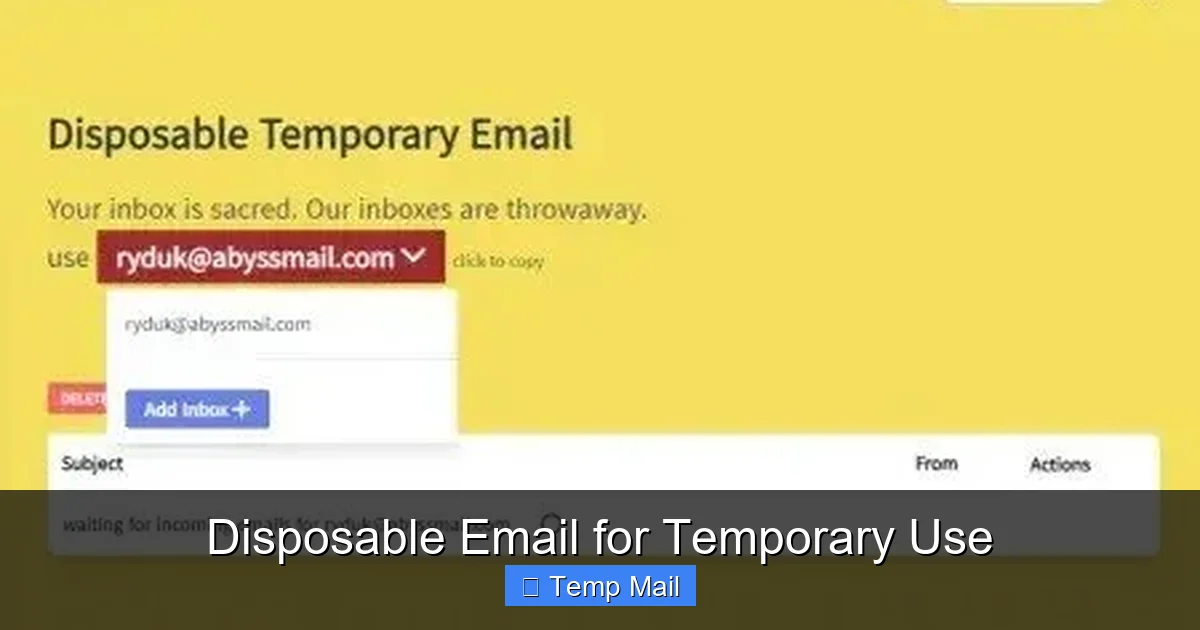
At its heart, a disposable email is an alias. You don’t create a full email account with a username and password. Instead, you visit a website like mailinator.com, guerrillamail.com, or 10minutemail.com. The service instantly generates a random inbox address for you, such as [email protected]. You copy this address, paste it into the form you’re testing, submit, and then return to the same service’s website to view the received email. The inbox is publicly accessible to anyone who knows the address—there is no authentication barrier. After a set period (often 10 minutes to 24 hours) or after a certain number of messages, the inbox and all its contents are permanently deleted by the service.
It’s important not to confuse disposable email with other email services. A regular email service (Gmail, Outlook) is persistent, secure (password-protected), and tied to your identity. A email forwarding service (like SimpleLogin or AnonAddy) creates a unique alias that forwards to your main inbox. You maintain control and the emails are stored in your primary account. A disposable email service is neither persistent nor private. The inbox is public, temporary, and the emails never reach a personal account. Its sole purpose is transient receipt and inspection.
You’ll see these terms used interchangeably. “Temp mail” is a direct shortening of “temporary mail.” “Burner email” borrows from the slang for a prepaid, disposable phone. “Throwaway email” emphasizes the intended single-use nature. All refer to the same core concept: a no-frills, ephemeral inbox for receiving emails without commitment.
The magic of these services is their utter simplicity. There’s no setup. Let’s walk through a typical testing workflow using a disposable email.

Visual guide about Disposable Email for Testing Email Forms
Image source: commercialforms.com
You navigate to a disposable email provider’s homepage. Immediately, a random inbox address is displayed. For example, on Mailinator, you might see [email protected]. You can often customize the local part (the part before @) if you want something memorable for a specific test, but the random string is usually fine.
You go to the website or application you are testing. You fill out the form—name, password, any other fields—and paste the disposable address into the email field. You submit the form. The application processes the submission as it would any real email, often sending a confirmation email, a password reset link, or a notification.
You switch back to the disposable email service’s tab or window. Within seconds (or minutes, depending on the sending server), the email appears in the public inbox list. You click on it to view the contents. Here, you can verify:
You can inspect headers, view attachments (if supported), and test any interactive elements. This entire process takes seconds and leaves no trace on your personal devices.
Once your verification is complete, you simply close the tab. You do not need to delete the email. The service’s backend will automatically purge the inbox after its designated lifespan (e.g., 24 hours for Mailinator’s free tier, 10 minutes for 10 Minute Mail). The address is then recycled and potentially reassigned to another user in the future. This automatic cleanup is a core feature, ensuring no residual data is stored.
Why go through this extra step? The benefits are compelling and directly address the pain points of real-email testing.

Visual guide about Disposable Email for Testing Email Forms
Image source: mailboxvalidator.hexa-soft.com
This is the most tangible benefit. Your primary inbox remains pristine. No more sorting through “Welcome to our newsletter!” emails from every form you tested last week. Your important work and personal communications stay separate from the digital debris of testing. This dramatically reduces inbox management overhead and the risk of missing a critical email amidst the spam.
By using a disposable address, you decouple your real identity from test data. Your personal email address is not stored in any test database, CRM, or analytics platform. This protects you from being targeted by spam campaigns that harvest email addresses from poorly secured databases. It also protects your organization from the liability of having employee emails scattered across uncontrolled test environments. In the event of a test data breach, the exposed emails are useless, temporary addresses.
For QA professionals, speed is everything. Disposable emails eliminate the friction of creating and managing a dedicated test email account (with password recovery, 2FA, etc.). You can generate a new address for every single test case, ensuring complete isolation between tests. This is invaluable for:
This agility allows for more thorough and repetitive testing without logistical overhead.
Most disposable email services are completely free for basic use. There’s no subscription fee, no setup cost. This makes them accessible to individual developers, freelancers, and small teams. For larger enterprises, even paid tiers with advanced features (like API access, custom domains, longer retention) are typically far cheaper than managing a fleet of dedicated test email accounts or dealing with the productivity loss from spam.
Disposable email is a powerful tool, but it’s not a magic bullet. Being aware of its limitations is crucial for effective testing.
To combat spam and fraud, many legitimate websites actively maintain and block lists of known disposable email domains. If you try to register or submit a form with an address from mailinator.com, you might get an immediate error: “Please use a valid email address.” This is a significant limitation. You cannot use a disposable email to test the user journey on sites that implement this block. Your testing must then fall back to a real, controlled email account. Always check if the target application has such a block before planning your test.
The temporary nature is a double-edged sword. If you are testing a workflow that involves delayed emails—like a “reminder email sent 24 hours after signup” or a “weekly digest”—the disposable inbox will likely have expired by the time the email is sent. You would miss the email entirely. These scenarios require a persistent, controlled test inbox that you manage yourself.
This should be obvious, but bears repeating: never use a disposable email for any communication that is legally binding, contains sensitive personal information (SSN, credit card numbers), or is critical for account recovery. Since the inbox is public and temporary, you have no recourse if you lose access. It is strictly for anonymous, non-sensitive, transient testing.
Not all disposable email services are created equal. Some free providers may have:
Testing your test tool is important. You need to know that the email you *think* you received is actually what the system sent.
To maximize the utility of disposable emails and avoid pitfalls, follow these best practices.
For basic form testing, established providers like Mailinator (public inboxes, 24-hour retention), Guerrilla Mail (more features, attachments), or Temp-Mail are reliable. For automated testing (CI/CD pipelines), look for services that offer a clean API, such as MailSlurp or Dispatch. These allow your test scripts to programmatically create inboxes, fetch emails, and extract data without manual browser interaction, which is essential for scalable automation.
Resist the urge to reuse the same disposable address for multiple test scenarios. If you test a login form, a newsletter signup, and a password reset with the same address, you create a tangled web of test data that can confuse your analysis. Generate a fresh address for each independent test case to maintain clarity and isolation.
In a manual test session, it’s easy to lose track of which disposable address you used for which test case. Keep a simple text file or note open. For each test step, jot down: [Test Case ID] - Used: [email protected] - Expected: Confirmation email with link. This prevents you from wasting time guessing which inbox to check.
Even though the inboxes are public, the service provider still has a privacy policy. Read it. Understand what they do with the data that passes through their servers. Some may log IP addresses or use the content for their own analytics. For most low-risk testing, this is negligible, but for sensitive internal applications, you should choose a provider with a clear, minimal-data policy.
Reiterating the earlier warning: a disposable inbox is a public bathroom, not a safe deposit box. Do not use it to receive emails containing passwords (even temporary ones), financial information, health data, or any PII. If your form sends such data via email (which it shouldn’t!), you must use a secure, private, persistent test inbox that you control.
The right tool depends on your workflow: manual browser testing vs. automated script execution.
For most manual testers, Mailinator or Guerrilla Mail will suffice. For any team practicing continuous integration or running regression suites, investing in an API-first tool like MailSlurp is a game-changer.
Disposable email for testing email forms is more than a convenience; it’s a fundamental practice for modern, responsible software development and quality assurance. It directly combats the twin threats of inbox pollution and privacy erosion that come from using real email addresses in test environments. By providing a sterile, temporary, and anonymous channel for email validation, these tools empower testers to work faster, cleaner, and more securely.
Remember the core philosophy: treat the disposable inbox as a public, temporary space. Use it to verify deliverability, check rendering, and confirm functionality, but never for sensitive data or long-term workflows. Choose your provider based on your specific needs—simplicity for manual checks, API power for automation. And always be mindful that some target systems will block these domains, so have a fallback plan.
Incorporating disposable email into your testing regimen is a small change that yields significant returns. It protects your personal and professional digital identity, keeps your primary communications untarnished, and allows you to focus on what matters: building and verifying great software. So the next time you need to test that “send confirmation email” button, reach for a disposable address. Your future, spam-free inbox will thank you.
Yes, using disposable email services is perfectly legal. They are legitimate tools designed for privacy and temporary communication. The legality concerns arise only if they are used for fraudulent activities, hacking, or to circumvent bans on platforms where they are prohibited.
It varies by provider. Some, like 10 Minute Mail, last exactly 10 minutes. Others, like Mailinator’s free tier, retain inboxes for about 24 hours. Paid API services often allow you to set a custom retention period, from minutes to days. Always check the specific service’s policy.
Yes, very easily. Most websites maintain or subscribe to public lists of disposable email domains (like those from disposable.debounce.io). When you enter an address, their backend checks the domain against this list. If it matches, they will typically block the submission with an error message. This is why you sometimes can’t use them on certain sites.
A disposable email is a temporary, public inbox with no login. Emails are received and stored briefly on the provider’s server for you to view. An email alias/forwarding service (e.g., SimpleLogin) creates a unique address that automatically forwards all incoming mail to your *permanent, private* inbox. You maintain full control and security through your main account.
Almost certainly not. Major platforms like Facebook, Twitter, Google, and all banking/financial apps actively block disposable email domains. They require a verifiable, persistent email address for account security, password recovery, and legal compliance. Attempting to use one will result in a registration error.
Exercise caution. While the inbox is temporary, the links and attachments themselves can be malicious. The disposable nature does not sanitize the content. If you are testing an email *you sent yourself* from a trusted system, the risk is low. If you are using a public disposable inbox to receive emails from unknown sources (which you generally shouldn’t), treat all links and downloads with the same suspicion you would in any public forum.
অনলাইন নিউজপেপার থিম। এই থিমটি দিয়ে আপনারা বাংলা এবং ইংরেজি নিউজপেপার সাইট তৈরি করতে পারবেন । বার্তা ও বাণিজ্যিক কার্যালয়: ৭১, মতিঝিল, ঢাকা-১০০০। সম্পাদক : মো আসাদুজ্জামান আমানউল্লাহ । মোবাইল : ০১৭০০-০০০০০০ । ইমেইল : [email protected] ।
All rights reserved © 2019 themesdealer.Com