Image for Disposable Email to Avoid Unwanted Emails



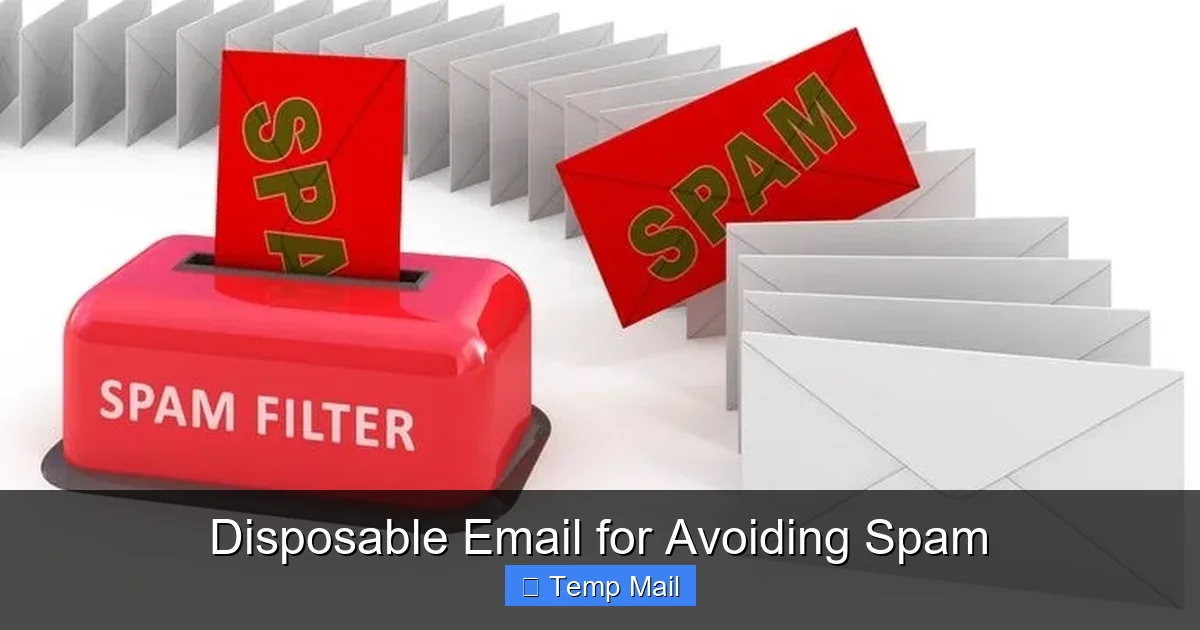
Tired of your main inbox being flooded with spam? Disposable email addresses are temporary, throwaway inboxes you can use for sign-ups, downloads, and any online activity where you don’t want to share your real email. They act as a protective shield, capturing unwanted promotional emails and potential scams so your primary email stays clean and secure. By using a temp mail service for one-time tasks, you take back control of your digital privacy and drastically reduce inbox clutter.
Open your email app right now. What do you see? A beautiful, organized inbox? Or a chaotic mix of newsletters you never signed up for, promotional blasts from a store you shopped at once five years ago, and the occasional “suspicious login attempt” alert that makes your heart skip? For most of us, it’s the latter. Our primary email address has become a digital home address we guard fiercely, yet we’re constantly forced to hand it out for the smallest online interaction. This constant exchange is the root of the problem. Every form filled, every resource downloaded, every account created is a potential gateway for spam. But what if you had a secret weapon? A way to participate in the digital world without sacrificing your main inbox to the spam gods? Enter the disposable email.
A disposable email (also called temp mail or throwaway email) is a temporary, anonymous email address that exists for a very short time—usually just long enough to complete a specific task. It’s like using a public library computer for a quick search instead of logging into your personal laptop. You get the job done, and then you walk away, leaving no trace behind. This simple concept is revolutionizing how people manage their online privacy and inbox hygiene. In this guide, we’ll dive deep into exactly how disposable email services work, why they are essential for modern digital life, the best ways to use them, and their important limitations. By the end, you’ll be equipped with the knowledge to use disposable email intelligently and reclaim your primary inbox.
At its heart, a disposable email service provides you with a random email address (like [email protected]) that is not tied to your identity. You don’t create an account; you simply visit a website, and an inbox is generated for you on the spot. This inbox has a unique address and a countdown timer. You use that address anywhere you need an email but don’t want to use your real one. Any emails sent to that address appear in the temporary web-based inbox. Once the timer expires—often after 10 minutes, 1 hour, or 1 day—the entire inbox and its address are permanently deleted from the server, never to be seen again.

Visual guide about Disposable Email to Avoid Unwanted Emails
Image source: clean.email
Your Gmail, Outlook, or Yahoo account is a permanent digital identity. It’s linked to your name, your contacts, your calendar, and often your other online accounts. It requires a password and two-factor authentication to protect. A disposable email is the polar opposite: it’s anonymous, requires no login or password (you access it via the unique URL given), and is designed for single-use, ephemeral communication. It has no contacts list, no storage for attachments long-term, and no connection to your real identity. It’s a tool for a specific job, not a communication hub.
Using a disposable email is famously simple, which is a huge part of its appeal. Let’s walk through a typical scenario.

Visual guide about Disposable Email to Avoid Unwanted Emails
Image source: support.rediff.com
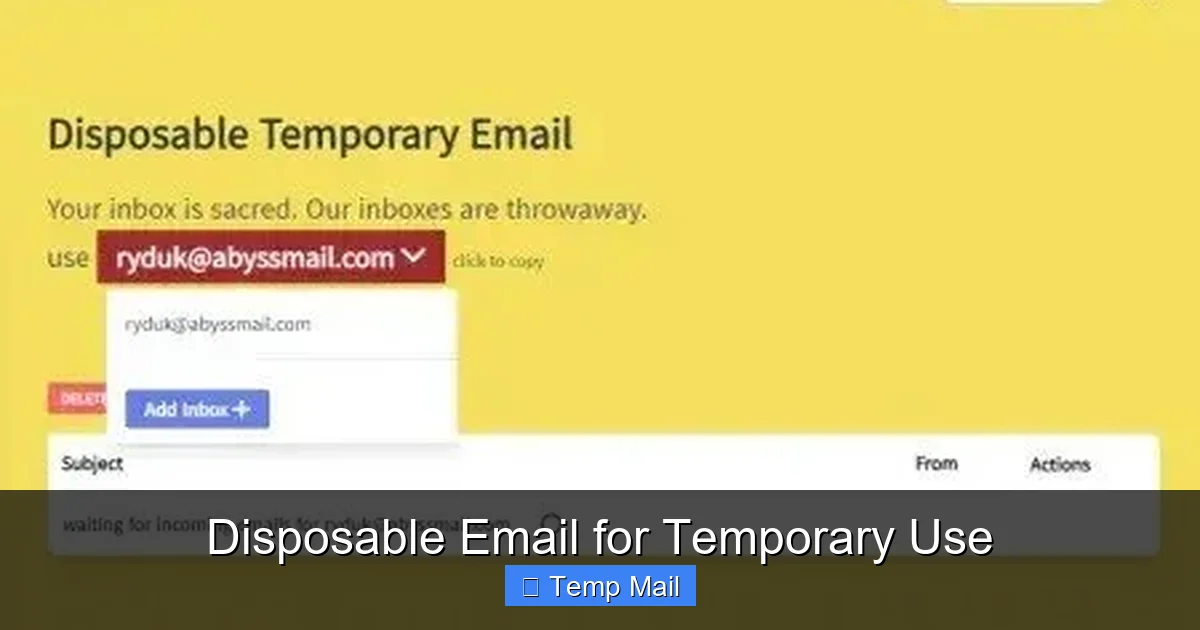
You navigate to a site like Temp-Mail, Guerrilla Mail, or 10MinuteMail. You are immediately presented with a randomly generated email address and a live, empty inbox. No sign-up forms, no “I agree to the terms” checkboxes. Just an address and an inbox.
You highlight and copy the provided email address ([email protected]). Then, you go to the website or app that is asking for your email—perhaps to download a whitepaper, sign up for a webinar, or create a trial account. You paste the disposable email address into the field and complete the registration or download process.
The service you signed up with will send a confirmation email or a download link to your temporary address. Back on the disposable email provider’s site, you’ll see that email appear in your inbox within seconds. You can open it, click the verification link, or copy the download code—all within the browser tab. The email might contain a link you need to click to activate your temporary account on the other service.
Once you’ve completed the task (clicked the link, downloaded the file), you can simply close the browser tab. The countdown timer on the service’s page continues ticking down. When it reaches zero, the entire system wipes that email address and its contents. If someone later tries to send an email to that same address, it will no longer exist. The digital trail ends.
These services run on automated systems. They maintain a large pool of domain names and generate random local-parts (the part before the @). Each active inbox is stored in a temporary database with a strict time-to-live (TTL) setting. There is no persistent user account; the “session” is tied to your browser window or the unique URL you were given. This architecture ensures minimal data storage and automatic cleanup, which is key to user privacy and the service’s efficiency.
Knowing *when* to use a disposable email is just as important as knowing how. Here are the prime scenarios where it’s not just helpful, but a smart privacy practice.

Visual guide about Disposable Email to Avoid Unwanted Emails
Image source: maketecheasier.com
You want that free ebook, industry report, or template. The website demands your email to send the download link. This is the #1 perfect use case. Use your disposable email. You’ll get the file, and any follow-up “nurture” emails from the company will go to the trash bin in an hour. Your primary inbox thanks you.
Signing up for a 30-day software trial, a new social media platform you’re just testing, or a forum account for a one-time question? Use the temp address. You get the access you need without committing your primary email to a company’s marketing list, which can be hard to unsubscribe from later.
You’re interested in a topic, and a blog offers a great newsletter. But you’re not sure if you’ll want it forever. Subscribe with a disposable email. If the content is valuable, you might later seek out the newsletter on your own terms. If it’s spammy, it self-destructs. No guilt, no clutter.
Developers and QA testers use disposable email services constantly to test email verification flows, password reset functions, and notification systems without flooding real employee inboxes or using test accounts that need manual cleanup.
When you use your real email on a low-security or unfamiliar website, that email-password combo can end up in a data breach dump on the dark web. If you used a disposable email for that site, the breached credential is useless because the email address no longer exists. It’s a fantastic way to contain the damage of a breach to a single, temporary identity.
For activities where you desire a higher degree of anonymity—like whistleblowing sites, certain forums, or anonymous feedback forms—a disposable email removes the direct link to your permanent identity.
Not all disposable email services are created equal. While they all share the core function, features and reliability vary. Here’s what to consider when picking one.
How long does the inbox last? The classic is 10 minutes, but many offer 1 hour, 1 day, or even a week. Choose based on your task. A quick download needs only 10 minutes; a multi-day trial account might need a 24-hour or 7-day address. Some services let you extend the time manually.
Some services offer multiple domain names (e.g., @tempmail.net, @tmpmail.org). This can be useful if a particular site blocks known disposable email domains. Having a few different domains in your toolkit increases your chances of success.
The best services are fast and clean. You don’t want to wait 30 seconds for emails to appear. Look for a service with a simple, ad-light interface that updates the inbox automatically (auto-refresh) so you don’t have to keep hitting F5.
Can the service receive emails with attachments? Most can, but there are often size limits (e.g., 10MB, 25MB). If you’re expecting a PDF or image, this is crucial. Test with a small file first if possible.
This is the hallmark of a true disposable email. You should never have to create an account, provide a phone number, or solve a CAPTCHA just to get an address. The moment a service asks for any of that, it’s defeating the purpose of anonymity and ease-of-use. Avoid those.
Well-known, reliable options include Temp-Mail, Guerrilla Mail, 10MinuteMail, and MailDrop. They all operate on the no-registration, auto-delete principle. Stick with these established names rather than obscure sites that might have malicious intent.
Using a disposable email is powerful, but it’s not a magic shield for everything. Understanding its limitations is vital to using it safely and effectively.
This is the cardinal rule. Never use a disposable email for any account you need to recover, access long-term, or that contains sensitive personal or financial information. This includes: your primary email recovery, online banking, investment accounts, government services (taxes, benefits), primary cloud storage (Google Drive, iCloud), and your main social media profiles. If you lose access to the temporary address, you lose access to the account forever. There is no password recovery.
Many websites and services actively maintain and update blocklists of known disposable email domains. If you try to sign up with an address from a blocked domain, the site will reject it with an error like “Please use a valid email address.” This is why having a service with multiple domain options can help, but eventually, popular disposable domains get flagged. For critical services (like a bank), this blocking is a good security feature; for a forum, it can be an annoyance.
Once the inbox expires, it’s gone. If you need to refer back to a confirmation email from six months ago, a disposable email is the wrong tool. There is no archive, no “All Mail” folder. The emails are transient by design.
Because they are anonymous, disposable email services are sometimes used for malicious purposes: creating spam accounts, posting abuse online, or bypassing bans. As a result, some email providers (like Gmail or Outlook) may flag all emails coming from a known disposable domain as spam or even reject them outright. This means a confirmation email you *need* might never arrive in your temporary inbox because the sending service’s servers rejected it. It’s a trade-off.
Some services that use disposable email addresses for sign-up may also send 2FA codes to that address. This is a major problem. If you need to log in from a new device and the 2FA code goes to an inbox that has expired, you are locked out. Always check if a service supports authenticator apps (Google Authenticator, Authy) as a 2FA method before using a temp mail for its sign-up.
To get the most benefit and avoid pitfalls, follow these practical tips.
As data privacy concerns grow and regulations like GDPR and CCPA give users more rights, tools like disposable email are becoming standard components of a savvy digital citizen’s toolkit. They represent a shift from the old model of “give us your email for everything” to a more granular, controlled approach to identity online. We’re also seeing evolution: some browser extensions now auto-generate and manage disposable email aliases that forward to your real inbox but can be disabled with one click (like SimpleLogin or AnonAddy). These “masked email” services bridge the gap, offering the privacy of a temp address with the convenience of a permanent inbox. The core principle remains the same: minimize the exposure of your primary email address. In a world of data brokers and relentless marketing, a disposable email isn’t just a convenience—it’s a fundamental act of digital self-defense.
Your primary email address is a valuable asset. It’s the key to resetting passwords, the hub for important notifications, and often a linchpin of your online identity. Yet, we carelessly scatter it across the web like confetti, inviting spam, scams, and data brokers to the party. Using a disposable email is the simplest, fastest, and most effective countermeasure available. It costs nothing, takes seconds to use, and automatically cleans up after itself. By adopting the habit of using a temporary address for any sign-up, download, or one-off interaction, you erect a powerful barrier between your valuable digital identity and the noisy, predatory corners of the internet. Start today. Bookmark a reliable service. Use it for the next free ebook you download. Experience the quiet joy of an inbox that only contains emails you actually care about. That’s the promise of the disposable email: not just avoiding unwanted emails, but actively reclaiming your peace and your privacy.
Yes, using disposable email services is completely legal. They are legitimate tools for privacy protection. However, using them to commit fraud, evade legal requirements, or create fake accounts for malicious purposes is illegal. The tool itself is neutral; it’s the intent behind its use that matters.
Reputable disposable email services are safe for their intended purpose. They do not require personal information, and the inboxes are isolated and auto-deleted. However, you should never send sensitive personal data (like passwords, credit card numbers, or ID scans) through a disposable address, as the service provider technically has access to that email content while it exists in the temporary inbox.
The lifespan varies by service. Common durations are 10 minutes, 1 hour, 1 day, or 1 week. Some services allow you to manually extend the time while the inbox is active. Always check the timer on your specific service’s page. Once the timer hits zero, the address and all its emails are permanently deleted.
Absolutely not. You should never use a disposable email for any account you need to recover, access long-term, or that is central to your digital life. If you lose access to the temporary inbox, you will be permanently locked out of that account with no way to reset the password. Use your permanent, secure email for these critical services.
If a website rejects your disposable email address, it means that domain is on the site’s blocklist. You can try a different disposable email service that uses a different domain. If all common disposable domains are blocked, the site is likely very strict about user verification, and you may need to use your real email address for that particular service.
The main downsides are: 1) They cannot be used for critical account recovery. 2) They are often blocked by websites. 3) Emails sent to them may sometimes be flagged as spam by the recipient’s server. 4) You cannot use them for long-term communication or to receive important updates from services you intend to keep. They are a tool for specific, temporary tasks, not a replacement for your primary email.
অনলাইন নিউজপেপার থিম। এই থিমটি দিয়ে আপনারা বাংলা এবং ইংরেজি নিউজপেপার সাইট তৈরি করতে পারবেন । বার্তা ও বাণিজ্যিক কার্যালয়: ৭১, মতিঝিল, ঢাকা-১০০০। সম্পাদক : মো আসাদুজ্জামান আমানউল্লাহ । মোবাইল : ০১৭০০-০০০০০০ । ইমেইল : [email protected] ।
All rights reserved © 2019 themesdealer.Com