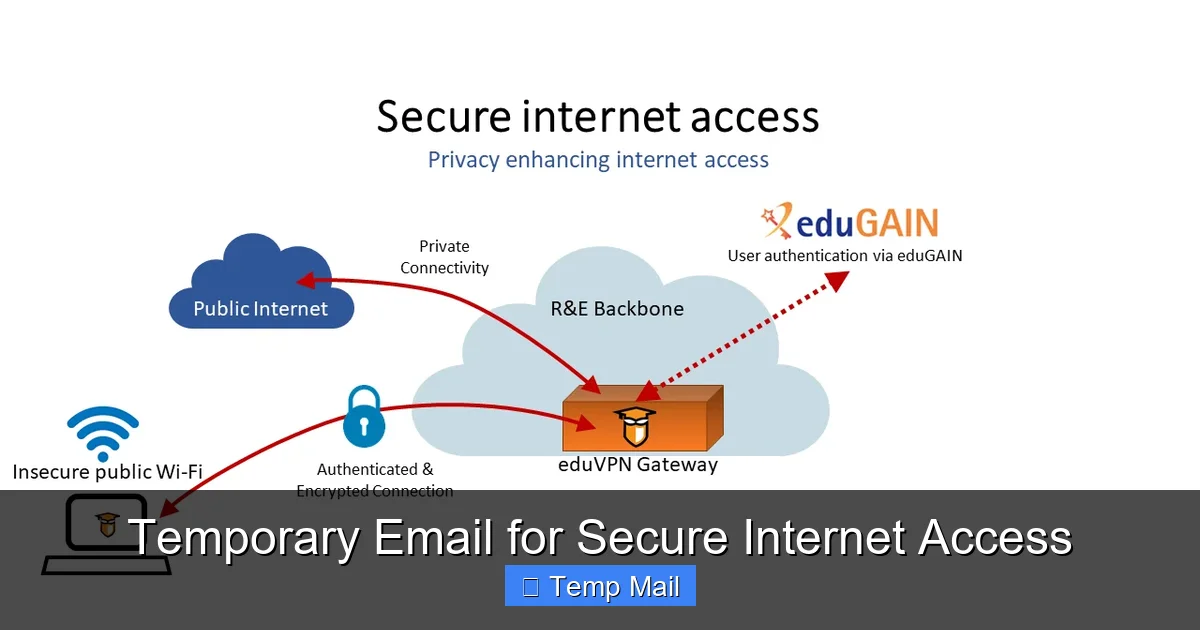
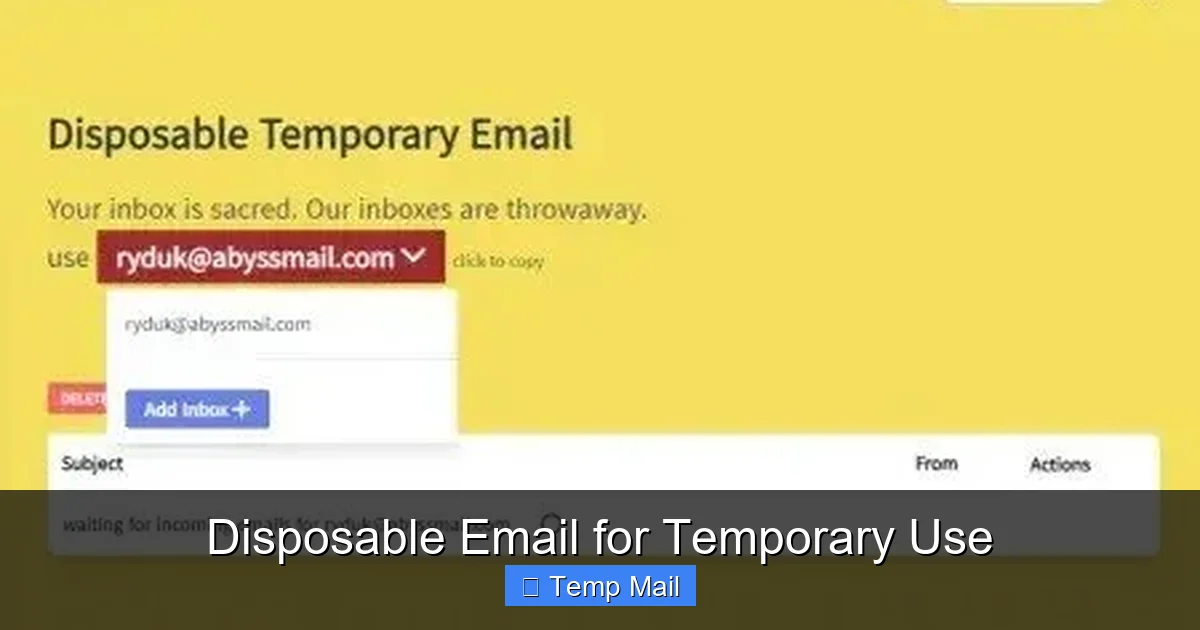
Image for Temporary Email for Secure Online Registrations



Using a temporary email address is a simple yet powerful way to shield your primary inbox from spam, data breaches, and unwanted marketing when registering for online services. It acts as a disposable shield, allowing you to sign up for websites, forums, or free trials without sacrificing your personal or professional contact information. This practice significantly enhances your online privacy and security hygiene by containing potential risks to a single, ephemeral account.
Have you ever hesitated to sign up for a free online course, a discount forum, or a new app because it demanded your email address? You’re not alone. That little voice asking, “Is this safe?” or “Will this just spam me?” is a sign of healthy digital caution. In today’s interconnected world, your email address is more than just a communication channel; it’s a master key to your digital identity. It’s the username for countless accounts, the recovery point for forgotten passwords, and a primary target for data harvesters and spammers. This is where a brilliant, low-tech solution comes into play: the temporary email.
Think of a temporary email as a burner phone for your online life. It’s a disposable, short-lived email address you can use for one-off registrations where you suspect the site’s privacy practices are questionable or you simply have no intention of maintaining a long-term relationship. It’s the ultimate “take this, and don’t call me again” tool for the internet. In this comprehensive guide, we’ll dive deep into how temporary email services work, why they are a cornerstone of modern digital hygiene, the best scenarios to use them, the potential pitfalls to avoid, and how to choose a reliable provider. By the end, you’ll have a clear, actionable strategy for using temporary email to fortify your online security and reclaim your inbox peace.
At its core, a temporary email service is a web-based platform that generates a random, unique email address for you to use immediately, without requiring any registration, personal details, or password. This address exists for a predetermined, short timeframe—typically anywhere from 10 minutes to 48 hours—or until a certain number of emails have been received. After that, the address and all its contents are permanently purged from the server.
The process is wonderfully simple, often taking less than 30 seconds:
Most services also provide a basic inbox interface where you can read received messages. Crucially, you do not log in with a password to this inbox; the unique URL containing the inbox ID is your only key, making it accessible to anyone who has that link while it’s active.
Not all temporary email providers are created equal. A robust service should offer:
The value proposition of a temporary email is straightforward: it trades the convenience of a single, permanent address for the security and privacy of compartmentalization. Let’s break down the tangible benefits.

Visual guide about Temporary Email for Secure Online Registrations
Image source: swool.io
This is the most immediate and gratifying benefit. When you use your primary email (e.g., your Gmail or Outlook address) to sign up for a freebie, a forum, or a “win a iPhone!” contest, you are almost certainly signing up for a lifetime of promotional emails. Even if you unsubscribe, your address is often sold to third-party data brokers. A temporary email acts as a spam sponge. All that marketing noise is directed to an address that will self-destruct, leaving your real inbox pristine for personal and professional communications.
Data breaches are not a matter of if but when. In 2023 alone, billions of records were exposed. Your email address is a crown jewel in a breach because it can be used for phishing, credential stuffing attacks (where hackers try your email/password combo on other sites), and identity theft. By using a disposable address for low-stakes websites, you dramatically reduce your “attack surface.” If that sketchy cooking forum gets hacked, hackers only get a dead email address. Your primary email, linked to your bank, Amazon, and main social media, remains untouched.
Many websites and blogs use “email walls” or “content gates” to force you to submit your email to access an article, whitepaper, or tool. While some offer legitimate value, many are lead generation traps. A temporary email lets you ethically bypass this without consequence. You get the content you need, and you avoid being added to yet another nurture email sequence.
For software developers, QA testers, or even marketers setting up multiple campaign accounts, creating hundreds of real email addresses is a nightmare. Temporary email services provide an instant pool of valid, receiving inboxes to test sign-up flows, email templates, and notification systems without polluting real inboxes or violating terms of service by creating fake accounts.
Your email address can reveal a lot. If you’re researching a sensitive topic, exploring a niche hobby, or looking for jobs in a confidential industry, using your permanent, identifiable address (e.g., [email protected]) creates a digital trail. A temporary email provides a veil of anonymity for these exploratory activities.
Knowing when to use a temporary email is as important as knowing how. Here are the prime scenarios where it’s not just helpful, but a smart security practice.

Visual guide about Temporary Email for Secure Online Registrations
Image source: on4t.com
You see a blog post titled “The Ultimate Guide to X” but it’s behind a form asking for your name and email. Use a temp mail. You want a free e-book or template from a marketing site you don’t trust? Temp mail. The content is a one-off download; you don’t need a long-term relationship with the sender.
That cool new social app your friend recommended? The trendy new project management tool? Before you commit your primary email, consider using a disposable one for the initial sign-up. You can always add your real email later if you decide to upgrade to a paid plan or integrate it deeply into your workflow.
Many online forums, especially those in gaming, tech, or hobbyist niches, are notorious for having poor moderation and members who might scrape member lists for spam. Protect your identity here with a temp address. You can still participate actively; you just won’t receive the inevitable “reply to this thread” notifications in your main inbox.
Signing up for a 14-day trial of a SaaS product? Use a temporary email. This is a critical one. If you forget to cancel, many services will attempt to charge the card on file, but they will also send relentless “your trial is ending” and “come back!” emails to the address on file. With a temp mail, these reminders vanish into the ether, making it easier to forget about the trial without a cluttered inbox as a reminder.
Let’s be clear: we do not endorse piracy. However, many users visit sites that host questionable software or media. These sites are often ad-infested and spammy. Using a temporary email for any registration on these domains is a non-negotiable safety step to avoid malware-laden emails and phishing attempts targeting your primary account.
While powerful, temporary email is not a universal solution. Misusing it can create new problems. Understanding its limitations is key to using it effectively and safely.

Visual guide about Temporary Email for Secure Online Registrations
Image source: emis.edupac.co.za
This is the most obvious but most frequently overlooked drawback. If you use a temp mail for Gmail, Facebook, your bank, or any account where you might need to reset your password, you will be locked out forever the moment you need that recovery email. Never, ever use a disposable address for any service you consider important, valuable, or identity-critical. The rule of thumb: if you’d be upset if you lost access to it, use your real email.
Many major platforms (Google, Microsoft, Facebook, Twitter/X, most major banks) maintain lists of known disposable email domains and will block you from registering with them. They see this as a fraud and spam prevention measure. If you try to sign up for a critical service with a temp mail, you’ll likely get an error message. This is a feature, not a bug, for those platforms.
You cannot have a meaningful conversation or establish a legal contract through a temporary email. It disappears. Any receipts, Terms of Service agreements, or legal notices sent to that address are effectively null and void. This is why legitimate businesses will never rely on them for official correspondence.
Because of their anonymity, disposable emails are popular with spammers, fraudsters, and those engaging in malicious activity. This means the domains themselves can quickly get blacklisted by legitimate email providers (like Gmail or Outlook). If you use a temp mail to sign up for a legitimate service, there’s a chance the confirmation email might be rejected or sent to spam because the sending domain has a poor reputation. Choosing a reputable provider mitigates this slightly.
A few services allow you to “reply” to emails sent to your disposable address. Be extremely cautious here. The reply will be forwarded to the original sender from the temp mail’s domain, not from your real address. This can create confusion and is generally not a reliable communication channel. Assume you can only receive, not send.
With dozens of options available, selection matters. A bad provider can be slow, insecure, or filled with deceptive ads. Here’s your checklist.
The service must load quickly and reliably. If the inbox page takes 10 seconds to refresh or is constantly down, you might miss a time-sensitive verification code. Test a few providers by generating an address and sending a test email from another account. Check the delivery speed and interface responsiveness.
Read the privacy policy (I know, exciting stuff). A reputable provider will state clearly that they do not log IP addresses, do not store emails after deletion, and do not sell user data. If the policy is vague or nonexistent, avoid that service. Your anonymity is the product; they shouldn’t be profiting from your data in other ways.
Free services need revenue. Expect banner ads. What you should not tolerate are ads that mimic the inbox interface (“Download” buttons that look like email links), pop-ups that are hard to close, or “virus detected” scareware ads. These are signs of a low-quality, potentially malicious site. A clean interface with standard, clearly labeled ads is acceptable.
Some services let you choose your own alias before the @ symbol (e.g., [email protected]). This can be helpful for organization if you use temp mail frequently for different purposes (e.g., one alias for forums, one for free trials). More domain options also help if one gets blocked by a specific website you’re trying to register for.
While the landscape changes, services like Temp-Mail.org, 10MinuteMail.com, Guerrilla Mail, and Maildrop.cc have established long-term reputations for reliability and basic security. They are good starting points. Avoid obscure sites with weird domain names that you’ve never heard of.
To integrate this tool seamlessly into your digital life, follow these strategic practices.
If you use temp mail frequently for different purposes, you might forget which disposable address you used for which site. Keep a simple note in a password manager (like Bitwarden or 1Password) or a secure text file. Note the site name and the temporary email address used. This is crucial if you need to log back into a service you signed up for. Some password managers even have a “notes” field perfect for this.
For enhanced privacy, consider using a separate browser (like Firefox) or a dedicated browser profile (Chrome profiles) solely for these disposable sign-up activities. This prevents any potential cookie or tracking overlap with your main browsing identity and keeps the temporary inbox sessions isolated.
Temporary inboxes have countdown timers. As soon as you generate an address and submit it on the target site, switch to the inbox tab and hit refresh. Do not wait. Verification emails can arrive in seconds, and if the timer expires before you click the link, you’ll have to start the whole process over with a new address.
This is the cardinal rule, worth repeating. Your primary email is the anchor of your digital identity. It is the recovery point for almost every other important account. If you lock yourself out of your email, you lock yourself out of your digital life. Temporary email is for front-door entry only, never for the back-door recovery key.
This is the ultimate power move. For a site you sign up for with a temp mail that you later decide is valuable (e.g., a project management tool you’ll use for work), log in, go to account settings, and change the email address to your permanent one. Then, save the login credentials in your password manager. This “upgrade” path lets you start safely and then solidify the account for long-term use.
If a website is asking for a temporary email and you have a deep, gut feeling it’s a scam or phishing site, don’t just use a temp mail and proceed. Abandon the site. A temp mail protects your inbox, but it won’t protect you from giving away other data (like a password you use elsewhere) on a malicious form. Use the temp mail as a tool for low-risk, borderline sites, not as armor against blatant fraud.
The internet was built on a foundation of open communication, but that openness has been exploited by data harvesters, spammers, and cybercriminals. Your email address is the linchpin of your online presence, and treating it with care is fundamental to 21st-century digital literacy. Temporary email services are not about being paranoid; they are about being prudent. They offer a simple, accessible method to practice data minimization—giving away only what is necessary, for only as long as necessary.
By adopting the habit of using a disposable address for any registration that feels non-essential, you are actively compartmentalizing your digital risk. You are building a moat around your primary identity. The peace of mind that comes from an uncluttered, spam-free main inbox is invaluable. It allows you to focus on the emails that matter: from family, your boss, your bank, and services you truly value.
Start today. The next time a website asks for your email for a free PDF or a trial you’re on the fence about, pause. Open a new tab, generate a temporary address, and use that instead. Experience the freedom of a registration without a long-term commitment. It’s a small habit that yields massive returns in your personal cybersecurity posture. In the battle for your digital privacy, the temporary email is a humble but mighty weapon in your arsenal. Wield it wisely.
Yes, using temporary email services is perfectly legal. It is an ethical tool for privacy protection when used for its intended purpose—signing up for non-essential services. The ethical line is crossed if it’s used for fraud, to evade bans on platforms where you agreed to terms prohibiting it, or for illegal activities.
Generally, no. Reputable services do not require any personal information to generate an address and often do not log IP addresses. However, your activity while using that address (the websites you visit while logged into the temp mail session) can still be tracked by those sites via cookies and other tracking technologies, but they won’t directly link to your real identity via the email itself.
Lifespan varies by provider. Common durations are 10 minutes, 1 hour, or until the browser tab is closed. Some services offer addresses that last 24-48 hours. Always check the specific timer on the service you are using. The address and all emails are permanently deleted once the time expires.
Most basic free temporary email services are receive-only. A few premium or specialized services offer the ability to send replies from the disposable address, but this is not standard. Assume you can only receive verification and notification emails.
You will be unable to recover that account. Password reset links will be sent to the now-defunct disposable address. This is why the golden rule is: never use a temporary email for any account where you need to maintain long-term access or that holds valuable data or payment information.
They are safe in the sense that they are isolated and short-lived, limiting the value of a breach. However, the inbox itself is accessible to anyone who has the unique URL while it is active. Do not access a temporary inbox on a public or shared computer without clearing your browser history. For sensitive operations, even a temp mail should be used on a private device.
অনলাইন নিউজপেপার থিম। এই থিমটি দিয়ে আপনারা বাংলা এবং ইংরেজি নিউজপেপার সাইট তৈরি করতে পারবেন । বার্তা ও বাণিজ্যিক কার্যালয়: ৭১, মতিঝিল, ঢাকা-১০০০। সম্পাদক : মো আসাদুজ্জামান আমানউল্লাহ । মোবাইল : ০১৭০০-০০০০০০ । ইমেইল : [email protected] ।
All rights reserved © 2019 themesdealer.Com