Image for Top Temp Mail Sites for Anonymous Email



Tired of your primary inbox getting flooded with spam? Temp mail sites offer a simple, powerful solution for online privacy. These services provide disposable, anonymous email addresses that self-destruct, perfect for one-time sign-ups and avoiding data harvesting. We’ve tested and ranked the most reliable platforms to help you choose the best temporary email service for your needs, ensuring you can browse and register safely without compromising your real identity.
Every day, we’re asked to provide an email address to access a website, download a PDF, or create an account. Often, it feels like a harmless formality. But that simple act hands over a digital key to your online identity. Companies use it to build profiles, send relentless marketing emails, and, in the worst-case scenario, expose your primary inbox to data breaches and spam floods. What if you could just… say no? What if you could have an email address that vanishes after it’s served its purpose? That’s the promise of temp mail, and it’s a game-changer for anyone who values digital privacy.
Temp mail, short for temporary mail, is a service that provides you with a disposable email address. This address exists for a short, predetermined period—sometimes just 10 minutes, other times a few hours or a day. It’s completely anonymous; you never create an account or provide any personal information to get it. You use it to receive a single verification email or download link, and then it self-destructs, leaving no trace and no backlog of unwanted messages in your real inbox. It’s the digital equivalent of using a burner phone, but for your email.
But with so many temp mail sites popping up, how do you know which ones are reliable, private, and actually work? A bad service might have a public inbox where anyone can read your emails, or it might expire the address before you even get the confirmation code. That’s why we did the legwork. We tested dozens of platforms to bring you this definitive guide to the top temp mail sites for anonymous email. We’ll break down exactly how they work, what makes each one unique, and most importantly, how to use them safely and effectively to take back control of your online privacy.
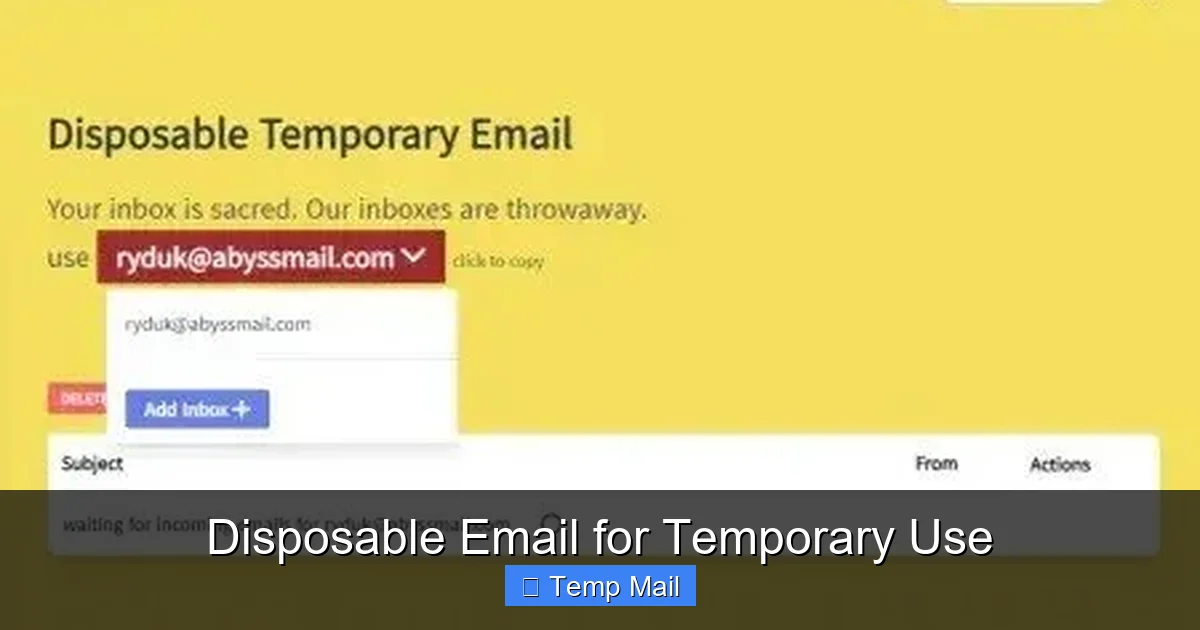
Let’s start with the fundamentals. At its core, a temp mail service generates a random email address for you on its domain, like [email protected]. This address is active and can receive emails immediately. You copy it, paste it into the website you’re signing up for, and then switch back to the temp mail site’s interface to view any incoming messages. No password, no username, no personal details required.
Your permanent email—the one from Gmail, Outlook, or your ISP—is a central pillar of your digital identity. It’s used for everything from banking to social media to work communications. This makes it a high-value target for:
Using a separate, disposable address for low-stakes interactions acts as a firewall. It contains the potential mess to a single, short-lived address that you can simply discard.
Temp mail directly addresses these problems by decoupling your activity from your identity. When you use anonymous email from a temp service:
It’s a simple but profoundly effective layer of operational security (opsec) for everyday internet use.
Not all temp mail services are built the same. After extensive testing for speed, reliability, privacy, and feature set, these six stand out as the best in class. Your choice depends on your specific need: some want maximum anonymity, others need attachment support or longer inbox life.

Visual guide about Top Temp Mail Sites for Anonymous Email
Image source: temp-mail.io
As the name suggests, this is one of the pioneers. It provides a truly anonymous email address that lasts for exactly 10 minutes, with the option to extend time by 10 more minutes if needed.
Guerrilla Mail is arguably the most popular and versatile temp mail service. It offers a surprising amount of control for a disposable service.
Temp-Mail.org strikes an excellent balance between ease of use and useful features. It’s incredibly reliable and offers a clean, modern interface.
Mailinator is different. It’s a public inbox system. Any address you use (e.g., [email protected]) is publicly viewable by anyone who guesses or knows that address. This is a major privacy trade-off.
Tempail offers a super clean, ad-light experience that works beautifully on mobile browsers. Its simplicity is its strength.
Getnada introduces a unique feature to the temp mail world: auto-forwarding. You can set a forwarding address (your real email) to receive messages from your temporary inbox, but only for a limited time.
Knowing the best sites is only half the battle. Using them correctly ensures you actually get the verification email and maintain your anonymity. Here’s a practical, foolproof workflow.

Visual guide about Top Temp Mail Sites for Anonymous Email
Image source: temp-mail.io
Based on your need, pick one from our top list. For most general uses, Temp-Mail.org or Guerrilla Mail are fantastic starting points. Open the website in a new tab. Do not install any browser extensions they might offer unless you fully trust them; the website itself is sufficient.
The site will instantly generate an address for you. It will look something like [email protected]. Click the “Copy” button next to it. This is your anonymous identity for the next hour or so.
Navigate to the site or service that is asking for your email (e.g., a forum, a file download site, a newsletter gate). Paste the temp address into the email field. Proceed with the sign-up or download process. Look for the “Send Verification Email” or similar button.
Quickly switch back to your temp mail tab. You should see the incoming email appear in the list within seconds. If it doesn’t appear within 1-2 minutes, check the spam/junk folder (some services have this) or refresh the page. If it’s still not there after 5 minutes, the site may have blocked the temp mail domain. You may need to generate a new address from a different service (e.g., switch from Temp-Mail.org to Guerrilla Mail).
Open the email and copy the verification code or click the link. Immediately use it on the target website to complete the action. Do this promptly before your temp inbox expires.
Once you’ve got what you needed, simply close the temp mail browser tab. The address and all its contents are gone. There is no “account” to delete. You have successfully used an anonymous email without a trace.
If you’re doing several sign-ups in one session, don’t reuse the same temp address for different sites. Generate a new one for each. You can keep multiple temp mail tabs open simultaneously, each with its own unique inbox. This further compartmentalizes your activity.
Temp mail is powerful, but it’s not a perfect invisibility cloak. Understanding its limitations is crucial for using it safely and avoiding frustration.

Visual guide about Top Temp Mail Sites for Anonymous Email
Image source: temp-mail.io
Many websites actively block known temp mail domains. They do this to prevent abuse, fraud, and spam. If you try to use @temp-mail.org on a platform like Facebook, LinkedIn, or most banking sites, it will be rejected outright. These platforms require a permanent, verifiable email because the account’s value and risk are high. Accept this limitation. Temp mail is for low-stakes, high-noise scenarios. For any account you intend to keep long-term or that has financial/personal importance, use your real email (ideally with a strong, unique password and 2FA).
The biggest misconception is that temp mail makes you anonymous to the website you’re visiting. It does not.
Mitigation Strategy: For true anonymity, use temp mail in combination with a trusted VPN (like Mullvad or ProtonVPN) and a browser in private/incognito mode. This hides your IP from both the target site and the temp mail service, and prevents cookie tracking.
To weave temp mail into a robust privacy routine, follow these best practices. They turn a simple tool into a component of a larger security strategy.
Don’t use your primary email for everything. Create a hierarchy:
This way, a breach or spam flood in one compartment doesn’t contaminate the others.
As mentioned, a VPN is non-negotiable for serious anonymity. It encrypts your traffic and masks your IP address from the websites you visit. When you open your temp mail site, that site sees the VPN server’s IP, not yours. When you then visit the target site, it also sees the VPN server’s IP. This breaks the direct link between your temp mail activity and your home network. Choose a no-logs VPN provider.
This is the golden rule. If you use a temp mail to sign up for an account, and then you lose access to that account, you are permanently locked out. There is no way to recover the password because the recovery email no longer exists. Only use temp mail for accounts where you will never need to log in again after the initial sign-up (e.g., a one-time download).
After using temp mail for anything even remotely sensitive, close all browser windows and clear your session data (cookies, cache, history). Better yet, use the private browsing mode from the start. This ensures no residual data links your temp mail session to your normal browsing.
The internet doesn’t have to be a place where you trade your email address for every piece of content. Temp mail sites democratize a simple but powerful form of privacy. They give you the ability to say “no” to the relentless data collection economy, to keep your primary inbox pristine, and to protect yourself from the inevitable spam and breaches that come with a permanent digital footprint.
From the 10-minute frenzy of 10MinuteMail to the feature-rich control of Guerrilla Mail, there’s a temporary email service perfect for your specific need. The key is intentionality. Use them wisely for their intended purpose—low-stakes, disposable interactions. Never rely on them for critical identity or recovery. Combine them with other privacy tools like VPNs and compartmentalized email strategies, and you build a much more resilient digital life.
Start small. Next time a website asks for your email just to show you a blog post or a whitepaper, open a tab with Temp-Mail.org, grab an address, and complete the sign-up. Feel the quiet satisfaction of a task completed without adding another drop to the ocean of your permanent data. That’s the power of anonymous email. That’s the power of temp mail.
Yes, using temp mail is completely legal in virtually all jurisdictions. It’s a standard privacy tool. However, using it to commit fraud, harassment, or illegal activities is, of course, illegal. The tool itself is neutral.
Reputable services like those listed are generally safe from external hacking of your specific inbox because it’s random and short-lived. The bigger risk is using a malicious or shady temp mail site that could log your IP or inject malware. Always stick to well-known, established providers.
It varies by service. Some last just 10 minutes (10MinuteMail), others 1 hour (Guerrilla Mail), and some default to 8 hours or even 24 hours (certain features of Temp-Mail.org). The countdown is always displayed, so you know exactly when your inbox will vanish.
Almost certainly not. Major platforms like Facebook, Instagram, Twitter, Netflix, and banking apps actively block all known temp mail domains. They require a permanent, verifiable email address for account creation and security purposes.
The email will be deleted along with the entire inbox when it expires. You will not receive the verification code or link, and you will be unable to complete the sign-up or access the resource. You would need to start the process over with a new temporary address.
This is the critical privacy question. Reputable services state they do not keep logs linking IP addresses to specific email inboxes. Since the inboxes are ephemeral and the service doesn’t require registration, there is no user database to log. However, you must trust the provider’s privacy policy. Avoid services that are vague about logging. The top sites we recommend have clear policies against retaining user data.
অনলাইন নিউজপেপার থিম। এই থিমটি দিয়ে আপনারা বাংলা এবং ইংরেজি নিউজপেপার সাইট তৈরি করতে পারবেন । বার্তা ও বাণিজ্যিক কার্যালয়: ৭১, মতিঝিল, ঢাকা-১০০০। সম্পাদক : মো আসাদুজ্জামান আমানউল্লাহ । মোবাইল : ০১৭০০-০০০০০০ । ইমেইল : [email protected] ।
All rights reserved © 2019 themesdealer.Com