Image for Top Temporary Mailboxes You Can Use Instantly



Tired of spam clogging your primary inbox? Top temporary mailboxes offer an instant, no-registration solution for signing up to websites, downloading files, or testing services without exposing your personal email. These disposable inboxes generate a random address that self-destructs, keeping your identity safe and your main mailbox clean. They’re perfect for one-time verification, accessing gated content, or protecting your privacy online with zero commitment.
Ever felt that pang of reluctance when a website asks for your email just to download a PDF or peek at an article? You know that handing over your primary address means it’s likely to be sold, shared, and eventually bombarded with promotional newsletters you never wanted. There’s a simple, clever workaround that millions of savvy internet users rely on: temporary mailboxes. These are not your grandpa’s email accounts. They are ephemeral, no-fuss digital addresses that pop into existence the moment you need them and vanish without a trace when you’re done. In this deep dive, we’re cutting through the noise to bring you the definitive list of the top temporary mailboxes you can use instantly, explaining exactly how they work, where they shine, and what hidden pitfalls to avoid.
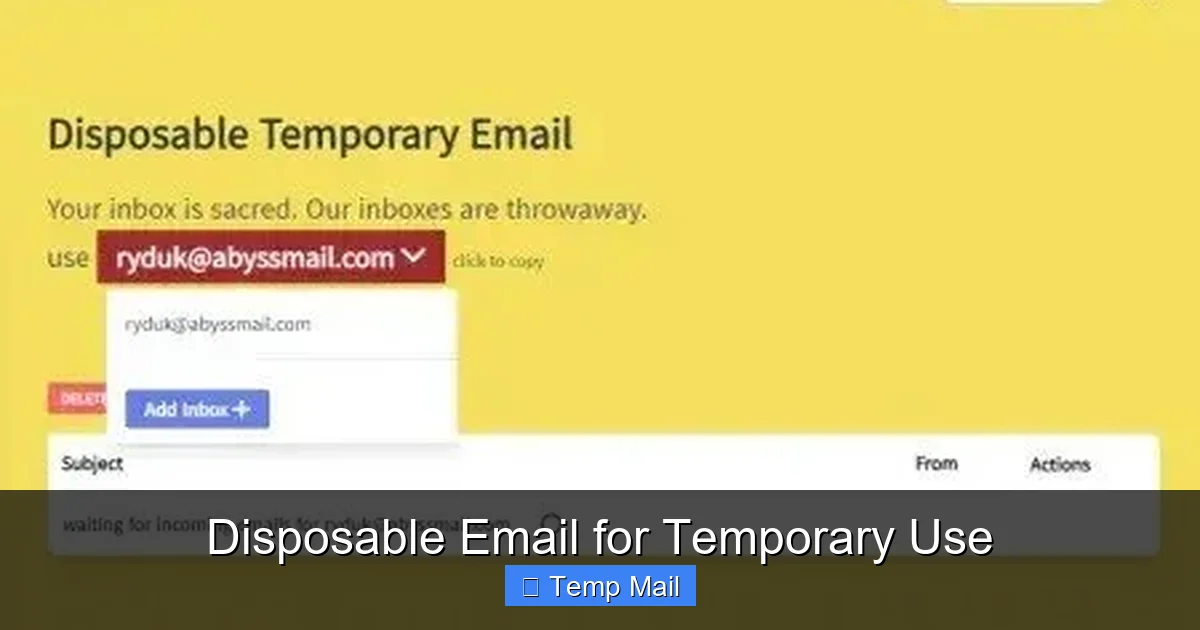
The concept is beautifully straightforward. Instead of using your real Gmail or Outlook address, you visit a temp mail website. It instantly generates a random inbox for you—something like [email protected]. You copy that address, paste it into the website you’re visiting, and then switch back to the temp mail tab to find the verification email. Once you’ve clicked the link or grabbed the code, you close the tab. That inbox, and all its history, is gone forever. No password to forget, no security questions to set, and no long-term digital footprint. It’s the ultimate “use and lose” tool for the modern web, putting control back in your hands regarding who gets to see your digital doorstep.
Before we jump into the “who’s who,” let’s demystify the mechanics. A temporary mailbox, also called a disposable email, is a service that provides a functional email address for a very short, predetermined period—usually from 10 minutes to 48 hours. The technology behind it is surprisingly elegant. These services maintain large pools of domain names and generate unique, random usernames on the fly. When an email is sent to that address, it’s routed to a temporary storage space linked to that specific session, which you access through a unique browser-based interface.
Unlike traditional email, there is no persistent account database linking you to the address. The service does not ask for, and therefore cannot store, your IP address, real name, or any other identifying information tied to the mailbox’s creation. Your access is purely through the URL containing a unique session ID. Once the time limit expires or you manually delete the inbox, the server wipes the data completely. This architecture is what makes them “instant”—there’s no sign-up form, no verification step, no “forgot password” flow. You arrive, you get an address, you use it, you leave.
Not all temp mail services are created equal. When evaluating them, keep an eye on these critical features:
Now, the moment you’ve been waiting for. We’ve tested dozens of services based on speed, reliability, feature set, and success rate with major websites (like Google, Facebook, Twitter, etc.). Here are the top-tier temporary mailboxes you can start using **this very second**.
Visual guide about Top Temporary Mailboxes You Can Use Instantly
Image source: mailboxes.com
Temp-Mail consistently ranks at the top for its balance of simplicity and powerful features. The moment you land on temp-mail.org, a random address is already generated and displayed prominently. No clicking required. The interface is clean, ad-light, and incredibly intuitive.
Why it’s a top pick: It offers multiple domains (like @temp-mail.org, @tempmail.com), allows you to manually change the username with one click, and supports attachments. The inbox automatically refreshes, and emails are displayed in a clear, thread-like view. The default inbox lifespan is a generous 48 hours, but you can manually delete it anytime. It also has excellent browser extensions for Chrome and Firefox, making it seamless to generate an address while browsing.
Best for: General users, beginners, and anyone who wants a hassle-free, feature-rich experience without unnecessary clutter.
As the name implies, 10MinuteMail.com is all about extreme disposability. It was one of the pioneers and remains a benchmark for pure, unadulterated speed. The address is live the second the page loads, with a giant countdown timer showing you exactly how many seconds remain.
Why it’s a top pick: Its singular focus means zero distractions. There’s no need to navigate menus; your inbox and address are front and center. The 10-minute timer is a powerful psychological nudge to complete your task quickly. It’s brilliantly simple and works flawlessly for fast sign-ups. If you need more time, you can click a button to extend the timer by 10 minutes.
Best for: Ultra-fast verifications where you know the email will arrive instantly, users who appreciate a no-frills, countdown-driven interface, and testing how quickly a service sends emails.
Guerrilla Mail has been around for over a decade and has a cult following due to its robust feature set and slightly rebellious branding. It goes beyond a simple inbox, offering a pseudo-“compose” function (you can send emails *from* your disposable address, though this is rarely needed) and a password option for a tiny bit more security on a shared computer.
Why it’s a top pick: It provides a huge selection of domains (over 15), including some quirky ones. You can choose your own username, and it supports attachments. The interface is a bit more “busy” than Temp-Mail’s, but it’s packed with options like setting a custom inbox expiration (1 hour to 6 days) and even a “scramble” feature to generate a new address while keeping your current inbox. Its longevity means it’s less likely to be blocked by websites.
Best for: Power users who want control over expiration times, users who need multiple domain options, and those who appreciate a feature-rich, established service.
DropMail stands out with its sleek, modern design and a strong emphasis on user privacy and security. It uses a unique “drop” metaphor where emails are “dropped” into your virtual mailbox. A key feature is its use of auto-generated, strong passwords for the inbox session, which are displayed only once, adding a layer of protection if you’re on a public machine.
Why it’s a top pick: It offers a very clean, ad-minimized experience. It supports custom usernames and has a “keep alive” button to extend the inbox life. It also provides a “forwarding” option (a paid feature) if you ever need emails from the temp address to go to your real one temporarily—a rare and useful capability. Its domains are less commonly blocked.
Best for: Privacy-conscious users, those on public/shared computers, and anyone who values a polished, modern user interface.
If you believe that less is more, Maildrop.cc is your spirit animal. The website is almost starkly simple. You go to the site, it gives you an address (you can change the random part), and that’s it. The inbox is a plain list of emails. There are no bells, no whistles, and very few ads.
Why it’s a top pick: Its extreme minimalism translates to incredible speed and reliability. It does the core job—receiving emails—perfectly without any potential for feature bloat to cause issues. The default inbox is cleared after 24 hours of inactivity, which is a sensible default. It’s a no-nonsense tool that gets out of your way.
Best for: Purists who want the absolute simplest tool, low-bandwidth situations, and anyone frustrated by overly complex interfaces.
Knowing *how* to use these tools is only half the battle. Understanding the *appropriate* scenarios for their use is what separates a savvy user from someone who might accidentally lock themselves out of an important account.
Visual guide about Top Temporary Mailboxes You Can Use Instantly
Image source: bhg.com
Think of a temporary mailbox as a digital mask or a throwaway burner phone. Use it for situations where the relationship is expected to be fleeting:
This is the most important section. Using a temporary mailbox in the wrong context can lead to serious, irreversible problems.
Temporary mailboxes are a privacy tool for the *sender-side* (you hiding from the receiver), but they offer limited security for the *content* itself. It’s crucial to understand this trade-off.
Visual guide about Top Temporary Mailboxes You Can Use Instantly
Image source: cheercrank.com
When you use a temp mail, you achieve anonymity from the recipient. The website you signed up with sees an email from [email protected]. It has no idea that “xyz123” is connected to *you*. Your IP address is not logged by the temp mail service in relation to that specific inbox (in reputable services). However, the content of the email is almost always unencrypted while in transit and at rest on the temp mail server. Anyone with access to that server (the service provider, a hacker, a government with a warrant) could technically read the plaintext emails. For most verification links and newsletters, this risk is negligible. For sensitive personal data, it is not.
Because temp mail services are public and accessible to anyone, they are targets for attackers. A sophisticated phishing attack could involve a threat actor monitoring a temp mail domain for incoming emails, potentially intercepting a password reset link if you foolishly used that temp address for a critical account. Furthermore, the very act of using a temp mail can sometimes be a red flag to security systems, triggering additional verification steps on the site you’re signing up for.
“No logs” is the promise, but the implementation varies. Reputable services like those listed above genuinely purge data quickly. However, some lesser-known free services might log IPs for analytics or, worse, sell aggregated data. Always use well-known, reviewed services. Remember, if you’re using a free service, you might be the product—but with temp mail, the “product” is your anonymous usage data, not your identity, which is still a better trade-off than selling your primary email address.
Master these techniques to become a temporary mailbox power user and avoid common pitfalls.
Do not put all your eggs in one disposable basket. If you’re using a temp mail for a critical sign-up that you might need to access again (like a free trial for a tool you’ll use for a month), consider these strategies:
Many popular platforms (Google services, Facebook, Instagram, major banking apps) have sophisticated algorithms that blacklist entire domains associated with temporary email services. If you get an error like “Invalid email address” or “This domain is not allowed,” here’s your action plan:
Never assume the email has arrived instantly. After submitting your temp address, stay on the temp mail tab and manually refresh the inbox every 15-30 seconds. Some sites send verification emails with a slight delay. Do not navigate away. Give it 3-5 minutes. If nothing arrives, check the site’s spam/junk folder (some have one!). If still nothing, the site may have blocked the domain, and you need to try a new address from a different service.
The internet doesn’t have to be a place where you trade your primary email address for every piece of content or every minor service. Temporary mailboxes are a liberating tool, a simple piece of tech that enforces a fundamental privacy principle: you should not have to reveal your core identity for trivial interactions. The top services we’ve highlighted—Temp-Mail, 10MinuteMail, Guerrilla Mail, DropMail, and Maildrop—are all excellent, instant options. Your choice depends on your need for features versus pure simplicity.
Incorporate them into your digital routine. Keep a favorite tab or extension pinned. Use them automatically for any sign-up that isn’t about your livelihood, your money, or your core social identity. By doing so, you take a powerful, proactive step against data harvesting, spam, and unnecessary digital clutter. You clean your primary inbox, you limit your attack surface, and you reclaim the right to be anonymous where anonymity makes sense. That’s not just smart browsing; it’s essential digital hygiene in the 21st century. So go ahead, generate that temporary address, and browse with a little less baggage.
Yes, using a disposable email service is perfectly legal in most countries. It’s a legitimate privacy tool. However, using it to commit fraud, evade legal bans, send spam, or create multiple accounts to manipulate a service violates Terms of Service and can be illegal depending on the action.
It varies by service. Common lifespans range from 10 minutes (10MinuteMail) to 24-48 hours (Temp-Mail, Maildrop). Some services allow you to manually extend the time. Always check the specific service’s policy. The inbox and all its emails are permanently deleted after the time expires or you manually clear it.
Most pure disposable email services are designed only for receiving emails. Some, like Guerrilla Mail, offer a limited “send” function, but it’s not reliable for actual communication. They are not built for sending; they are built for receiving verification codes and links. For sending, you need a real email account.
Mostly, no. Major platforms like Google, Facebook, Instagram, and Twitter actively block known disposable email domains. You will likely get an “invalid email” error. For these services, you must use a real, reputable email provider like Gmail, Outlook, or ProtonMail.
They offer privacy (your real email is hidden) but limited security. The email content is typically unencrypted on the server. They should never be used for sensitive information like passwords, financial data, or private documents. Their security model is “no persistence,” not “military-grade encryption.” Use them only for low-risk verifications.
You will be permanently locked out. Since the email address no longer exists, the password reset link cannot be delivered. This is why the cardinal rule is: never use a temporary mailbox for any account where you might need account recovery or long-term access. Treat it as a single-use ticket, not a key.
অনলাইন নিউজপেপার থিম। এই থিমটি দিয়ে আপনারা বাংলা এবং ইংরেজি নিউজপেপার সাইট তৈরি করতে পারবেন । বার্তা ও বাণিজ্যিক কার্যালয়: ৭১, মতিঝিল, ঢাকা-১০০০। সম্পাদক : মো আসাদুজ্জামান আমানউল্লাহ । মোবাইল : ০১৭০০-০০০০০০ । ইমেইল : [email protected] ।
All rights reserved © 2019 themesdealer.Com